
If you’re writing an email, essay, resume, or quick text and stop at the words scraped vs scrapped, you’re not alone. These two words look almost identical, but they can mean very different things. One extra p changes the word, its pronunciation, and sometimes the whole meaning of your sentence.
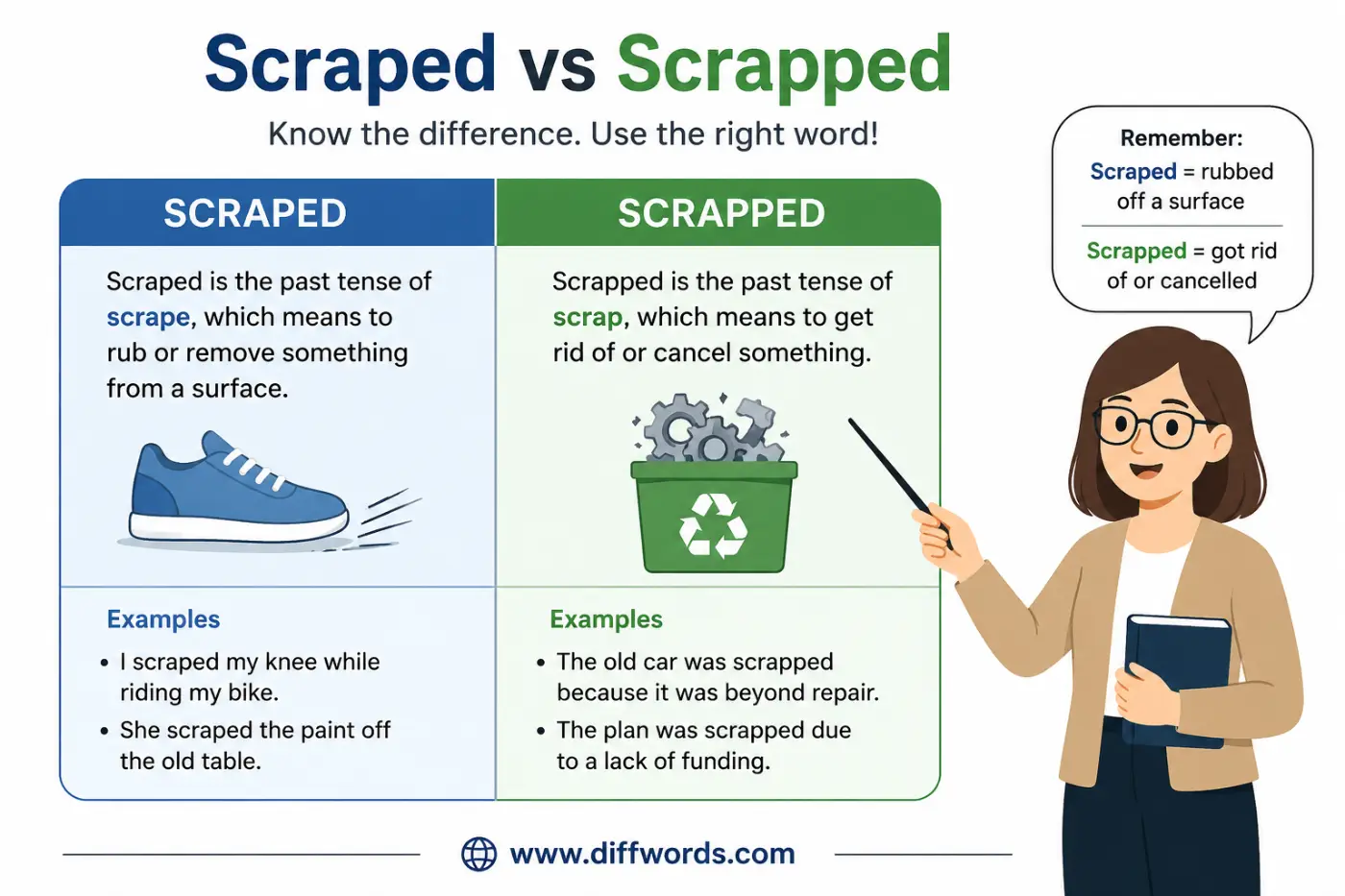
Scraped usually means rubbed against a surface, removed something from a surface, or collected information from a website. Scrapped usually means canceled, abandoned, or thrown away; it can also mean damaged something by scraping against it.
That small spelling difference matters in school writing, work emails, technical writing, and everyday conversation. The good news is that the distinction is easy to remember once you see the patterns.
This guide explains the word origins, meanings, pronunciation, synonyms, intensity levels, regional usage, common mistakes, and the best choice for different situations. You’ll also get plenty of real examples so you can use each word naturally.
What do scraped vs scrapped mean?
The easiest way to understand scraped vs scrapped is to look at the base verbs: scrape and scrap.
| Word | Base verb | Main meaning |
|---|---|---|
| Scraped | scrape | Rubbed against something, removed something with a tool, or collected something |
| Scrapped | scrap | Canceled, abandoned, discarded, or treated as waste |
Scraped is the past tense and past participle of scrape.
For example:
I scraped my knee on the pavement.
Here, the skin rubbed against a rough surface.
It can also describe removing something:
She scraped the paint from the wall.
In computing and data work, scraped can mean information was collected automatically from websites:
The program scraped product prices from several online stores.
Scrapped, on the other hand, comes from scrap.
The company scrapped its old plan.
This means the company abandoned or canceled the plan.
It can also mean something discarded:
The damaged car was scrapped.
So, as a quick memory rule:
- Scraped = rubbed, removed, or collected
- Scrapped = canceled, discarded, or abandoned
Where do scrape vs scrap come from?
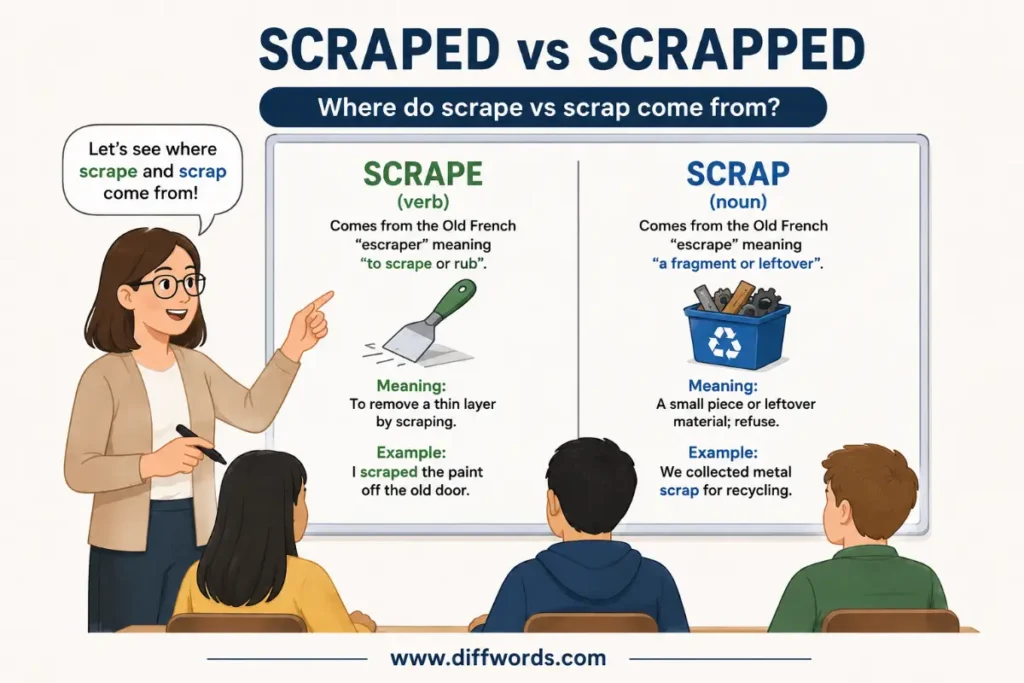
The words scrape and scrap are related in sound, but they developed as separate words with different uses.
Scrape has a long history in English and is connected with the idea of rubbing or scratching a surface. The word describes both an action and the mark or injury that can result from that action. That’s why we can talk about scraping a plate clean, scraping paint from a door, or getting a scrape on a knee.
Scrap has several historical senses. As a noun, it can mean a small leftover piece of material, such as a scrap of paper or scrap of metal. From this idea of something left over or unwanted came the verb scrap, meaning to discard or abandon something.
This explains why the two words have such different modern meanings.
Think of the relationship this way:
scrape → rubbing or removing
scrap → something discarded or a plan abandoned
The extra p in scrapped is not just a spelling detail. It points you to a different base verb.
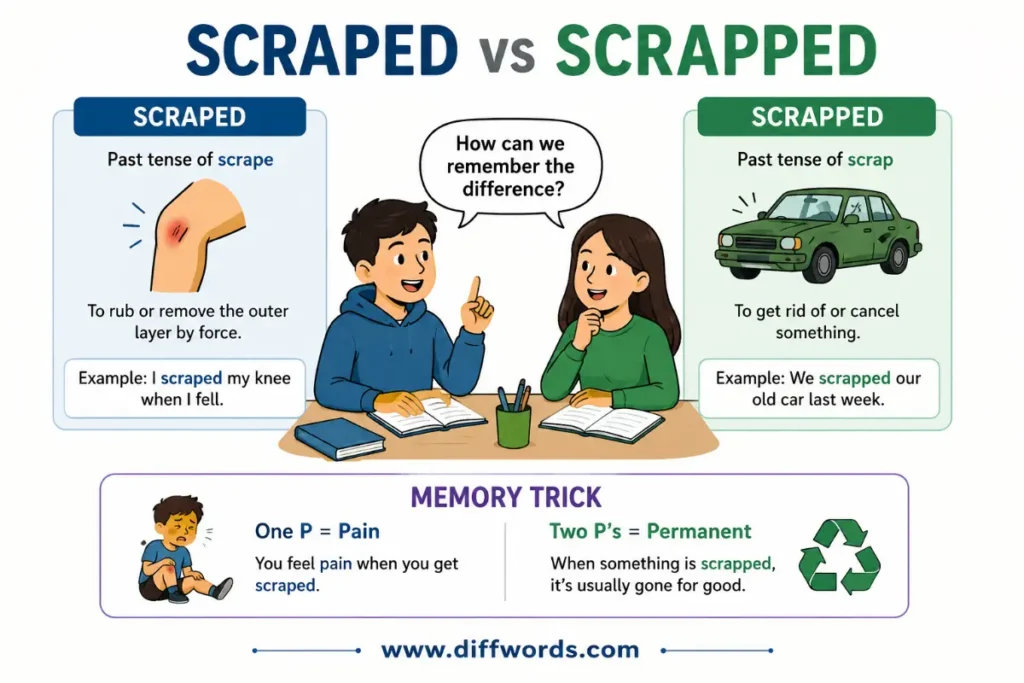
How do you remember scraped vs scrapped?
Use the letter P as a memory trick.
If you mean canceled, abandoned, or thrown away, think of scrap. When you put it in the past tense, the final consonant doubles:
scrap → scrapped
If you mean rubbed, scratched, removed, or collected, use:
scrape → scraped
The silent e stays in the spelling:
scrape → scraped
Compare these:
- The child scraped his elbow.
- The school scrapped the old rule.
- The researcher scraped data from public pages.
- The manager scrapped the proposal.
A useful question is:
Did something touch or remove a surface, or was something canceled or discarded?
If it involves a surface, tool, scratch, or data collection, scraped is often right.
If it involves ending, canceling, abandoning, or throwing something away, scrapped is usually right.
What are the best synonyms for scraped vs scrapped?
The right synonym depends on what you mean. There is no single replacement that works in every sentence.
Here is a larger synonym guide, grouped by tone and everyday use.
| Word | Meaning | Tone | Example |
|---|---|---|---|
| rubbed | Moved against a surface | Simple | The box rubbed against the wall. |
| scratched | Made a light mark on a surface | Everyday | The keys scratched the table. |
| scuffed | Marked or damaged a surface by rubbing | Everyday | His shoes scuffed the floor. |
| abraded | Wore away a surface through friction | Formal | The material was abraded by repeated contact. |
| chafed | Irritated a surface through rubbing | Everyday | The rough fabric chafed her skin. |
| shaved | Removed a thin layer | Everyday | He shaved the wood smooth. |
| gathered | Collected information or items | Everyday | We gathered the survey results. |
| extracted | Took information or material out | Formal | The tool extracted the relevant fields. |
| harvested | Collected information or resources | Technical | The system harvested public data. |
| canceled | Decided something will not happen | Everyday | They canceled the meeting. |
| abandoned | Gave up an idea or project | Neutral | The team abandoned the proposal. |
| discarded | Threw something away or rejected it | Formal | The committee discarded the proposal. |
| ditched | Got rid of something | Slang | We ditched the old design. |
| dumped | Got rid of something quickly | Informal | They dumped the outdated system. |
| rejected | Decided something was not acceptable | Neutral | The editor rejected the draft. |
| eliminated | Removed something from consideration | Formal | The company eliminated the extra step. |
| abolished | Officially ended a rule or system | Formal | The law was abolished. |
| discontinued | Stopped producing or offering something | Formal | The product was discontinued. |
| aborted | Stopped a process before completion | Technical | The operation was aborted. |
| shelved | Put an idea aside for later | Neutral | The proposal was shelved. |
| axed | Canceled or removed something | Informal | The network axed the show. |
| scrapped | Canceled, abandoned, or discarded | Neutral | They scrapped the original plan. |
What are synonyms for scraped from mild to strong?
Synonym choice can show how serious an action was.
For physical contact, you can think of the scale like this:
touched → rubbed → brushed → scratched → scuffed → scraped → abraded
These aren’t exact substitutes in every sentence, but they help show differences in force.
Mild physical contact
Words such as brushed, rubbed, and touched suggest limited contact.
The bag brushed against the door.
There may be no visible damage.
Moderate physical damage
Scratched, scuffed, and scraped suggest a visible mark or some loss of material.
The bicycle scraped the side of the car.
Strong or technical damage
Abraded, worn away, and damaged can sound stronger or more technical.
Years of friction abraded the surface.
For information collection, the intensity scale is different:
gathered → collected → extracted → scraped → harvested
Again, these aren’t perfect replacements. In technical writing, the exact word depends on how the information was obtained.
What are synonyms for scrapped from mild to strong?
For plans and ideas, the strength can vary:
shelved → postponed → dropped → rejected → abandoned → canceled → scrapped
A shelved plan may return later.
The company shelved the project until next year.
A scrapped plan is usually no longer being pursued in its current form.
The company scrapped the project after the budget was cut.
Abandoned can sound especially final.
The researchers abandoned the original approach.
For physical objects, discarded, dismantled, and recycled can describe different stages of getting rid of something.
What part of speech are scraped vs scrapped?
Both scraped and scrapped can function as the past tense or past participle of their verbs.
Scraped as a verb
She scraped the mud off her shoes.
It can also appear in passive constructions:
The old paint was scraped from the door.
It may also work as an adjective in some contexts:
He had a scraped knee.
Here, scraped describes the knee.
Scrapped as a verb
The committee scrapped the proposal.
It can also be used in a passive construction:
The proposal was scrapped.
In some contexts, scrapped describes something that has been discarded or sent for disposal:
The scrapped vehicle was taken away.
The important point is that both words can appear in several grammatical structures. Their spelling still depends on the base verb.
Is scraped or scrapped used differently in the US and UK?
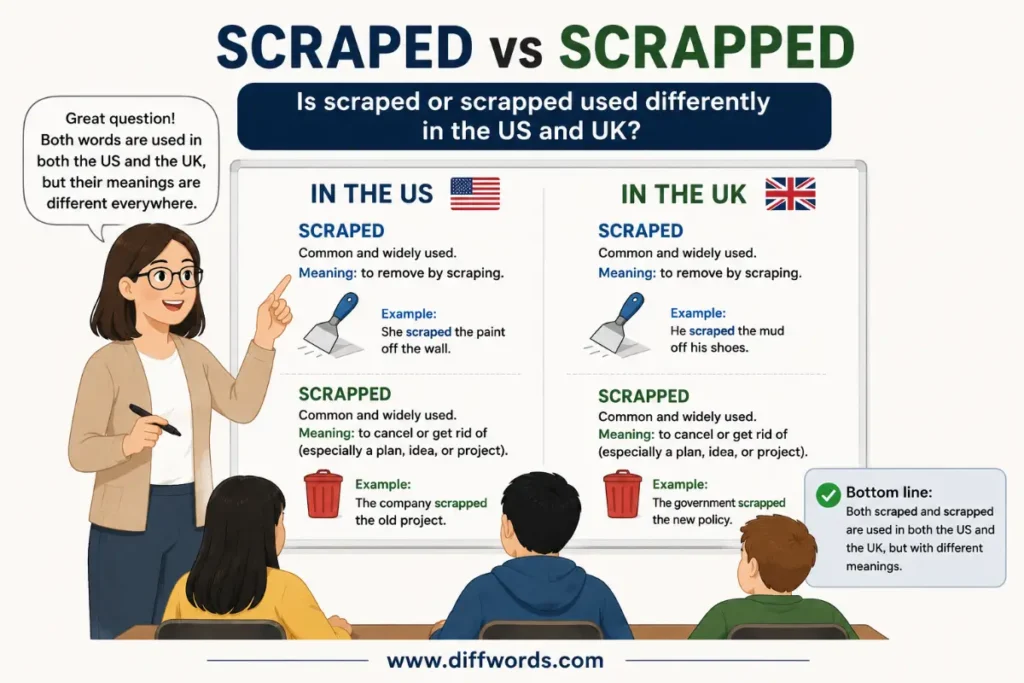
There is no major US-versus-UK spelling difference between scraped and scrapped. Both forms are standard in American and British English.
The main differences are more likely to come from vocabulary choices around the words.
For example, scrapped is widely used in both varieties of English to mean canceled or abandoned:
The government scrapped the proposal.
British English may use scrap particularly often in discussions about canceling policies, plans, or rules, but Americans use it too.
The noun scrap also has common meanings in both varieties:
- a scrap of paper
- scrap metal
- leftover scraps
- a scrap yard or scrapyard
In technology, scraped is also widely used in both US and UK English for collecting online information.
So if you’re writing for an American audience, you don’t need to change either word simply because of regional spelling.
What should you use on a resume: scraped vs scrapped?
On a resume, scraped is usually the better choice when you describe data collection.
For example:
Scraped public data from multiple sources using Python.
That sentence tells a technical reader that you collected data automatically.
You could also write:
Collected and cleaned public web data for market analysis.
This may be clearer if your reader isn’t technical.
Be careful with scrapped. On a resume, it normally means something was canceled or discarded:
Scrapped outdated reporting processes and introduced a new workflow.
That can be useful if you’re describing an improvement, but it has a different meaning from data collection.
For professional writing, choose the word that makes the action clear rather than choosing a fancier synonym.
What should you use in an essay: scraped vs scrapped?
In an essay, choose scraped for physical contact, surface removal, or data collection.
The storm caused tree branches to scrape against the roof.
Use scrapped when discussing a plan, policy, proposal, or project that was abandoned.
The council scrapped the proposed development plan.
For academic writing, you may sometimes prefer more precise words such as removed, collected, abandoned, or discontinued.
For example:
Researchers collected data from publicly available sources.
This may be clearer than:
Researchers scraped data.
Both can be correct, but the best choice depends on what the researchers actually did.
What should you use in an email: scraped vs scrapped?
In an everyday email, use scraped for physical or data-related actions and scrapped for canceled plans.
For example:
I scraped the old label off the package.
Or:
We’ve scrapped the original schedule and will send a new one.
If the email is formal, consider whether a more neutral word would sound better.
Instead of:
We scrapped the meeting.
You might write:
We canceled the meeting.
Instead of:
We scraped the information from the website.
You might write:
We collected the information from the website.
The simpler word may be better when your audience isn’t familiar with technical language.
What should you use when texting friends?
In casual texting, scrapped and scraped still keep their normal meanings.
You might write:
I scraped my shoe on the curb.
Or:
They scrapped the trip.
For a very casual message, words such as ditched, dropped, or canceled may sound more natural depending on the situation.
We dropped the old plan.
They canceled the game.
We ditched the original idea.
Remember that ditched is informal. It isn’t the best choice for every audience.
What should you say when speaking?
In conversation, clarity matters more than showing off vocabulary.
If you mean physical contact, say:
I scraped my hand.
If you mean canceling something, say:
We scrapped the plan.
And if the listener might misunderstand, use a simpler synonym:
We canceled the plan.
I scratched the surface.
We removed the old material.
The best word is the one your listener understands immediately.
What are some real examples of scraped vs scrapped?
Here are original examples from different situations.
- Physical injury:He scraped his knee while playing on the playground.
- Surface damage:The moving box scraped the wall and left a small mark.
- Removing material:She scraped the dried paint from the window.
- Food preparation:He scraped the last bit of sauce from the bowl.
- Website data:The developer scraped publicly available product information for the analysis.
- Canceled plan:The team scrapped the original design after testing it.
- Abandoned project:The company scrapped the project because it was too expensive.
- Old vehicle:The damaged truck was eventually scrapped.
- Canceled event:The organizers scrapped the outdoor event because the location was unavailable.
- Policy change:
The school scrapped the old rule after reviewing student feedback.
- Research:
The researchers scraped public pages to build a dataset.
- Construction:
The machine scraped away the top layer of soil.
- Everyday object:
The chair scraped across the floor when he moved it.
- Business decision:
Management scrapped the proposal and started working on a simpler option.
- Cooking:
She scraped the remaining batter from the bowl.
These examples show why context is important. The spelling isn’t interchangeable.
Scraped vs scratched — what’s the difference?
Scraped and scratched are close in some physical situations, but they aren’t always equal.
A scratch is often a narrow mark made by something sharp or rough.
The cat scratched the sofa.
A scrape often involves rubbing against a rough surface or removing a layer.
The bike scraped the wall.
A scrape can also refer to a minor skin injury:
She got a scrape on her elbow.
Think of the difference this way:
| Word | Typical idea | Example |
|---|---|---|
| Scratched | A mark made by a pointed or rough object | The branch scratched the car. |
| Scraped | Rubbing against or dragging across a surface | The car scraped the gate. |
There is some overlap. In ordinary conversation, people may use the words loosely. But when precision matters, consider whether the action involved a mark from a scratch or rubbing/removing material through contact.
Scrapped vs canceled — what’s the difference?
Canceled and scrapped are also close, but scrapped can suggest that an idea, plan, system, or object was rejected or abandoned rather than simply having an event removed from a calendar.
Compare:
The meeting was canceled.
This simply means the meeting won’t happen.
The proposal was scrapped.
This suggests the proposal itself was abandoned.
A canceled appointment might be rescheduled.
A scrapped project may be replaced, redesigned, or ended completely.
| Word | Main idea | Example |
|---|---|---|
| Canceled | Something planned will not happen | The flight was canceled. |
| Scrapped | A plan, idea, or project was abandoned | The company scrapped the project. |
So canceled is often the safer general-purpose word, while scrapped adds the sense of abandoning an idea or getting rid of something.
Scraped vs collected — what’s different in data writing?
In technology, scraped and collected can overlap, but they don’t always mean exactly the same thing.
Collected is broad. It can describe information gathered manually, automatically, through surveys, through forms, or from databases.
The team collected customer feedback.
Scraped is more specific. It often suggests that software or a script extracted information from websites or online pages.
The script scraped product names and prices from public pages.
Therefore:
- Collected = broad and easy to understand
- Scraped = more specific to automated extraction, especially from websites
If you’re writing for a general audience, collected may be clearer. If you’re describing a technical process, scraped may be more precise.
What are common mistakes with scraped vs scrapped?
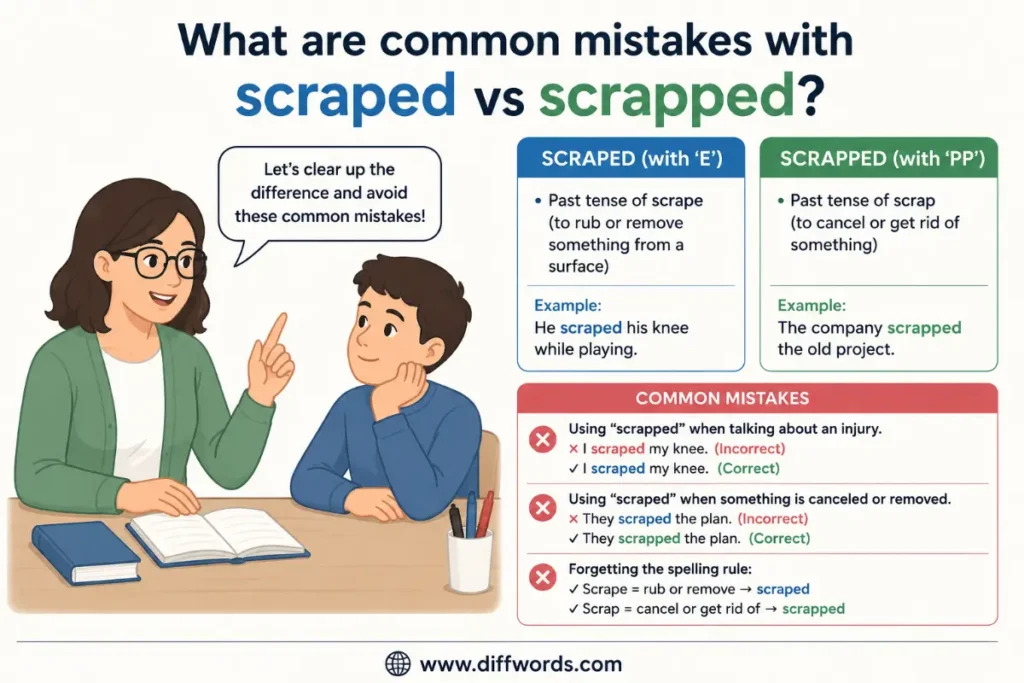
The most common mistake is using scrapped when you mean scraped.
Mistake 1: Using scrapped for a physical scrape
Incorrect:
I scrapped my knee.
Correct:
I scraped my knee.
The first sentence suggests the verb scrap, which doesn’t express the normal meaning of rubbing or injuring the knee.
Mistake 2: Using scraped for a canceled plan
Incorrect:
The company scraped the project.
Correct:
The company scrapped the project.
The project wasn’t rubbed against a surface. It was abandoned.
Mistake 3: Confusing data scraping with discarding data
Correct:
The program scraped data from the website.
This means the program collected information.
But:
The company scrapped the old data.
This means the company discarded or abandoned the data.
Mistake 4: Assuming extra letters are optional
They aren’t.
Scrape → scraped
Scrap → scrapped
Changing the spelling changes the base verb and meaning.
Mistake 5: Choosing a synonym that changes the meaning
For example, deleted isn’t always a synonym for scrapped.
The company scrapped its marketing campaign.
This means it abandoned the campaign.
The company deleted its marketing campaign.
This could mean the digital files were removed, not necessarily that the campaign itself was canceled.
Always check the action behind the word.
When should you NOT use scraped?
Don’t use scraped simply because something was removed.
For example:
The company canceled the event.
Don’t replace canceled with scraped. The event wasn’t physically rubbed or technically extracted.
Likewise, if you mean that someone deliberately scratched a surface, scratched may be more accurate.
Don’t use scraped for every kind of data collection, either. If information came from interviews, surveys, or internal records, collected may be the better word.
Use scraped when the specific method matters.
When should you NOT use scrapped?
Don’t use scrapped when you mean a physical scrape.
He scraped his knee.
Don’t write:
He scrapped his knee.
Also, don’t use scrapped when you only mean something was delayed.
Delayed means it will happen later.
Shelved can mean temporarily put aside.
Scrapped usually suggests that the original plan, idea, or project has been abandoned or discarded.
For example:
The launch was delayed.
doesn’t mean:
The launch was scrapped.
The first suggests a later launch may still happen. The second suggests the plan was abandoned.
What are the antonyms of scraped vs scrapped?
The opposite of scraped depends on its meaning.
For physical contact, possible opposites include:
- protected
- preserved
- covered
- left untouched
- smoothed
For data scraping, possible opposites include:
- ignored
- excluded
- withheld
- left uncollected
And for scrapped, the opposite depends on context.
Possible choices include:
- approved
- adopted
- accepted
- continued
- retained
- preserved
- implemented
- maintained
For example:
The committee scrapped the proposal.
Opposite:
The committee approved the proposal.
And:
The company scrapped the old system.
Opposite:
The company kept the old system.
There isn’t one universal antonym for either word.
How do you choose the right word quickly?
Use this five-question check.
1. Did something rub against a surface?
Use scraped.
The metal scraped the floor.
2. Did someone remove material from a surface?
Use scraped.
She scraped the mud off her boots.
3. Did software collect information from websites?
Use scraped when that technical method is what you mean.
The tool scraped public web pages.
4. Was a plan, project, rule, or idea abandoned?
Use scrapped.
The committee scrapped the proposal.
5. Was something simply canceled?
Use canceled if that is clearer.
The appointment was canceled.
You don’t need the more colorful word when a simple word says exactly what happened.
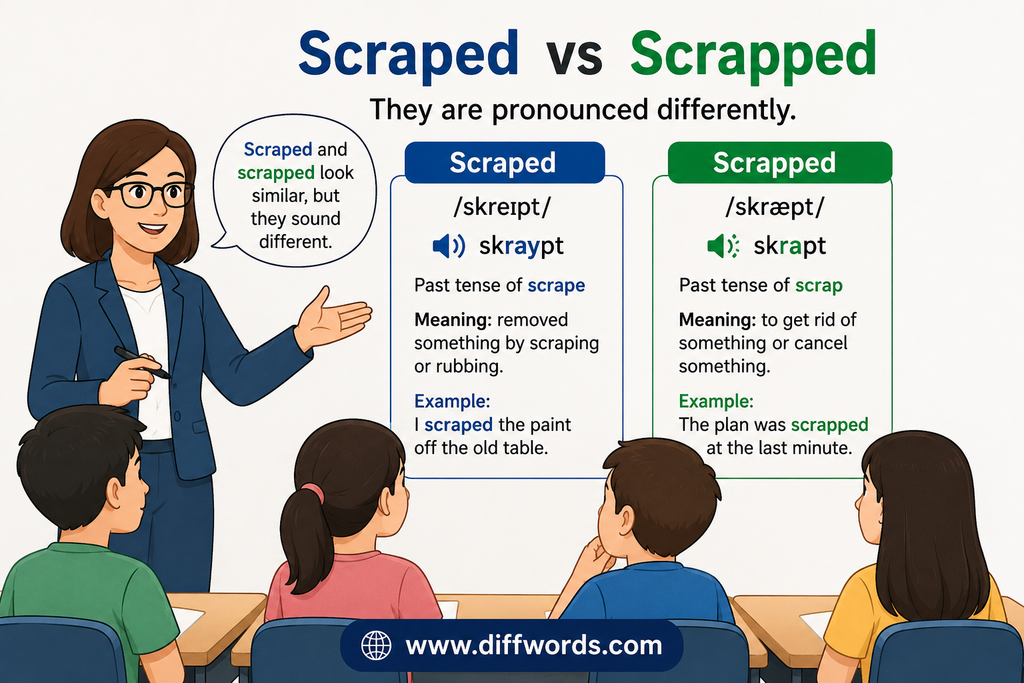
Can scraped vs scrapped be pronounced differently?
Yes. Their pronunciation is different because they come from different base words.
Scraped comes from scrape and has one syllable:
scraped
Scrapped comes from scrap and also has one syllable:
scrapped
The final sounds differ slightly. Scraped ends with a sound based on the -ed ending after the /p/ sound, while scrapped has a similar final consonant cluster without the silent e found in the spelling of the base verb.
The most reliable way to avoid confusion in speech is to connect each pronunciation to its meaning:
- scraped → scrape → rubbed/removed/collected
- scrapped → scrap → canceled/discarded
Why does the p double in scrapped?
This follows a common English spelling rule.
The verb scrap is a short, one-syllable word ending in a consonant. When -ed is added, the final consonant is doubled:
scrap + ed = scrapped
The same pattern appears in words such as:
- stop → stopped
- plan → planned
- drop → dropped
- shop → shopped
But scrape already ends with a silent e:
scrape + d = scraped
The final e is retained in the spelling.
Compare:
scrape → scraped
scrap → scrapped
This spelling pattern is one of the easiest ways to remember the difference.
What is the simplest memory trick?
Think about the E.
Scrape has an E.
That E can remind you of a surface:
scrape → rubbed or removed from a surface
Scrap has no E.
That can remind you of something you throw away:
scrap → discard or abandon
Then remember the past forms:
scrape → scraped
scrap → scrapped
Another quick trick is to connect scrapped with stopped. Both often describe something that has been ended.
The project was stopped.
The project was scrapped.
And connect scraped with scratched when you’re talking about physical surfaces.
The table was scratched.
The table was scraped.
What words can replace scraped in different situations?
The best alternative depends on the sentence.
| Situation | Better alternatives |
|---|---|
| Minor skin injury | scratched, grazed, rubbed |
| Surface damage | scratched, scuffed, abraded |
| Removing paint | removed, stripped, shaved |
| Removing food from a bowl | removed, gathered, cleared |
| Website data collection | collected, extracted, harvested |
| Removing material with a tool | shaved, stripped, removed |
For example, if you write:
The software scraped the data.
A general audience may understand:
The software collected the data.
A technical audience may prefer:
The software extracted the data.
The context should guide the choice.
What words can replace scrapped in different situations?
Again, choose based on what happened.
| Situation | Better alternatives |
|---|---|
| Event will not happen | canceled |
| Project ended | abandoned, discontinued |
| Idea rejected | rejected, dropped |
| Plan put aside temporarily | shelved |
| Rule officially ended | abolished |
| Product no longer made | discontinued |
| Informal conversation | ditched, axed |
| Old metal or vehicle discarded | recycled, dismantled, discarded |
For formal writing, canceled, abandoned, discontinued, or eliminated may be clearer than scrapped.
For casual writing, dropped, ditched, or axed can work when the tone allows them.
What is the best word for formal writing?
Formal writing usually benefits from precision rather than stronger-sounding vocabulary.
If you mean collecting website information, use scraped when the technical method is relevant.
If you mean abandoning a proposal, scrapped is acceptable, but abandoned, discontinued, or rejected may be more precise depending on the situation.
For example:
The committee abandoned the proposal after reviewing the evidence.
This is more formal than:
The committee scrapped the proposal.
Neither is automatically better. The second is direct and natural; the first may fit a formal academic report better.
What is the best word for everyday English?
For everyday English, scraped and scrapped are both natural.
Use:
I scraped my knee.
The company scrapped the plan.
If you’re unsure whether your reader knows the word scrapped, simply use canceled or abandoned when appropriate.
If you’re unsure about scraped, use scratched, rubbed, or removed only when that alternative accurately describes the action.
Simple English isn’t about avoiding useful words. It’s about choosing words that match the meaning.
A quick comparison chart
| If you mean… | Use | Example |
|---|---|---|
| Rubbed against a surface | scraped | The chair scraped the floor. |
| Got a minor skin injury | scraped | I scraped my elbow. |
| Removed material | scraped | He scraped paint from the door. |
| Collected website data | scraped | The program scraped public data. |
| Canceled a plan | scrapped | They scrapped the plan. |
| Abandoned a project | scrapped | The team scrapped the project. |
| Discarded an old object | scrapped | The vehicle was scrapped. |
| Ended a policy | scrapped | The government scrapped the policy. |
What should you remember about scraped vs scrapped?
The key difference is simple:
Scraped comes from scrape and usually involves rubbing, scratching, removing, or collecting.
Scrapped comes from scrap and usually involves canceling, abandoning, or discarding.
When you see the extra p, think of something being put away or abandoned. When you see the e in scrape, think of a surface or the act of removing something from it.
A single letter can change the meaning, so always check the base verb before choosing the past-tense form.
Conclusion
The easiest way to remember scraped vs scrapped is to focus on the base verbs. Scrape is connected with rubbing, scratching, removing material, and collecting information. Scrap is connected with discarding, canceling, or abandoning something.
Use scraped for sentences such as “She scraped her knee,” “He scraped paint from the wall,” and “The program scraped public data.” Use scrapped for sentences such as “The team scrapped the proposal” or “The old vehicle was scrapped.”
When a synonym seems possible, don’t choose it just because it sounds more formal. Ask what actually happened. Was something rubbed, removed, or collected? Or was it canceled, abandoned, or discarded? Once you make that distinction, the correct spelling becomes much easier to choose.
Frequently Asked Questions
What is the difference between scraped vs scrapped?
Scraped means rubbed against, removed from a surface, or collected, while scrapped means canceled, abandoned, or discarded. The words come from different verbs: scrape and scrap.
Is it scraped my knee or scrapped my knee?
The correct phrase is “scraped my knee.” A scrape is a minor injury caused by rubbing against a rough surface.
Is it scraped the plan or scrapped the plan?
The correct phrase is “scrapped the plan.” It means the plan was canceled or abandoned.
What’s another way to say scraped?
Depending on the meaning, you can say rubbed, scratched, scuffed, removed, collected, or extracted. The best synonym depends on whether you’re talking about a physical surface or information.
What’s another way to say scrapped?
You can say canceled, abandoned, dropped, discarded, rejected, shelved, or discontinued. Choose the word that best describes whether something was ended, rejected, or simply put aside.
Is scraped or scrapped correct for collecting website data?
Scraped is correct when software collects information from websites. For example, “The program scraped public product data.”
Is scraped vs scrapped only a spelling difference?
No. The spelling difference reflects two different base verbs and meanings. Scraped comes from scrape, while scrapped comes from scrap.