
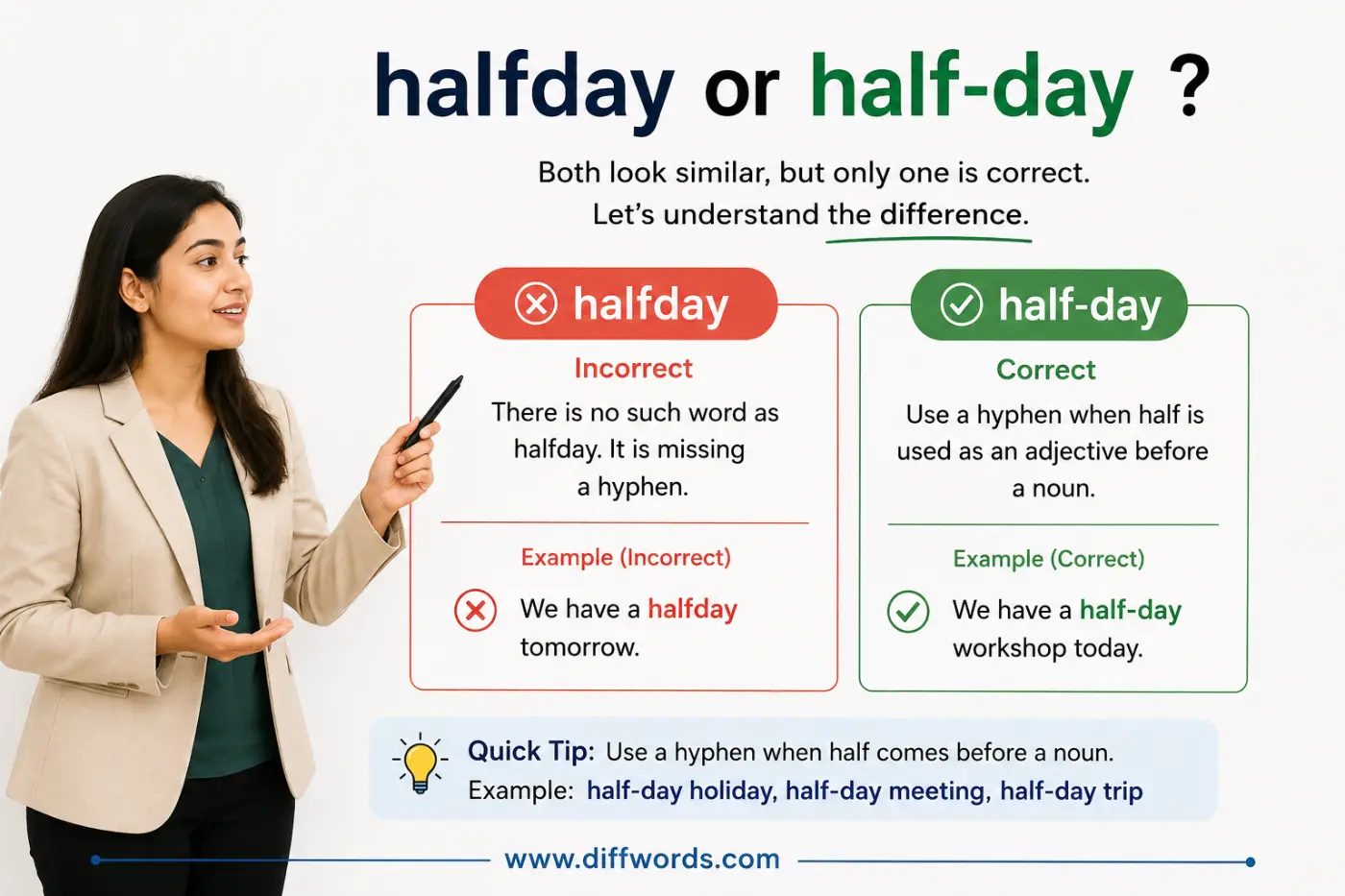
You’re writing an email to your boss, planning a school event, or describing a short trip, and you stop at halfday or half-day. Should it be one word, two words, or hyphenated? This small spelling question can be surprisingly confusing.
The short answer is simple: “half day” is normally written as two words when it’s a noun, while “half-day” is commonly hyphenated when it works as an adjective before another noun. “Halfday” is generally not the standard form.
For example, write “I took a half day off” when the phrase is a noun. But write “We attended a half-day workshop” when it describes the workshop.
This guide explains the spelling, grammar, word history, hyphenation rules, regional differences, common phrases, examples, mistakes, synonyms, and the best choice for emails, resumes, essays, texting, and everyday speech.
Wondering whether boujee vs bougie is correct? Explore their meanings, spellings, and differences in modern slang.
Is it halfday, half day, or half-day?
The standard choices are half day and half-day, depending on how the phrase is used. Halfday as one word is generally not the standard spelling in ordinary American English.
The basic rule is:
| Form | Main use | Example |
|---|---|---|
| half day | Noun phrase | “I took a half day off.” |
| half-day | Compound adjective | “It was a half-day event.” |
| halfday | Generally nonstandard | Avoid in normal English writing |
The important difference is grammatical.
When half day names a period of time, it usually stays open:
“The appointment lasted half a day.”
“I need a half day to finish the work.”
When half-day comes before another noun and describes it, the hyphen makes the compound easier to read:
“We attended a half-day training session.”
“She signed up for a half-day course.”
So, when comparing halfday or half-day, don’t simply ask which spelling looks right. Ask how the phrase functions in the sentence.
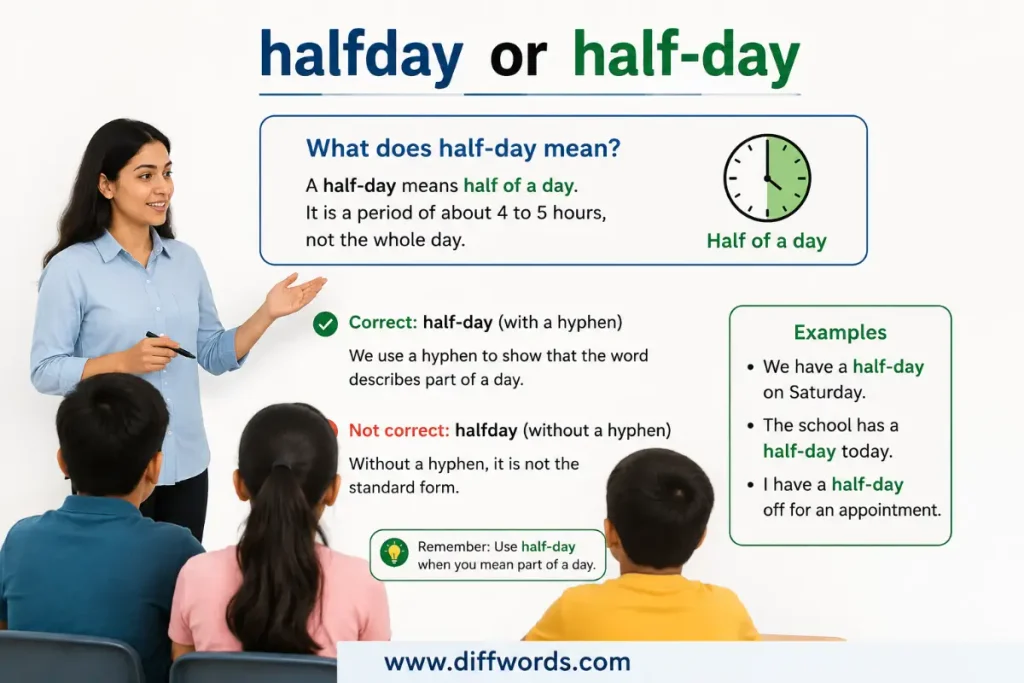
What does half day mean in simple English?
Half day means a period of time equal to approximately half of a normal day.
Since a full day contains 24 hours, half of a day is 12 hours. However, in everyday work, school, and business contexts, half day usually doesn’t mean exactly 12 hours.
For example, a workplace might have:
- a morning half day,
- an afternoon half day,
- a half-day work schedule,
- a half-day school session.
A person might say:
“I’m taking a half day off tomorrow.”
This normally means the person will work for part of the usual workday and take the remaining part off.
Similarly:
“The students have a half day on Friday.”
This usually means school ends earlier than usual.
The exact length depends on the context.
What does half-day mean?
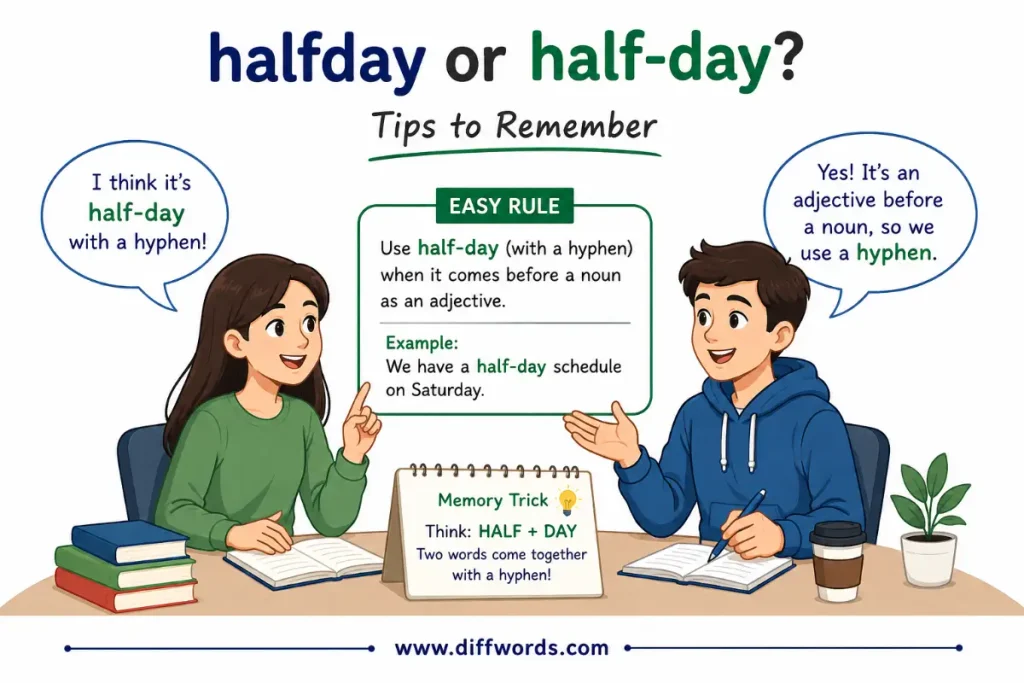
Half-day is commonly used as a hyphenated compound adjective when it comes directly before a noun.
Examples include:
- half-day workshop
- half-day course
- half-day trip
- half-day training
- half-day meeting
- half-day session
- half-day program
- half-day tour
- half-day event
In each case, half-day works together to describe the noun that follows it.
For example:
“We planned a half-day tour.”
The phrase half-day tells us what kind of tour it is.
Without the hyphen, the meaning is still understandable:
“We planned a half day tour.”
But in polished writing, the hyphen makes the compound modifier clearer.
Is halfday one word correct?
In standard general English, halfday is usually not the form you should choose.
You may see it in:
- informal writing,
- company names,
- websites,
- specialized publications,
- product labels,
- usernames,
- social media,
- or writing influenced by other languages.
But that doesn’t make it the preferred spelling for ordinary English.
For most professional and academic writing, choose:
half day
or
half-day
depending on the grammatical role.
For example:
“I requested a half day off.”
“I attended a half-day seminar.”
Avoid:
“I requested a halfday off.”
and:
“I attended a halfday seminar.”
The one-word form can look like a spelling error to many readers.
Why is halfday or half-day confusing?
The confusion comes from English compound words.
English often combines two words into a new expression, but not every combination becomes one word.
Compare:
- half day
- half-day
- half time
- half-time
- half hour
- half-hour
- half price
- half-price
Hyphenation often depends on whether the expression is being used as a compound modifier.
For example:
“The meeting lasted half an hour.”
But:
“It was a half-hour meeting.”
The same basic idea applies to half day vs half-day.
The noun phrase remains open in many constructions, while the compound adjective is often hyphenated before a noun.
Where does the word half come from?
Half is an old English word with Germanic roots. It has been used for centuries to describe one of two equal parts of something.
The basic mathematical idea is straightforward:
1 whole ÷ 2 = 1 half
So a half is one of two equal parts.
The word day is also very old. It refers to a period associated with the Earth’s rotation and, depending on context, can mean a calendar day, a 24-hour period, or a person’s usual daytime schedule.
When the two ideas combine, half day simply refers to half of a day or, more commonly in practical settings, part of a normal day’s schedule.
How should you use half day as a noun?
Use half day as a noun phrase when you’re talking about the period of time itself.
Examples:
“I need a half day to complete the project.”
“She took a half day from work.”
“We spent half a day at the museum.”
“The students will have a half day on Friday.”
The phrase can also appear after verbs such as:
- take
- spend
- need
- work
- schedule
- request
- use
For example:
“I’ll take a half day off.”
Here, half day is the thing being taken.
How should you use half-day as an adjective?
Use half-day when it describes a noun that follows.
Examples:
“We organized a half-day workshop.”
“She joined a half-day training course.”
“The school offers a half-day program.”
“They booked a half-day tour.”
The hyphen shows that half and day work together as one modifier.
Compare:
“The workshop lasted half a day.”
with:
“It was a half-day workshop.”
Both are correct, but their grammar is different.
What is the easiest rule for halfday or half-day?
Here’s the easiest rule to remember:
Before a noun as a combined description: use “half-day.”
As a normal time expression: use “half day.”
Examples:
Before a noun:
“a half-day course”
As a noun phrase:
“I took a half day off.”
After “a” in a time expression:
“The trip lasted half a day.”
This rule will solve most spelling questions.
What are the main synonyms for half day?
There aren’t many perfect one-word synonyms for half day, because the exact meaning depends on the context. Still, several related expressions can communicate a similar idea.
| Word or phrase | Meaning | Tone | Example |
|---|---|---|---|
| part of a day | Less than a full day | Simple | “We spent part of a day there.” |
| half a day | Twelve hours or roughly half a schedule | Neutral | “The task took half a day.” |
| abbreviated day | Shortened period | Formal | “The school had an abbreviated day.” |
| short session | Brief scheduled period | Everyday | “We held a short session.” |
| brief session | Short period of activity | Formal | “The committee had a brief session.” |
| morning | First part of the day | Simple | “The class meets in the morning.” |
| short day | A day with fewer hours | Everyday | “It was a short day at school.” |
| shortened workday | Workday with fewer hours | Workplace | “Friday is a shortened workday.” |
| partial shift | Part of a work shift | Workplace | “She worked a partial shift.” |
| reduced hours | Fewer working hours | Formal | “The employee requested reduced hours.” |
| part-time session | Session shorter than full schedule | Everyday | “The course offers a part-time session.” |
| short course | Course lasting a short time | Everyday | “She took a short course.” |
| short workshop | Workshop lasting a limited time | Everyday | “They attended a short workshop.” |
| morning class | Class held in the morning | Simple | “I have a morning class.” |
| afternoon class | Class held in the afternoon | Simple | “The afternoon class starts at one.” |
| limited session | Session with restricted duration | Formal | “The team held a limited session.” |
| shortened session | Session made shorter | Formal | “The shortened session ended early.” |
| compact session | Condensed session | Formal | “The conference includes a compact session.” |
| quick session | Short session | Informal | “Let’s have a quick session.” |
| short shift | Work period shorter than usual | Workplace | “She picked up a short shift.” |
| partial shift | Only part of a normal shift | Workplace | “He worked a partial shift.” |
| limited-hours day | Day with restricted hours | Formal | “The clinic has a limited-hours day.” |
These aren’t all exact substitutes. For example, morning session specifically refers to the morning, while half day could refer to either morning or afternoon.
What are synonyms for half day in simple English?
For everyday writing, the clearest alternatives are:
- half a day
- part of a day
- part of the day
- a short day
- a morning session
- an afternoon session
- a partial day
Example:
“The project took half a day.”
You could also say:
“The project took part of a day.”
But half a day is more precise if you really mean half.
What are formal alternatives to half-day?
In professional or academic writing, you may sometimes prefer:
- partial day
- shortened day
- reduced schedule
- shortened workday
- partial schedule
- reduced hours
- abbreviated session
For example:
“Employees may request a partial day of leave.”
This sounds more formal than:
“Employees may take a half day off.”
However, don’t replace a familiar phrase with a formal one just to sound professional. Half day is perfectly acceptable in most workplace writing.
What are informal alternatives to half day?
In casual conversation, people often use simple phrases such as:
- half a day
- half the day
- part of the day
- a short day
- a few hours
- the morning
- the afternoon
Examples:
“We’ll be there for half a day.”
“I only have a few hours.”
“Let’s spend the morning there.”
These phrases often sound more natural in conversation than formal alternatives.
What are alternatives by intensity or duration?
Unlike words such as “small,” “large,” or “huge,” half day has a fairly specific duration. Still, you can describe different lengths.
Shorter than half a day
Use:
- a few hours
- a couple of hours
- a brief session
- a short session
- part of a morning
Example:
“The meeting lasted a couple of hours.”
About half a day
Use:
- half a day
- a half day
- a half-day session
- a partial day
- a shortened day
Example:
“The training takes half a day.”
Longer than half a day
Use:
- most of the day
- nearly a full day
- a full day
- all day
Example:
“The conference lasted most of the day.”
The best choice depends on how exact you need to be.
What part of speech is half day?
Half day is generally a noun phrase when it refers to a period of time.
For example:
“I took a half day off.”
The phrase identifies a period of time.
Half-day, on the other hand, commonly functions as a compound adjective when it modifies a following noun:
“a half-day conference”
Here, half-day describes the conference.
This distinction is more important than memorizing a single spelling.
Noun use
“I requested a half day.”
Adjective use
“I requested a half-day leave period.”
The second example is more formal and may vary by workplace style.
Is half-day always an adjective?
No. Half-day can also appear as a noun in some dictionaries and varieties of English, particularly in expressions such as “a half-day.” However, usage and style preferences vary.
For clear general American English, a useful editorial approach is:
- half day when treating it as an ordinary noun phrase,
- half-day when it is a compound modifier before another noun.
This approach is especially helpful for professional web writing because it makes the grammatical relationship easy for readers to understand.
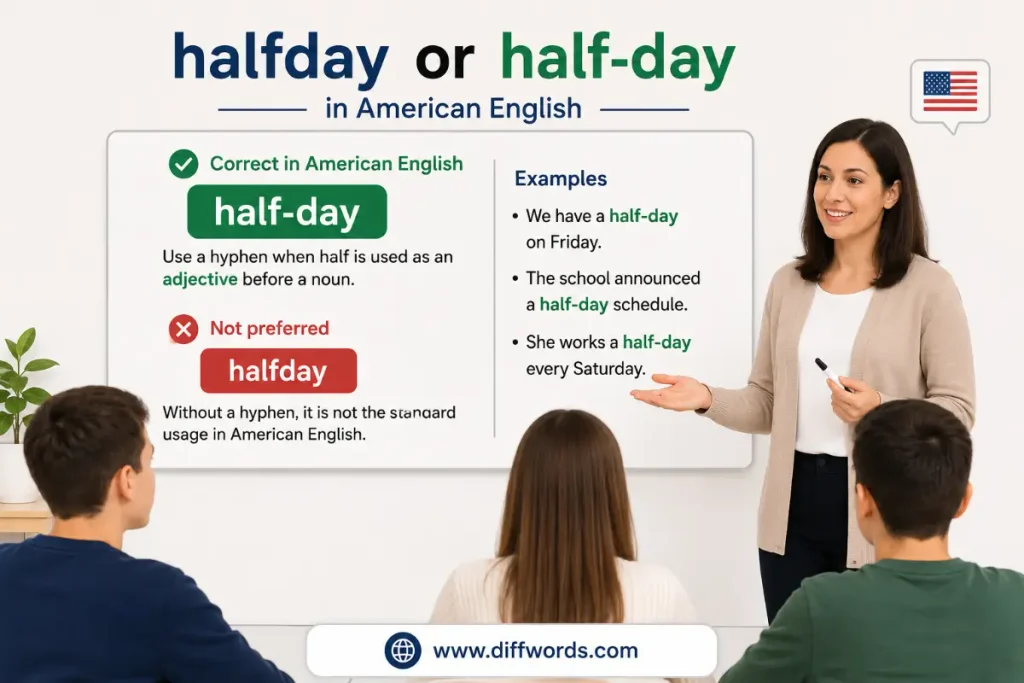
Is halfday or half-day correct in American English?
In American English, halfday is generally not the preferred spelling.
Use:
“a half-day workshop”
and:
“I took a half day off.”
American style generally uses hyphens to make compound modifiers clear before nouns.
For example:
“a two-hour meeting”
“a five-day trip”
“a half-day course”
The hyphen connects the words that work together as one modifier.
Is halfday or half-day different in British English?
British English also commonly uses half-day as a compound modifier.
For example:
“a half-day course”
“a half-day conference”
British workplace and school contexts may use related terms such as:
- half-day leave
- half-day session
- half-day holiday
- half-day closing
The exact treatment of hyphens can vary by publisher and style guide.
The safest general rule for international readers is still:
Use “half-day” before a noun when it acts as one compound adjective.
Does half day need a hyphen after “a”?
This is where sentence structure matters.
Compare:
“I took a half day off.”
Here, half day is functioning as a noun phrase, so many writers leave it open.
Now compare:
“I attended a half-day workshop.”
Here, half-day modifies workshop, so the hyphen makes the compound adjective clear.
Another example:
“She worked a half day.”
versus:
“She completed a half-day shift.”
The first treats the phrase as a time period. The second uses it to describe the shift.
Should you write half-day event or half day event?
For polished writing, use:
half-day event
The hyphen helps show that half-day is one compound modifier describing event.
The same applies to:
- half-day event
- half-day meeting
- half-day workshop
- half-day class
- half-day conference
- half-day seminar
- half-day course
- half-day program
- half-day tour
- half-day trip
The pattern is simple:
half-day + noun
Should you write half day off or half-day off?
This phrase can vary by style and regional usage, but “a half day off” is a very common and clear choice when referring to taking part of a workday away from work.
Examples:
“I need to take a half day off tomorrow.”
“She took a half day off for her appointment.”
You may also encounter:
“I need a half-day off.”
This is used by some writers and style systems, but the open form half day is a safe general choice when it functions as the noun phrase.
If you’re following a workplace or publication style guide, follow its preferred convention consistently.
What is the best spelling in an email:halfday or half-day
For professional emails, clarity should come first.
Write:
“I’d like to take a half day off on Friday.”
Or:
“I’ll be attending a half-day training session on Friday.”
Both are clear.
Avoid:
“I’d like to take a halfday off.”
The one-word form can look like a typo.
Example professional email
Hi Sarah,
I’d like to take a half day off this Friday for a personal appointment. I’ll finish the urgent tasks before I leave.
Thanks.
This is natural and professional.
What is the best spelling on a resume:halfday or half-day
On a resume, half-day is usually appropriate when it comes before a noun.
Examples:
“Completed a half-day leadership workshop.”
“Led a half-day employee training session.”
“Organized a half-day professional development seminar.”
If you’re describing time away from work, use the noun phrase:
“Worked a half day during the transition period.”
Don’t use halfday as one word.
What is the best spelling in an essay?
Academic writing should use standard spelling and clear grammatical structures.
Examples:
“The students attended a half-day seminar.”
“The fieldwork lasted half a day.”
“The researchers completed the survey in a half-day session.”
The third example uses half-day as a compound modifier.
For more formal writing, you could also write:
“The fieldwork lasted approximately twelve hours.”
But don’t use a more complicated expression when half a day is clearer.
What is the best spelling in texting:halfday or half-day
Text messages are flexible, but standard spelling still helps.
Natural examples include:
“I’ll be there for half a day.”
“It’s a half-day event.”
“I’m taking a half day tomorrow.”
You might see people type halfday informally, but there’s little benefit to doing so.
The standard forms are just as short and easier for most readers to understand.
What is the best spelling in speaking?
When speaking, the spelling doesn’t matter because listeners hear the words rather than see them.
You can say:
“It’s a half-day workshop.”
or:
“I’ll be there for half a day.”
The distinction becomes important when you write the sentence.
In speech, the listener understands the meaning from context and pronunciation. In writing, punctuation and word spacing can help show the grammatical structure.
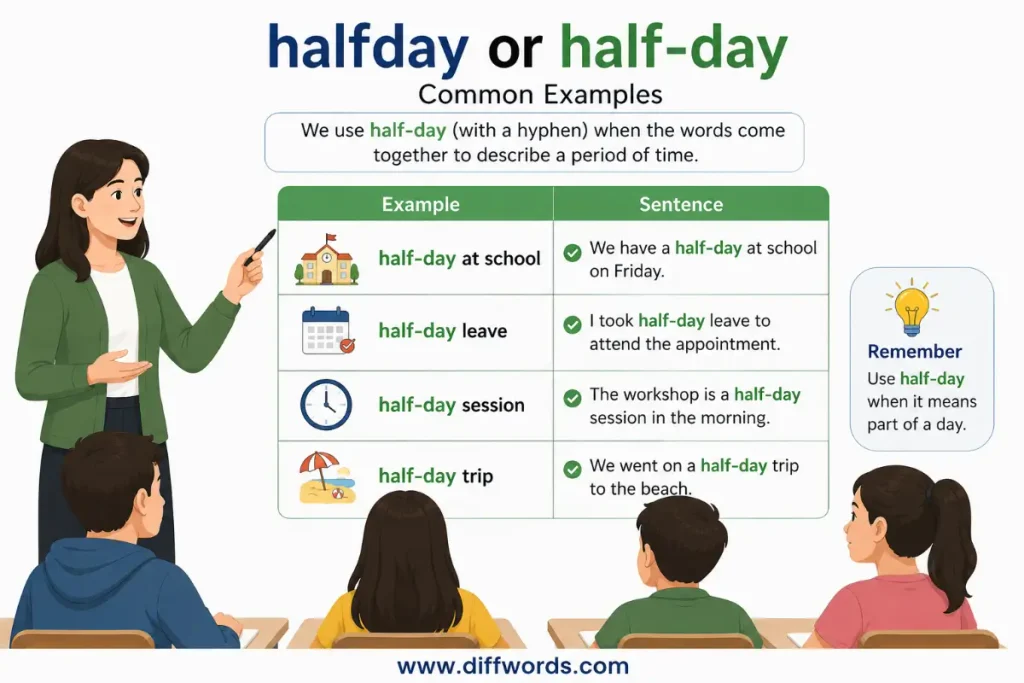
What are common examples of halfday or half-day?
Here are practical examples from work, school, travel, and everyday life.
- “I took a half day off work.”
- “The students have a half day on Friday.”
- “We spent half a day exploring the museum.”
- “The company organized a half-day workshop.”
- “She attended a half-day training session.”
- “The tour lasts half a day.”
- “I’ll need a half day to finish the report.”
- “The office will operate on a half-day schedule.”
- “They planned a half-day trip to the nearby town.”
- “He worked a half day before leaving.”
- “The conference includes a half-day seminar.”
- “We completed the first part in half a day.”
- “The school offers a half-day program.”
- “I spent half a day preparing the presentation.”
- “The team held a half-day planning session.”
- “She requested a half day for the appointment.”
- “The museum offers a half-day guided tour.”
- “The training is a half-day course.”
- “We only had half a day to complete the assignment.”
- “The office closes after a half day on Friday.”
These examples show how the spelling changes depending on the sentence.
What are the most common mistakes with halfday or half-day?
Mistake 1: Writing halfday as one word
Incorrect:
“We attended a halfday workshop.”
Better:
“We attended a half-day workshop.”
Mistake 2: Hyphenating every use
Some writers assume the phrase must always be half-day.
For example:
“I took a half-day off.”
This can be seen in real-world writing, but when half day is being used as the noun phrase, the open form is often clearer:
“I took a half day off.”
The key is to look at the sentence structure rather than hyphenating automatically.
Mistake 3: Confusing half a day with half-day
These aren’t identical grammatical structures.
“The project took half a day.”
Here, half a day is a normal measurement of time.
“It was a half-day project.”
Here, half-day modifies project.
Both can describe a similar amount of time, but the grammar is different.
Mistake 4: Treating halfday as a standard compound
English doesn’t automatically turn every phrase into one word.
For example, we don’t normally write:
“halfday”
just because half and day frequently appear together.
Standard spelling matters more than shortening a phrase.
When should you not use half-day?
Don’t use half-day simply because the phrase contains the word “half.”
If you’re describing duration after a verb, a phrase such as half a day may be more natural.
Instead of:
“The trip lasted a half-day.”
prefer:
“The trip lasted half a day.”
For example:
“We spent half a day at the beach.”
This is straightforward and natural.
Use half-day especially when it directly describes another noun:
“a half-day beach trip”
That distinction keeps your writing clean.
What are the antonyms of half day?
The most direct opposite is:
full day
Depending on the context, you might also use:
- whole day
- entire day
- full-day
- all day
Compare:
“a half-day workshop”
with:
“a full-day workshop”
Or:
“I worked a half day.”
with:
“I worked a full day.”
When full-day appears before a noun as a compound modifier, the hyphen is commonly used:
“a full-day conference”
This follows the same general pattern as half-day.
Half-day vs full-day: what’s the difference?
These expressions are useful when describing schedules, events, and programs.
| Expression | Meaning | Example |
|---|---|---|
| half-day | Lasting about half a normal day | “a half-day course” |
| full-day | Lasting a whole normal day | “a full-day conference” |
| half a day | A duration of approximately half a day | “The trip took half a day.” |
| a full day | A complete day or schedule | “The training took a full day.” |
The hyphenated forms are especially useful before nouns.
Half-day vs part-time: what’s the difference?
Half-day refers to duration, while part-time usually refers to a reduced work or study schedule.
For example:
“I attended a half-day workshop.”
This tells you how long the workshop lasted.
But:
“I have a part-time job.”
This tells you that the job involves fewer hours than a full-time job.
A part-time employee may work:
- several hours each day,
- several days each week,
- or another reduced schedule.
So half-day and part-time aren’t interchangeable.
Half-day or half a day: what’s the difference?
The meanings can be similar, but the grammar differs.
| Form | Typical role | Example |
|---|---|---|
| half a day | Duration | “The trip lasted half a day.” |
| half day | Noun phrase | “I took a half day off.” |
| half-day | Compound adjective | “It was a half-day trip.” |
A good way to remember it is:
half a day = duration
half day = noun phrase
half-day = modifier
This isn’t an absolute rule for every dictionary or style guide, but it’s a reliable approach for clear general writing.
Half-day vs morning session: what’s the difference?
A morning session specifically takes place in the morning.
A half-day session simply tells you the approximate duration.
For example:
“The morning session lasted three hours.”
“The half-day session lasted about four hours.”
A half-day session could occur in the morning or afternoon.
Therefore, don’t use morning session as a direct replacement for half-day session unless you know the event takes place in the morning.
Half-day vs shortened day: what’s the difference?
These expressions overlap but aren’t always equal.
A half-day generally suggests roughly half of the normal schedule.
A shortened day simply means shorter than usual.
For example:
“Friday is a half-day.”
This suggests a substantially reduced schedule.
But:
“Friday is a shortened day.”
could mean the day is only slightly shorter than normal.
If precision matters, use the expression that matches the actual schedule.
How do you choose the right form quickly?
Use this five-step check.
Step 1: Look at what comes after the phrase
If a noun comes immediately after it, consider a hyphen:
“half-day workshop”
Step 2: Ask whether you’re describing duration
If you’re saying how long something lasted, use:
“half a day”
Example:
“The job took half a day.”
Step 3: Ask whether you’re naming time off
For a normal noun phrase, use:
“a half day off”
Step 4: Avoid the one-word form
Unless you’re following a specific proper name or specialized usage, don’t write:
“halfday”
Step 5: Keep your style consistent
If your organization has a style guide, follow it. Consistency matters in professional and published writing.
What is the best rule for writers and editors?
If you’re writing for a general audience, this simple style is reliable:
Use “half day” when the words form an ordinary noun phrase.
“I took a half day off.”
Use “half-day” when the words work together as an adjective before a noun.
“I took part in a half-day workshop.”
Also use “half a day” when you’re expressing duration.
“The workshop lasted half a day.”
Avoid “halfday” as one word.
This approach gives readers an immediate clue about how the phrase functions.
Quick reference: halfday or half-day?
| If you mean… | Best form | Example |
|---|---|---|
| A period of time | half day | “I took a half day off.” |
| Duration | half a day | “It took half a day.” |
| A compound adjective | half-day | “a half-day workshop” |
| One-word spelling | Avoid halfday | Not standard in general writing |
| A shorter work schedule | half day / half-day schedule | “It’s a half-day schedule.” |
| A short event | half-day event | “It’s a half-day event.” |
| Historical or formal writing | Depends on grammar | “a half-day session” |
Why hyphens matter in compound adjectives
Hyphens aren’t decoration. They can help readers understand which words belong together.
Consider:
“a half day workshop”
A reader can understand it, but the structure is less clearly marked.
Compare:
“a half-day workshop”
Now half-day clearly works as one modifier for workshop.
The same principle appears in:
- two-hour meeting
- five-day course
- ten-minute break
- three-week program
- full-time employee
- part-time worker
- half-day event
Hyphenation helps prevent temporary confusion and creates cleaner professional writing.
Does half-day mean exactly 12 hours?
Not necessarily.
In a literal mathematical sense, half of a 24-hour day is 12 hours.
But in everyday scheduling, half-day usually refers to approximately half of a normal schedule.
For example, if a school day runs from 8 a.m. to 3 p.m., a half-day might end around 11:30 a.m. or noon.
Likewise, if an employee normally works from 9 a.m. to 5 p.m., a half day might mean working either the morning or afternoon portion.
So context determines the actual length.
Can you say “half-day leave”?
Yes. Half-day leave is common, especially in workplace and administrative contexts.
For example:
“Employees can request half-day leave for personal appointments.”
In this phrase, half-day works as a compound modifier describing leave.
You may also see:
“half day leave”
especially in informal or regional workplace writing.
For polished general English, half-day leave is a clear choice when the phrase directly modifies leave.
Can you say “half-day holiday”?
Yes.
For example:
“The office will close for a half-day holiday.”
However, depending on the exact meaning, half day off may sound more natural in American English.
“I’m taking a half day off.”
If you’re describing an official schedule or policy, half-day holiday can be appropriate.
Can you say “half-day work”?
You can, but more specific phrases are often clearer.
For example:
“a half-day work schedule”
or:
“a half-day shift”
These tell the reader exactly what you’re describing.
Simply writing:
“half-day work”
can sound vague.
Clear writing usually names the specific thing:
- half-day shift
- half-day schedule
- half-day job
- half-day session
- half-day workshop
What should teachers and schools write?
Schools frequently use half-day as a compound adjective.
Examples:
“Friday will be a half-day schedule.”
“Students will attend a half-day program.”
“The school will have a half-day session.”
You can also write:
“Students will attend school for half a day.”
The second version is especially useful when you’re describing the duration rather than labeling the schedule.
What should businesses write:halfday or half-day
Businesses can use both forms.
For employee time off:
“I need to take a half day off.”
For events:
“The company is hosting a half-day workshop.”
Also for schedules:
“Employees will work a half-day schedule on Friday.”
And for duration:
“The training will last half a day.”
These forms are clear and professional.
What should travel websites write?
Travel writing often uses half-day before activities and half a day for duration.
Examples:
“Book our half-day city tour.”
“The excursion takes half a day.”
“Enjoy a half-day guided tour.”
“You’ll spend half a day exploring the historic district.”
This distinction is useful for SEO content because readers often search phrases such as “half-day tour” and “half-day trip.”
What should you use in website headings?
When the phrase modifies a noun in a heading, half-day is generally the cleaner choice.
Examples:
- Half-Day Tours
- Half-Day Trips
- Half-Day Workshops
- Half-Day Courses
- Half-Day Training
- Half-Day Activities
But if the heading is a question about duration, use the natural phrase:
“How Long Is Half a Day?”
This is clearer than forcing a hyphen into every use.
What should you use in SEO titles:halfday or half-day
For SEO titles, use the form that matches the searcher’s likely intent.
Examples:
Half-Day Tour: What to Expect
Half-Day vs Full-Day Tour: What’s Better?
How Long Is Half a Day?
Avoid:
Halfday Tour
unless the phrase is part of a specific brand or product name.
Natural spelling improves readability and trust.
Conclusion
The spelling choice becomes much easier once you look at the grammar. Half day is commonly used as a noun phrase when you’re talking about a period of time or time off, as in “I took a half day off.” Half-day is commonly hyphenated when it acts as a compound adjective before another noun, as in “a half-day workshop.” When you’re describing duration, half a day is often the most natural form: “The trip lasted half a day.” The one-word spelling halfday should generally be avoided in standard English. If you’re writing for work, school, a website, or a general audience, these three forms will cover nearly every situation. When in doubt, check what the phrase is doing in the sentence rather than relying on how it sounds.
Frequently Asked Questions
Is it halfday or half-day?
Use “half-day” when it works as a compound adjective, and “half day” when it functions as a noun phrase. The one-word form “halfday” is generally not standard in ordinary English.
Is it half day or half-day off?
“A half day off” is a common clear form when you mean time away from work. When the phrase modifies another noun, use the hyphenated form, such as “a half-day workshop.”
Should I write half-day workshop or half day workshop?
Write “half-day workshop.” The hyphen shows that “half-day” functions together as one modifier describing “workshop.”
What’s another way to say half a day?
You can say a partial day, part of a day, a shortened day, or a few hours, depending on the exact duration you mean. “Half a day” is usually the clearest option when the period is approximately half a day.
Is halfday one word in English?
Halfday is generally not the standard one-word spelling in general English. Use “half day,” “half a day,” or “half-day” according to the sentence.
Is half-day used in American and British English?
Yes, both American and British English commonly use “half-day” as a compound modifier. Exact hyphenation can vary by style guide, but the one-word form is generally best avoided in standard writing.
Does half-day mean 12 hours?
Not usually in everyday scheduling. Although half of a 24-hour day is 12 hours, “half-day” commonly means roughly half of a normal work, school, or event schedule.
1 thought on “halfday or half-day: Simple Spelling Guide”