
When you’re writing an email, essay, story, or text, you might stop at sheath vs sheathe. The two words look almost identical, and they are closely related. But they aren’t interchangeable because one is mainly a noun, while the other is a verb.
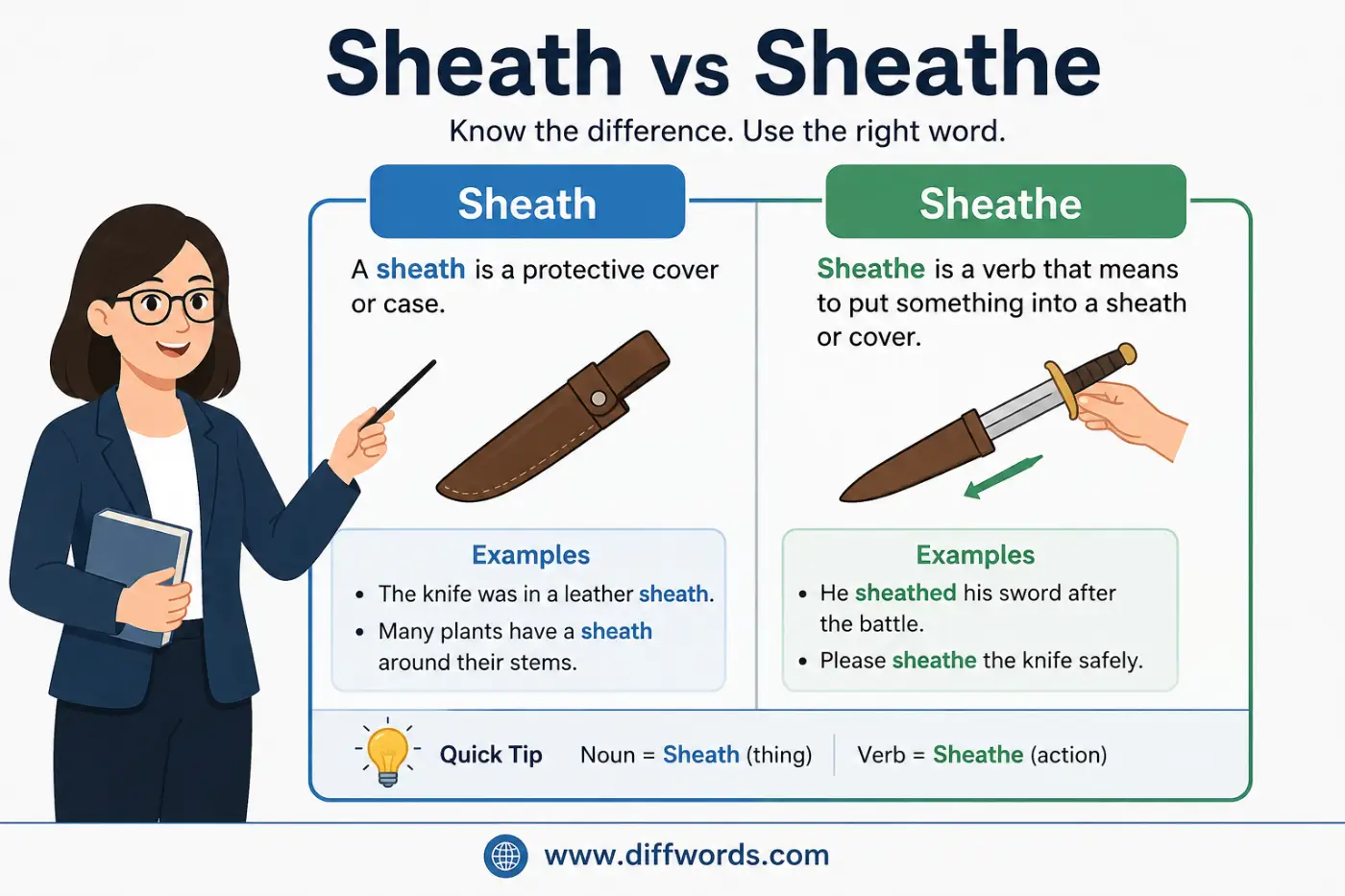
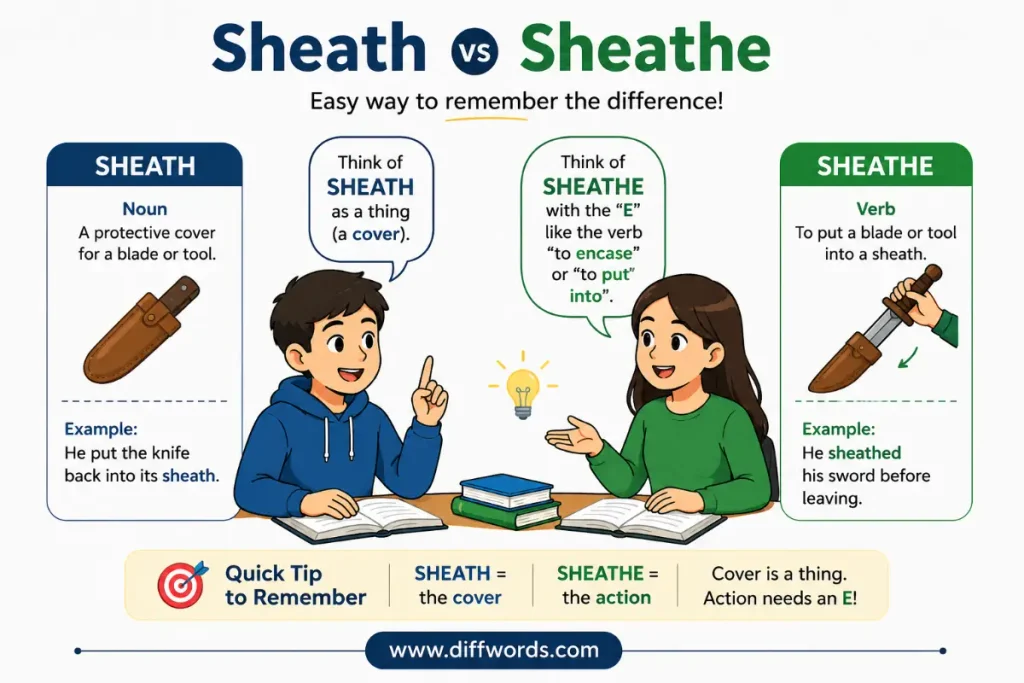
Sheath is usually a noun meaning a covering or case for something, while sheathe is a verb meaning to put something into a sheath or covering.
For example, a sword can have a sheath, and you can sheathe the sword. The spelling difference is small, but the grammatical difference is important.
This guide explains the meaning, origin, pronunciation, grammar, synonyms, examples, common mistakes, and US vs. UK usage. You’ll also see how to choose the right word in essays, emails, resumes, texts, and everyday speech.
Should you say cleverer vs more clever? Discover which form sounds natural in different sentences.
What is the difference between sheath vs sheathe?
The main difference is part of speech and function.
| Word | Part of speech | Basic meaning | Example |
|---|---|---|---|
| sheath | Noun | A covering or case | The knife was in its sheath. |
| sheathe | Verb | To put something into a sheath | He sheathed the knife. |
Think of the relationship this way:
A sheath is the covering. To sheathe is to put something inside that covering.
Sheath as a noun
A sheath is a protective covering or case that fits around an object.
For example:
The sword rested in its sheath.
Here, sheath is the thing holding or covering the sword.
Sheathe as a verb
Sheathe means to put something into a sheath.
For example:
The warrior sheathed his sword.
Here, sheathed tells us what the warrior did.
The simplest memory trick is:
sheath = thing
sheathe = action
What does sheath mean in plain English?
A sheath is a cover, case, or protective layer around something.
The word is commonly associated with swords, knives, and other long, narrow objects, but its meaning is broader than that.
Examples include:
- a sword sheath
- a knife sheath
- a cable sheath
- a protective sheath around a wire
- a plant sheath
- a medical or anatomical sheath
The exact meaning depends on the context.
For example:
The cable has a thick plastic sheath.
Here, sheath means an outer protective covering.
In another sentence:
The sword was returned to its sheath.
Here, it means a case designed to hold the sword.
What does sheathe mean in plain English?
Sheathe is a verb meaning to put something into a sheath or covering.
For example:
He sheathed his sword.
This means he put the sword into its sheath.
It can also be used figuratively:
The mountains were sheathed in snow.
Here, the mountains weren’t literally put into a physical case. Instead, they were covered by snow.
So sheathe can mean either:
- to put something into a sheath, or
- to cover something with a layer or covering.
Is sheath a noun or a verb?
Sheath is primarily a noun, but it can also be used as a verb.
As a noun:
The dagger was inside its sheath.
As a verb:
He sheathed the dagger.
The noun is much more common in ordinary usage.
When sheath is used as a verb, it means essentially the same thing as sheathe.
However, sheathe is the more specific verb form when you mean “put into a sheath.”
Is sheathe a noun or a verb?
Sheathe is a verb.
It describes an action.
Examples:
Sheathed the sword.
The soldier sheathed his weapon.
The tree was sheathed in ice.
You don’t normally use sheathe as the name of the covering itself.
For the covering, use sheath.
Where did the word sheath come from?
Sheath is an old English word with Germanic roots.
It is related to older words meaning a covering or case for a blade. The word has been used for centuries to describe protective coverings around swords and similar objects.
Over time, its meaning expanded.
Today, sheath can refer to many kinds of protective coverings, not just weapon cases.
You can therefore find the word in fields such as:
- engineering
- biology
- medicine
- anatomy
- botany
- electronics
- everyday language
The basic idea remains the same: something that covers, surrounds, or protects another thing.
Where did the word sheathe come from?
Sheathe developed from the noun sheath.
The basic idea is simple: if a sheath is a covering for an object, then to sheathe something is to place it in that covering.
This noun-to-verb relationship is common in English.
For example:
- bottle → bottle something
- shelter → shelter something
- cover → cover something
- sheath → sheathe something
The extra e in sheathe helps mark the word as a verb and also changes its pronunciation.
How do you pronounce sheath and sheathe?
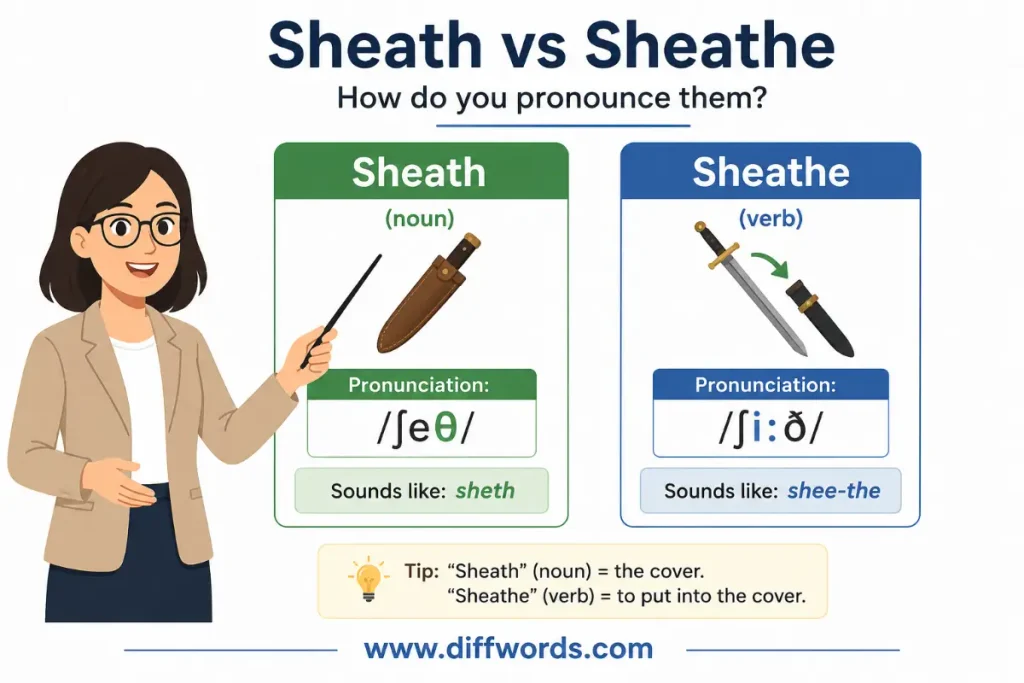
The pronunciation difference is small but useful.
Sheath is usually pronounced like:
sheeth
It ends with the unvoiced th sound, as in bath.
Sheathe is usually pronounced like:
sheeth
with a voiced th sound, like the th in breathe.
The vowel sound is similar, but the final consonant differs.
A simple comparison:
| Word | Ending sound | Similar sound |
|---|---|---|
| sheath | unvoiced /θ/ | bath |
| sheathe | voiced /ð/ | breathe |
For many learners, this is one of the easiest ways to hear the difference.
Why do sheath and sheathe look so similar?
They are related words.
Sheath is the noun for the covering.
Sheathe is the verb formed from that noun.
The spelling difference is just one letter, but it helps distinguish their grammatical roles.
Compare:
The sword is in the sheath.
with:
The soldier sheathed the sword.
The first sentence names an object.
The second describes an action.
What are the main synonyms for sheath?
The best synonym depends on what kind of sheath you’re talking about.
| Group | Word | Meaning | Tone | Example |
|---|---|---|---|---|
| Simple | cover | Something that covers another thing | Everyday | The wire has a protective cover. |
| Simple | case | A container or covering | Everyday | The knife has a case. |
| Simple | holder | Something that holds an object | Everyday | The tool has a holder. |
| Simple | wrapper | Material around something | Everyday | The cable has a protective wrapper. |
| Simple | covering | Something placed over another object | Neutral | The covering protects the wire. |
| Everyday | guard | Something that protects | Everyday | The guard protects the blade. |
| Everyday | sleeve | A tube-like covering | Everyday | The cable has a rubber sleeve. |
| Everyday | jacket | An outer protective layer | Technical/Everyday | The wire has an outer jacket. |
| Everyday | housing | Outer protective structure | Technical | The device has a protective housing. |
| Everyday | container | Something that holds an object | Neutral | The container protects the tool. |
| Formal | enclosure | A structure surrounding something | Formal | The equipment has a sealed enclosure. |
| Formal | casing | Outer protective layer | Technical | The machine has a metal casing. |
| Formal | protective layer | Material covering something | Formal | The protective layer prevents damage. |
| Formal | covering layer | Outer material surrounding something | Formal | The covering layer is waterproof. |
| Formal | encasement | A surrounding protective covering | Formal | The structure has a concrete encasement. |
| Formal | mantle | A surrounding layer | Literary/Technical | A mantle of ice covered the surface. |
| Informal | cover-up | Something used to hide or cover | Informal | The cover-up protected the equipment. |
| Informal | shell | Outer protective layer | Everyday/Technical | The device has a strong outer shell. |
| Informal | skin | Outer layer | Technical/Informal | The cable has a tough outer skin. |
| Informal | wrap | Material wrapped around something | Informal | Add a wrap around the pipe. |
Not every synonym works in every sentence.
For example, sleeve is a good alternative for a tube-like covering, while case is better for a container that can be removed.
What are synonyms for sheathe?
Because sheathe is a verb, its synonyms are actions rather than objects.
| Word | Meaning | Tone | Example |
|---|---|---|---|
| cover | Put a covering over something | Everyday | Snow covered the ground. |
| encase | Completely surround with a case | Formal | Ice encased the branches. |
| enclose | Surround or contain | Neutral/Formal | The structure enclosed the equipment. |
| wrap | Cover by winding material around it | Everyday | She wrapped the cable. |
| cover up | Put something over another thing | Informal | The blanket covered up the box. |
| protect | Keep something safe from harm | General | The coating protects the wire. |
| surround | Form a covering around something | Neutral | A layer of ice surrounded the pipe. |
| coat | Put a layer over something | Technical/Everyday | The surface was coated with paint. |
| encapsulate | Completely contain or surround | Technical | The material encapsulates the component. |
| conceal | Hide from view | Formal | The covering concealed the object. |
| hide | Keep something from being seen | Everyday | The cloth hid the equipment. |
| cover over | Put something over another thing | Everyday | The snow covered over the path. |
These words are related but not identical.
For example, protect doesn’t necessarily mean to place something inside a covering. Hide focuses on visibility, not protection.
What are the synonyms by intensity?
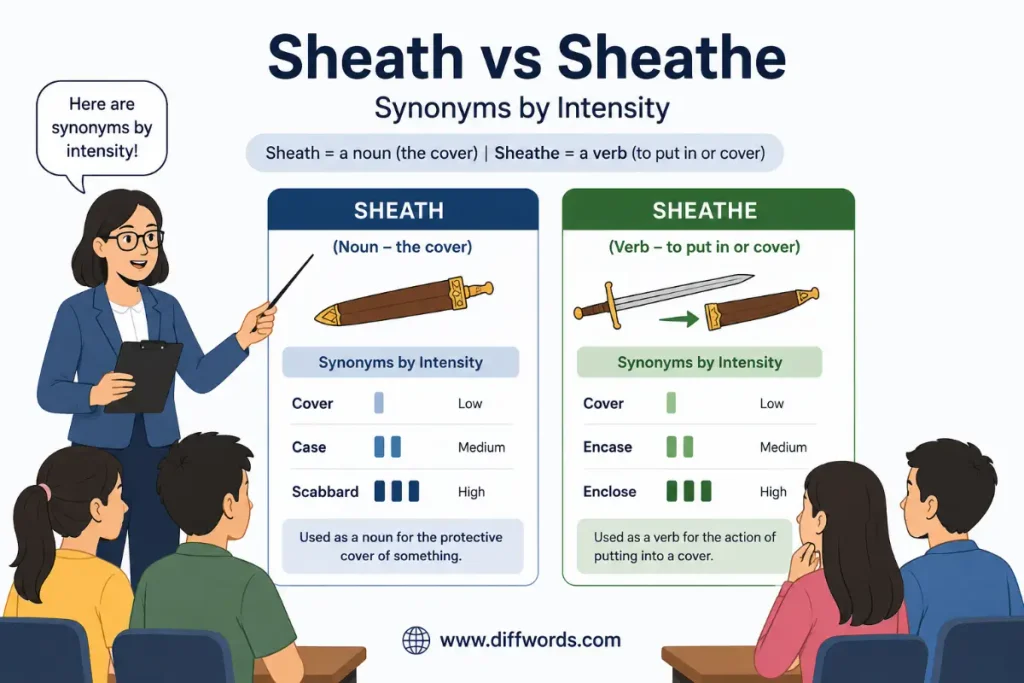
The idea of covering can range from light coverage to complete enclosure.
Mild or partial covering
- cover
- layer
- coat
- wrap
- surround
Example:
A thin layer of dust covered the surface.
Stronger covering
- encase
- enclose
- surround completely
- encapsulate
- seal
Example:
The material was completely encased in ice.
Complete protection
Words such as encase, encapsulate, and seal often suggest that something is surrounded or protected more completely.
The component was sealed inside a protective casing.
That doesn’t necessarily mean it was sheathed, because a sheath is usually a specific type of covering.
What part of speech is sheath?
Sheath is most commonly a noun.
Examples:
- a knife sheath
- a sword sheath
- a cable sheath
- a protective sheath
- a plant sheath
It can also function as a verb, though sheathe is the more familiar verb when discussing putting something into a sheath.
Related forms include:
| Form | Word | Example |
|---|---|---|
| Noun | sheath | The blade has a sheath. |
| Verb | sheathe | He will sheathe the blade. |
| Past tense | sheathed | He sheathed the blade. |
| Present participle | sheathing | Sheathing protects the cable. |
What part of speech is sheathe?
Sheathe is a verb.
Its common forms are:
- sheathe
- sheathed
- sheathing
Examples:
Sheathe the sword.
He sheathed the sword.
The wire is covered by protective sheathing.
The noun sheathing is especially common in technical contexts.
What does sheathing mean?
Sheathing can mean a protective covering or the material used to cover something.
For example:
The cable’s sheathing protects the wires inside.
It can also describe the process of putting a covering around something.
In construction:
The roof sheathing was installed before the final roofing material.
Here, sheathing refers to a layer of material used as part of a structure.
This is different from the weapon-related meaning of sheathe.
What does a sword sheath mean?
A sword sheath is a protective case designed to hold a sword’s blade when it isn’t being used.
For example:
The sword was placed carefully in its sheath.
The sheath protects the blade and makes the sword easier and safer to carry.
The important grammar distinction is:
The sword has a sheath.
But:
The warrior sheathed the sword.
What does “sheathe a sword” mean?
To sheathe a sword means to put the sword into its sheath.
For example:
The knight sheathed his sword.
This means the sword was returned to its protective covering.
The opposite action can be described as draw, unsheathe, or draw a sword, depending on the context.
What does unsheathe mean?
Unsheathe means to remove something from its sheath.
For example:
The soldier unsheathed his sword.
This is the opposite of:
The soldier sheathed his sword.
The related noun is sheath.
So the basic sequence is:
sheath → sheathe → unsheathe
- sheath = the covering
- sheathe = put into the covering
- unsheathe = remove from the covering
Is sheath used outside weapons?
Yes.
This is one of the most important points about the word.
Although many people first think of swords or knives, sheath has many technical and scientific uses.
Examples include:
Cable sheath
A cable sheath is an outer layer that protects the wires or components inside.
The cable has a durable outer sheath.
Plant sheath
In botany, a sheath can be a structure that surrounds part of a plant, such as the base of a leaf.
Biological sheath
In biology and medicine, sheath can describe a covering around a structure.
For example, certain nerves or tissues can have protective coverings described as sheaths.
Tool sheath
Knives and other tools may have protective sheaths.
So the general idea remains:
A sheath is something that surrounds or protects another structure.
Is sheathe used outside weapons?
Yes.
Although sheathe is strongly associated with swords and blades, it can be used more broadly to mean cover or encase.
For example:
The branches were sheathed in ice.
This means ice covered the branches.
Another example:
The hills were sheathed in mist.
This is a more literary use.
Here, sheathed doesn’t mean someone literally put the hills into a case. It means they were covered or surrounded by something.
Sheath vs sheathe: which one should you use in a sentence?
Use sheath when you need to name the covering.
The knife is in its sheath.
Use sheathe when you need to describe the action of putting something into the covering.
He sheathed the knife.
A useful test is to ask:
Am I naming a thing or describing an action?
If you’re naming the thing, use sheath.
If you’re describing the action, use sheathe.
Is sheath or sheathe used in a resume?
A resume rarely needs either word unless your work involves technical equipment, manufacturing, construction, engineering, or similar fields.
For example:
Installed protective cable sheathing according to safety specifications.
Here, sheathing is a technical noun.
If your job involved putting equipment into protective coverings, you might write:
Sheathed electrical cables according to project specifications.
However, avoid these words if a simpler technical term explains the work better.
Is sheath or sheathe better in an essay?
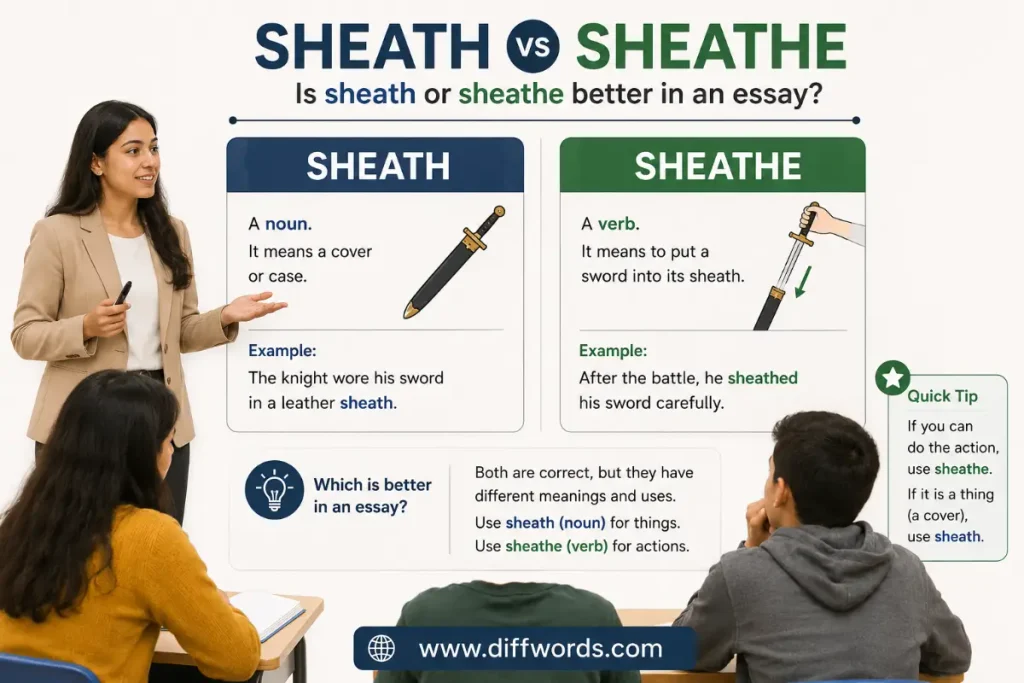
Both can be useful in an essay, depending on the subject.
For a historical essay:
The warrior returned his sword to its sheath.
For a science essay:
The nerve is surrounded by a protective sheath.
And for descriptive writing:
The mountain peaks were sheathed in mist.
In formal writing, make sure you use the word according to its exact meaning rather than choosing it simply because it sounds sophisticated.
Can sheath be a verb?
Yes, but sheath as a verb is less common than sheathe for the specific action of putting something into a sheath.
For example:
The blade was sheathed.
is standard and clear.
You may also encounter:
He sheathed the blade.
The form sheathe makes the intended action clear.
Can sheathe be used for clothing?
Usually not in ordinary contexts.
You wouldn’t normally say:
Sheathed the jacket.
if you simply mean someone put on a jacket.
However, sheathed can be used figuratively or descriptively when something is tightly covered.
For example:
The tower was sheathed in glass.
This means glass covered the outside of the tower.
The word therefore works best when the covering is close, protective, or surrounding.
What does “sheathed in” mean?
Sheathed in is a common descriptive phrase meaning covered or surrounded by something.
Examples:
The trees were sheathed in ice.
The hills were sheathed in fog.
The building was sheathed in glass.
This construction is especially useful in descriptive and literary writing.
It doesn’t mean the object was placed inside a physical sheath.
Instead, it creates an image of something being completely covered.
What are common mistakes with sheath vs sheathe?
Mistake 1: Using sheathe for the object
Incorrect:
The sword was in its sheathe.
Correct:
The sword was in its sheath.
The case is a sheath.
Mistake 2: Using sheath for the action
Less precise:
He sheath the sword.
Correct:
He sheathed the sword.
The verb needs the correct tense.
Mistake 3: Writing sheathed as sheatheded
Incorrect:
He sheatheded the sword.
Correct:
He sheathed the sword.
Sheathed already contains the past-tense ending.
Mistake 4: Confusing sheath vs sheathe because of pronunciation
The two words sound very similar.
Remember:
- sheath → noun
- sheathe → verb
Mistake 5: Using sheathe when you mean cover generally
Not every type of covering is a sheath.
For example:
Sheathe the table with a cloth.
This is possible in a creative or unusual context, but cover the table with a cloth is much more natural.
Use sheathe when the idea of close surrounding or protective covering fits.
When should you NOT use sheath?
Don’t use sheath simply as a synonym for every kind of container.
A box, bag, case, and sheath aren’t always interchangeable.
For example:
Put the laptop in its sheath.
sounds unusual.
Put the laptop in its case.
is much more natural.
A sheath usually has a close-fitting or surrounding relationship with the object.
When should you NOT use sheathe?
Don’t use sheathe whenever you mean simply “put something somewhere.”
For example:
Sheathed the book on the table.
is incorrect if you mean placed the book on the table.
Instead:
She placed the book on the table.
Use sheathe when something is put inside or covered by a sheath-like layer.
What are the antonyms of sheath?
Because sheath is a noun, its antonyms depend on context.
Possible contrasting ideas include:
- exposure
- openness
- uncovered surface
- bare exterior
For example:
sheath ↔ exposure
But there isn’t one exact opposite in every situation.
What are the antonyms of sheathe?
For the verb sheathe, the clearest opposite is:
unsheathe
Other possible opposites include:
- uncover
- expose
- remove
- reveal
- unwrap
- uncover completely
For a sword:
sheathe ↔ unsheathe
For a general covering:
sheathe ↔ uncover
How can you remember sheath vs sheathe?
Try this simple memory trick:
Sheath = shell
Both are nouns for a protective covering.
The sword has a sheath.
Sheathe = action
The extra e can remind you that you’re doing something:
Sheathe the sword.
Another useful pair is:
Sheath = thing
Sheathe = action
If you’re unsure, ask whether the word can follow a/the.
a sheath ✅
a sheathe ❌
Now ask whether it can follow to.
to sheathe ✅
to sheath ❌ in the usual specific sense
This quick test can help.
What are the closest word pairs to sheath vs sheathe?
Several English word pairs work in a similar way because one form names a thing and another describes an action.
Examples include:
| Noun | Related verb |
|---|---|
| shelter | shelter |
| cover | cover |
| wrap | wrap |
| container | contain |
| encasement | encase |
| sheath | sheathe |
The relationship isn’t always exact, but it can help you understand how English creates related words.
20 example sentences to master the difference
Here are some practical examples.
- The hunter placed the knife in its sheath.
- The soldier sheathed his sword.
- The leather sheath protected the blade.
- She carefully sheathed the dagger.
- The cable has a strong outer sheath.
- The branches were sheathed in ice.
- The knife’s sheath was made of leather.
- He sheathed the blade after cleaning it.
- The wire has a plastic sheath.
- The mountains were sheathed in mist.
- The tool came with a protective sheath.
- The engineer inspected the cable sheathing.
- The warrior slowly sheathed his sword.
- The electrical cable needs a thicker sheath.
- The building was sheathed in reflective glass.
- The knife remained inside its sheath.
- She sheathed the blade before putting it away.
- The plant has a leaf sheath around the stem.
- The metal pipe was sheathed in insulation.
- The protective sheath had become damaged.
Sheath vs sheathe: quick comparison
| Feature | Sheath | Sheathe |
|---|---|---|
| Main role | Noun | Verb |
| Meaning | Protective covering or case | Put into a sheath; cover |
| Example | The sword has a sheath. | He sheathed the sword. |
| Related form | Sheathing | Sheathed |
| Common context | Blades, cables, biology | Blades, coverings, descriptions |
| Pronunciation | Ends with unvoiced “th” | Ends with voiced “th” |
| Easy memory | The thing | The action |
Which word”sheath vs sheathe” should you use in texting?
For texting, the distinction is the same.
If you’re talking about a sword’s covering:
The sword is in its sheath.
If you’re talking about putting it away:
He sheathed the sword.
Since these words are uncommon in casual texting, you may not use them often. But when you do, the noun-versus-verb distinction still matters.
Which word should you use in formal writing?
Both are appropriate in formal writing when they fit the subject.
For technical writing:
The cable’s outer sheath provides mechanical protection.
For descriptive writing:
The valley was sheathed in fog.
And for historical writing:
The soldier sheathed his sword.
The key is accuracy.
Don’t replace simple words such as cover or case with sheath just to make your writing sound more advanced.
Conclusion
The easiest way to remember sheath vs sheathe is to focus on grammar. Sheath is mainly a noun: it names a protective covering or case. Sheathe is a verb: it describes putting something into a sheath or covering it with a surrounding layer. Once you connect the noun with the object and the verb with the action, the spelling becomes much easier.
You’ll often see sheath with swords, knives, cables, plants, and biological structures. You’ll see sheathe in sentences describing actions or in descriptive phrases such as “sheathed in ice.” The related forms sheathed and sheathing are also useful. When in doubt, ask yourself: “Am I naming the covering, or describing the action?” That simple question usually gives you the answer.
Frequently Asked Questions
Is a sheath a cover or a case?
A sheath is a type of protective cover or case that closely surrounds or holds an object. It is commonly used for blades, cables, plants, and various biological structures.
What is the difference between sheath vs sheathe?
Sheath is mainly a noun, while sheathe is a verb. A sheath is the covering; to sheathe something means to put it into that covering or surround it with a layer.
Is it “sheathe the sword” or “sheath the sword”?
“Sheathe the sword” is the clearest standard form for the action. The noun is sheath, as in “Put the sword in its sheath.”
What’s another way to say sheathe?
Cover, encase, enclose, wrap, surround, or protect can work depending on the context. Unsheathe is the opposite when you’re talking about removing a sword or blade from its sheath.
Is “sheathed in” grammatically correct?
Yes, “sheathed in” is a correct phrase meaning covered or surrounded by something. For example, “The trees were sheathed in ice.”
What is the plural of sheath?
The plural of sheath is sheaths. For example: “The knives came with leather sheaths.”
Is sheath used outside sword and knife vocabulary?
Yes, sheath has many technical and scientific uses. It can describe protective coverings around cables, nerves, plant structures, and other objects.
1 thought on “Sheath vs Sheathe: The Best Simple Grammar Guide”