
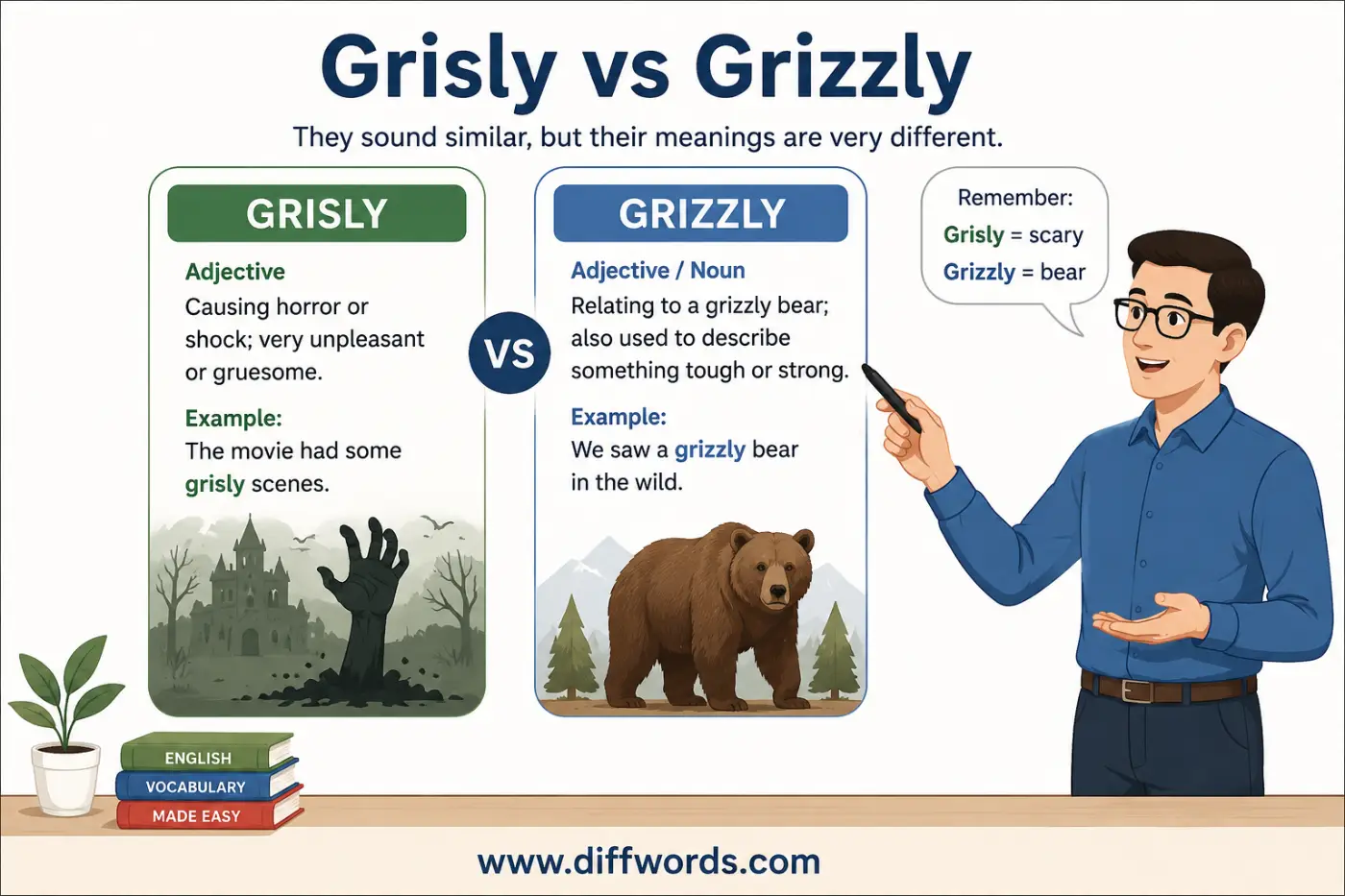
If you’re writing an email, essay, story, or text and pause over grisly vs grizzly, you’re not alone. These two words look almost identical, but they have very different meanings. One describes something shocking or horrifying, while the other is usually connected with a large North American bear.
“Grisly” means horrifying, gruesome, or unpleasant, while “grizzly” usually refers to the grizzly bear or describes something grayish or streaked with gray.
The difference is easy to remember once you connect each spelling with its meaning. Grisly has nothing to do with bears. Grizzly is the spelling you want when you’re talking about the animal.
In this guide, you’ll learn the origins and meanings of both words, their synonyms, intensity levels, common phrases, US and UK usage, and the best choice for essays, resumes, emails, texting, and speech. You’ll also see plenty of examples and learn how to avoid the most common spelling mistake.
Extent vs extant look similar but mean different things. Discover how to tell them apart in seconds.
What is the difference between grisly vs grizzly?
The simplest distinction is:
| Word | Main meaning | Example |
|---|---|---|
| Grisly | Horrifying, gruesome, or disturbing | The detective described the grisly scene. |
| Grizzly | A type of bear; also grayish or streaked with gray | We saw a grizzly in the distance. |
Both words are adjectives, but grizzly can also be used as a noun when it means the bear.
What does grisly mean?
Grisly means frightening, horrifying, or unpleasant, especially because something involves death, injury, or disturbing details.
For example:
The detective discovered a grisly scene.
Here, grisly tells us that the scene was horrifying or disturbing.
Other examples include:
- a grisly discovery
- a grisly murder
- a grisly scene
- a grisly story
- grisly details
- a grisly reminder
The word often appears in news reports, crime writing, horror stories, and descriptions of disturbing events.
What does grizzly mean?
Grizzly most commonly refers to the grizzly bear, a large North American bear that is a subspecies of brown bear.
For example:
The hikers spotted a grizzly near the river.
Here, grizzly is a noun because it names the animal.
It can also be an adjective:
The researchers studied grizzly bear behavior.
In addition, grizzly can describe something that is gray or streaked with gray, although this meaning is much less common in everyday American English.
What does grisly mean in plain English?
A simple definition of grisly is:
Very unpleasant, horrifying, or disturbing, especially because of death or violence.
The word is stronger than simply saying something is bad, sad, or unpleasant.
Compare:
It was an unpleasant scene.
This tells us the scene wasn’t nice.
It was a grisly scene.
This suggests something much more disturbing or horrifying.
The word is therefore useful when you need to communicate a strong emotional reaction without describing graphic details.
What does grizzly mean in plain English?
A simple definition of grizzly is:
A grizzly is a large North American brown bear, and “grizzly” can also describe something grayish or streaked with gray.
The animal meaning is by far the most familiar one.
For example:
A grizzly bear can be difficult to identify from a distance.
You may also see:
The old horse had a grizzly coat.
In that context, grizzly refers to a grayish appearance rather than the animal.
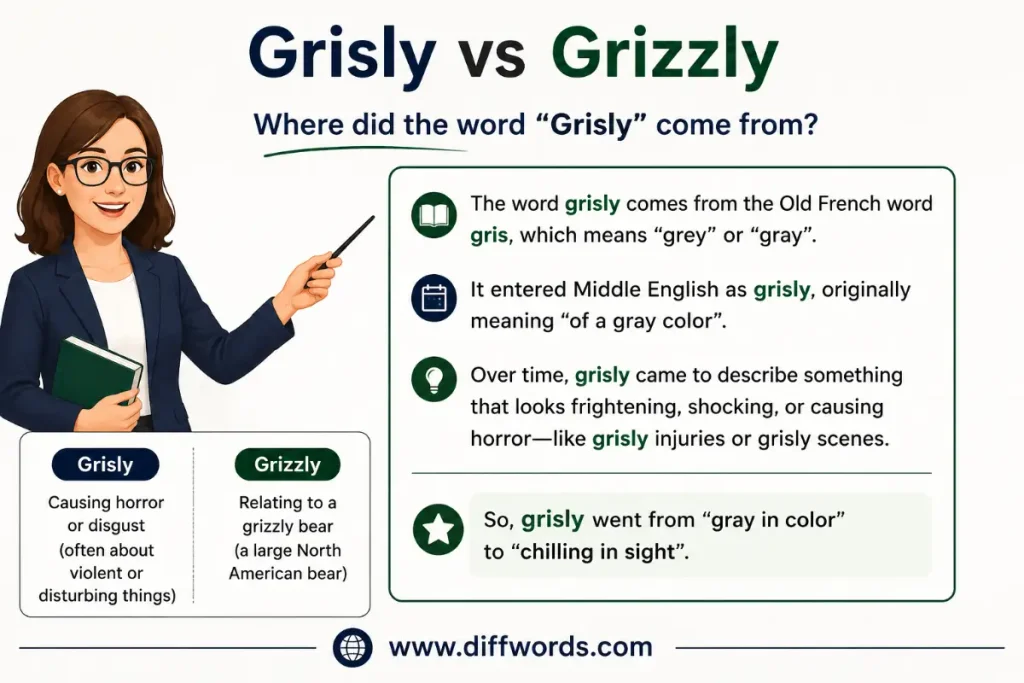
Where did the word grisly come from?
Grisly has a long history in English. It is related to an old Germanic root associated with fear, terror, or dread.
The word has been used for centuries to describe things that inspire horror or fear.
Its connection with frightening situations is still clear today.
You can see that meaning in phrases such as:
- grisly tale
- grisly sight
- grisly discovery
- grisly details
- grisly scene
Unlike grizzly, grisly isn’t connected to the name of the bear.
Where did the word grizzly come from?
The word grizzly has a different history.
The bear’s name is linked to the animal’s appearance. Its fur can have gray or silver-colored tips, giving the coat a somewhat grizzled or gray appearance.
The word grizzly is related to grizzled, which means gray or partly gray.
That’s why the animal’s name makes sense: the bear can appear to have a grayish, silver-tipped coat.
So there’s a useful connection:
grizzly → grizzly bear → grayish or grizzled appearance
That can help you remember the spelling.
Why are grisly vs grizzly so easy to confuse?
There are several reasons.
First, the words differ by only one letter:
- grisly
- grizzly
Second, they sound similar in many accents.
Third, both can appear in descriptions, which makes it easy to type the wrong spelling.
For example, someone might accidentally write:
We saw a grisly bear.
If they mean the animal, that’s incorrect.
The correct sentence is:
We saw a grizzly bear.
On the other hand:
The detective reported a grizzly scene.
is usually wrong if the intended meaning is horrifying.
The correct word is:
The detective reported a grisly scene.
What are the main synonyms for grisly?
Because grisly describes something disturbing or horrifying, it has many related words.
| Word | Meaning | Tone | Example |
|---|---|---|---|
| horrifying | Causing great fear or shock | Strong | It was a horrifying discovery. |
| gruesome | Extremely unpleasant or disturbing | Strong | The story contained gruesome details. |
| ghastly | Very frightening or unpleasant | Strong | It was a ghastly sight. |
| horrific | Extremely shocking or terrible | Strong | The event was horrific. |
| disturbing | Causing discomfort or concern | Neutral | The report was disturbing. |
| frightening | Causing fear | Neutral | It was a frightening experience. |
| shocking | Causing surprise or horror | Neutral | The news was shocking. |
| dreadful | Very bad or unpleasant | Neutral | It was a dreadful situation. |
| appalling | Extremely bad or shocking | Strong | The conditions were appalling. |
| unpleasant | Not enjoyable or comfortable | Mild | It was an unpleasant sight. |
| harrowing | Extremely difficult or upsetting | Strong | She described the harrowing experience. |
| macabre | Connected with death or disturbing subjects | Literary | The novel has a macabre tone. |
| morbid | Focused on death or unpleasant subjects | Formal | The discussion became morbid. |
| repulsive | Causing strong dislike | Strong | The smell was repulsive. |
| shocking | Surprisingly disturbing | Everyday | The discovery was shocking. |
| alarming | Causing worry or fear | Neutral | The report contained alarming information. |
| unnerving | Making someone feel nervous or uneasy | Neutral | The silence was unnerving. |
| eerie | Strange and frightening | Atmospheric | The empty building felt eerie. |
| sinister | Suggesting danger or evil | Strong | The message had a sinister tone. |
| bleak | Lacking hope or comfort | Neutral | The report presented a bleak picture. |
| sombre | Serious and sad | Formal | The ceremony had a sombre mood. |
| grim | Serious, unpleasant, or depressing | Strong | The situation looked grim. |
| dire | Extremely serious or urgent | Strong | The town faced dire conditions. |
Not every synonym is a perfect replacement.
For example, tragic focuses on sadness, while grisly focuses more on horror or disturbing details. Eerie suggests a strange, unsettling atmosphere, but it doesn’t necessarily involve death.
What are the main synonyms for grizzly?
The word grizzly has fewer direct synonyms when it refers to the animal.
| Word | Meaning | Tone | Example |
|---|---|---|---|
| grizzly bear | A North American brown bear | Neutral | A grizzly bear crossed the trail. |
| brown bear | The broader species group | Scientific/Neutral | The brown bear has a wide range. |
| bear | General animal category | Simple | We saw a bear. |
| North American brown bear | More specific animal description | Formal | The North American brown bear is widely studied. |
| Ursus arctos | Scientific name for brown bear | Scientific | Ursus arctos includes brown bear populations. |
| grizzled | Gray or streaked with gray | Descriptive | His grizzled hair was silver. |
| grayish | Somewhat gray in color | Simple | The coat looked grayish. |
| gray | Having a gray color | Simple | The animal had gray fur. |
| silver-streaked | Containing streaks of silver or gray | Descriptive | The coat was silver-streaked. |
Be careful with brown bear. Not every brown bear is called a grizzly. “Grizzly” generally refers to particular North American populations of brown bears.
What are grisly synonyms from mild to strong?
The intensity of grisly can vary.
Mild
These words suggest something unpleasant without necessarily being horrifying:
- unpleasant
- uncomfortable
- upsetting
- unsettling
- concerning
Example:
The documentary included some unsettling scenes.
Moderate
These suggest stronger emotional discomfort:
- disturbing
- alarming
- shocking
- grim
- frightening
- unnerving
Example:
The article contained disturbing information.
Strong
These words suggest intense horror or shock:
- grisly
- gruesome
- horrific
- horrifying
- ghastly
- harrowing
- appalling
Example:
The investigation uncovered a grisly scene.
Choose the intensity that matches the situation. If something is merely uncomfortable, grisly may be too strong.
What are the different meanings of grizzly?
Grizzly has two main uses worth knowing.
Grizzly as a noun
It can mean a grizzly bear.
The photographer watched a grizzly from a safe distance.
Here, grizzly is a noun.
Grizzly as an adjective
It can describe the bear:
The park is home to grizzly bears.
It can also describe something grayish or streaked with gray:
He had a grizzly beard.
That second use is less common than the bear-related meaning.
Is grisly an adjective or noun?
Grisly is an adjective.
It describes something horrifying, disturbing, or unpleasant.
Examples:
- grisly discovery
- grisly scene
- grisly story
- grisly details
- grisly crime
You wouldn’t normally use grisly as a noun.
For example, this is incorrect:
We saw a grisly.
You would need a noun:
We saw a grisly scene.
Is grizzly a noun or adjective?
Grizzly can be both a noun and an adjective.
As a noun:
A grizzly crossed the road.
As an adjective:
The park protects grizzly bears.
This difference is useful because the same spelling can perform two grammatical jobs.
What is the difference between grisly and gruesome?
Grisly and gruesome are very close in meaning.
Both can describe something horrifying or disturbing.
| Grisly | Gruesome |
|---|---|
| Often associated with death, violence, or disturbing scenes | Often emphasizes extreme unpleasantness or horror |
| Common in crime and news writing | Common in horror, crime, and descriptions |
| Can sound serious or factual | Often sounds stronger or more graphic |
Examples:
The police investigated a grisly discovery.
The movie included gruesome scenes.
In many situations, either word can work. Gruesome often feels a little stronger.
What is the difference between grisly and grim?
These words overlap but aren’t identical.
Grisly usually suggests something horrifying or disturbing.
Grim can mean serious, depressing, unpleasant, or without hope.
Compare:
The newspaper described a grisly discovery.
The focus is on horror.
The economic report gave a grim warning.
The focus is on a serious or depressing situation.
You can remember:
- grisly → horrifying
- grim → serious, bleak, or depressing
What is the difference between grisly and ghastly?
Both words can describe something shocking or horrifying.
Ghastly is broader. It can describe a frightening appearance, a pale face, a terrible event, or something unpleasant.
Grisly more strongly suggests disturbing scenes, especially those connected with death or violence.
For example:
The house had a ghastly appearance.
The investigators found a grisly scene.
The words can overlap, but their typical contexts differ.
What is the difference between grizzly and brown bear?
A grizzly is a type of North American brown bear.
The term brown bear is broader.
This means:
Every grizzly is a brown bear, but not every brown bear is a grizzly.
This distinction is especially useful in wildlife, science, and geography writing.
For general conversation, however, people often simply say grizzly bear when referring to this particular animal.
What is the difference between grizzly and grizzled?
These words are related but not identical.
Grizzly commonly refers to the bear.
Grizzled means having gray or partly gray hair, fur, or appearance.
For example:
The grizzly walked through the forest.
But:
The old sailor had grizzled hair.
You can remember the connection through the animal’s gray-tipped appearance.
How do you use grisly in a sentence?
Here are examples from different situations.
News writing
The article reported a grisly discovery.
Fiction
The detective entered the room and saw a grisly scene.
History
The book describes the grisly realities of medieval warfare.
Conversation
That’s a pretty grisly story.
Documentary
The documentary contains some grisly descriptions.
Review
The movie has several grisly scenes.
Notice that the word usually describes something that causes a strong negative reaction.
How do you use grizzly in a sentence?
Wildlife
The hikers saw a grizzly near the mountain.
Science
Researchers are studying grizzly bear behavior.
Travel
The park is known for its grizzly population.
News
Officials warned visitors about recent grizzly activity.
Description
The animal looked large and powerful.
When you mean the animal, grizzly is usually followed by bear when clarity matters.
What are 15 original examples of grisly?
- The detective described the discovery as grisly.
- The novel contains a grisly mystery.
- The documentary discussed a grisly historical event.
- The newspaper reported the grisly details carefully.
- The investigators arrived at a grisly scene.
- The old legend tells a grisly story.
- The author used a grisly image to create suspense.
- The museum exhibit described the grisly side of the conflict.
- The witness remembered the scene as particularly grisly.
- The crime novel opens with a grisly discovery.
- The reporter avoided unnecessary grisly details.
- The documentary was disturbing because of its grisly subject matter.
- The detective found evidence of a grisly crime.
- The story became more grisly as the investigation continued.
- The warning described the possible consequences without giving grisly details.
What are 15 original examples of grizzly?
- We saw a grizzly near the river.
- The grizzly bear moved slowly through the valley.
- Rangers monitor the area’s grizzly population.
- The hikers were warned to stay away from wildlife, including grizzlies.
- The documentary follows researchers who study grizzly bears.
- A grizzly was spotted several miles from the campsite.
- The park provides information about grizzly safety.
- The photograph showed a large grizzly walking through the snow.
- Researchers recorded several grizzly bears in the region.
- The guide explained how to recognize signs of grizzly activity.
- A grizzly appeared briefly on the trail camera.
- The wildlife team tracks grizzly movements.
- The visitor saw a grizzly bear from a safe distance.
- The region is known for its grizzly population.
- The ranger explained that the grizzly should not be approached.
Which word should you use in a resume: Grisly vs Grizzly
You probably won’t need either word often on a resume.
If your job involves wildlife, environmental science, journalism, or research, grizzly may be appropriate.
For example:
Assisted with field research involving grizzly bear populations.
Grisly could appear in a journalism or investigative-writing resume:
Reported on sensitive and grisly crime cases.
However, be careful. A resume should usually focus on professional skills rather than dramatic wording.
Which word should you use in an essay?
Both can be correct, depending on what you’re discussing.
Use grisly when describing something disturbing:
The historical account presents a grisly picture of the conflict.
Use grizzly when discussing the animal:
The grizzly bear plays an important role in the region’s ecosystem.
If you’re writing an academic essay, choose the word based on its exact meaning rather than how it sounds.
Which word should you use in an email?
Grizzly is appropriate if you’re talking about the animal.
The team found evidence of grizzly activity.
Grisly may be appropriate in a serious report:
The article describes the grisly details of the incident.
But in a professional email, avoid dramatic wording unless the subject actually requires it.
Which word should you use in texting?
In a normal text:
We saw a grizzly!
means you saw a grizzly bear.
If you’re describing something horrifying:
That’s a grisly story.
The spelling matters even in casual writing because the two words communicate completely different ideas.
Which word should you use when speaking:Grisly vs Grizzly
Pronunciation alone may not make the distinction obvious, so context matters.
If you’re talking about wildlife, say grizzly.
If you’re describing something horrifying, say grisly.
For example:
We saw a grizzly while hiking.
versus:
The documentary showed a grisly historical event.
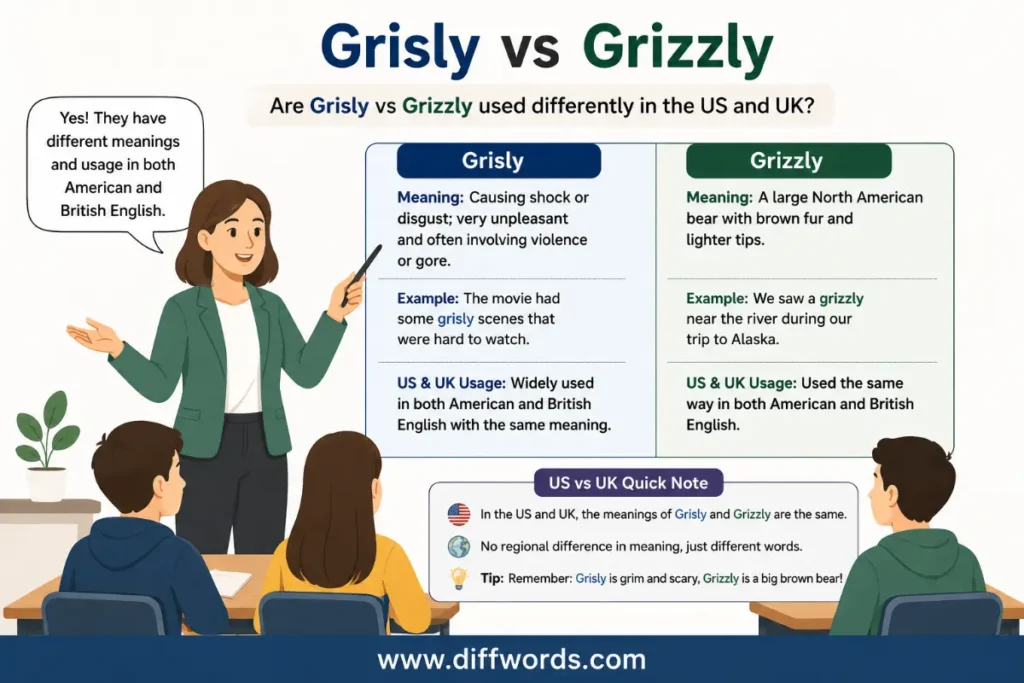
Is grisly used differently in the US and UK?
The meaning of grisly is generally the same in American and British English.
It means horrifying, gruesome, or disturbing.
The spelling doesn’t normally change between US and UK English.
For example:
a grisly discovery
works in both varieties.
Is grizzly used differently in the US and UK?
The word grizzly is widely recognized in both American and British English.
However, the animal is especially associated with North America, particularly western parts of the United States and Canada.
In British English, you may encounter grizzly bear in wildlife writing, documentaries, and discussions of North American animals.
The spelling remains grizzly.
What are the common mistakes with grisly vs grizzly?
Mistake 1: Writing “grisly bear”
If you’re talking about the animal, this is usually a spelling mistake.
Incorrect:
We saw a grisly bear.
Correct:
We saw a grizzly bear.
Mistake 2: Writing “grizzly scene”
If you mean a horrifying scene, use grisly.
Incorrect:
The reporter described a grizzly scene.
Correct:
The reporter described a grisly scene.
Mistake 3: Assuming the words are interchangeable
They’re not.
Grisly describes something horrifying.
Grizzly usually names or describes the bear.
Mistake 4: Using grisly when you mean grayish
If you’re describing a gray or streaked appearance, grizzly may be the intended word.
For example:
He had a grizzly beard.
Although grizzled is often more natural for gray hair.
Mistake 5: Choosing the spelling based on pronunciation
The words can sound very similar, so pronunciation isn’t always enough.
Look at the meaning instead.
What are the antonyms of grisly?
Possible opposites include:
- pleasant
- peaceful
- comforting
- beautiful
- cheerful
- lovely
- harmless
- reassuring
The best antonym depends on the sentence.
For example:
a grisly scene ↔ a peaceful scene
a grisly story ↔ a pleasant story
There isn’t one perfect antonym for every use.
Does grizzly have an antonym?
Not really.
When grizzly means a bear, it is a specific animal name, so it doesn’t have a normal antonym.
When grizzly means grayish or streaked with gray, a contrasting description might be:
- colorful
- bright
- dark
- brown
- golden
But these aren’t strict dictionary antonyms.
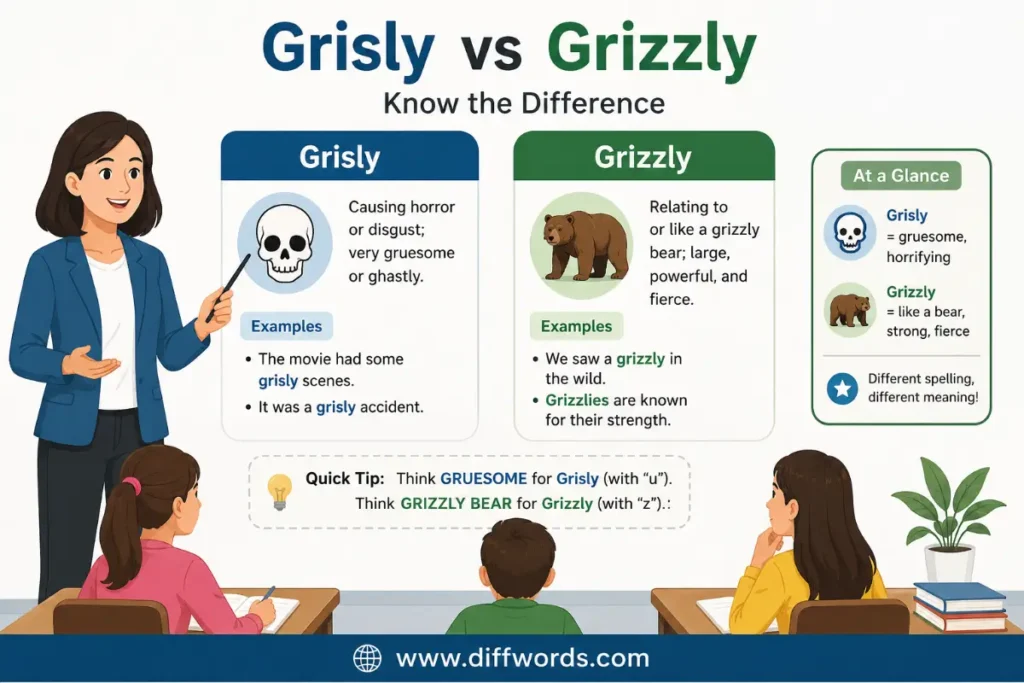
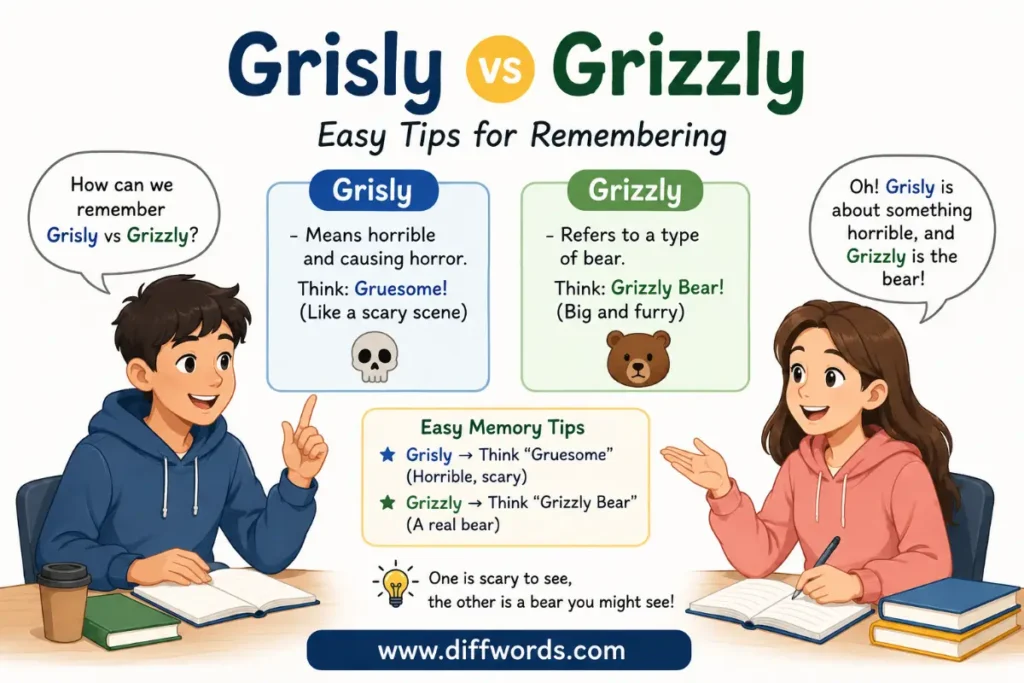
What is the easiest memory trick for grisly vs grizzly?
Try this:
GRIZZLY has a Z because it has a bear.
Or connect the spelling with:
grizzly → grizzly bear
Then remember:
grisly → gruesome
Both words begin with gri, but the extra z in grizzly can remind you of the bear.
Another quick trick:
Grisly = gruesome.
Grizzly = bear.
That’s usually enough to get the spelling right.
Which word is correct: grisly vs grizzly?
Neither word is always “correct.” The correct choice depends on what you’re trying to say.
Use grisly when you mean:
- horrifying
- gruesome
- disturbing
- shocking
- unpleasant
Use grizzly when you mean:
- a grizzly bear
- something grayish or streaked with gray
For example:
The documentary showed a grisly scene.
But:
The documentary showed a grizzly bear.
Changing one letter completely changes the meaning.
Quick comparison of grisly vs grizzly
| Feature | Grisly | Grizzly |
|---|---|---|
| Main meaning | Horrifying or disturbing | A North American bear |
| Part of speech | Adjective | Noun and adjective |
| Common phrase | grisly scene | grizzly bear |
| Related idea | Horror | Wildlife |
| Common synonym | gruesome | grizzly bear |
| Example | It was a grisly discovery. | We saw a grizzly. |
| Extra meaning | Disturbing | Grayish or streaked with gray |
| Common in everyday English? | Yes | Yes |
Quick tips for choosing the right word:Grisly vs Grizzly
- Use grisly for something horrifying or disturbing.
- Use grizzly for the bear.
- Remember grisly = gruesome.
- Remember grizzly = grizzly bear.
- If you’re talking about wildlife, check for the z.
- If you’re describing a disturbing scene, use grisly.
- Grizzly can be a noun: “We saw a grizzly.”
- Grizzly can also be an adjective: “a grizzly bear.”
- Grisly is an adjective: “a grisly scene.”
- Don’t choose based only on pronunciation.
- Look at the meaning before choosing the spelling.
- If you’re describing gray hair or a grayish appearance, consider grizzled as well.
Conclusion
The difference between grisly vs grizzly comes down to meaning, not just spelling. Grisly describes something horrifying, gruesome, or deeply disturbing. It’s commonly used with words such as scene, discovery, story, and details. Grizzly, on the other hand, usually refers to the North American bear and can also describe a grayish or streaked appearance.
The quickest memory trick is simple: grisly = gruesome; grizzly = bear. If you’re writing about a disturbing event, choose grisly. If you’re writing about wildlife, choose grizzly. Once you connect each spelling with its meaning, this pair becomes much easier to remember and use correctly.
Frequently Asked Questions
What is the difference between grisly vs grizzly?
Grisly means horrifying or gruesome, while grizzly usually refers to a large North American bear. The two words look and sound similar but have different meanings.
Is it a grisly bear or a grizzly bear?
The correct phrase is “grizzly bear.” Grizzly is the name used for the animal, while grisly means horrifying or disturbing.
Does grisly mean scary?
Grisly can mean horrifying, gruesome, or disturbing. It usually describes something especially unpleasant, often involving death or violence.
What’s another way to say grisly?
Gruesome, horrifying, disturbing, ghastly, and horrific are common alternatives. The best choice depends on how strong you want the description to sound.
Why is a grizzly bear called a grizzly?
The name is connected with the bear’s grayish or silver-tipped fur. The word is related to the idea of a grizzled or gray appearance.
Is grisly vs grizzly a spelling difference or a meaning difference?
It’s both a spelling and meaning difference. Grisly means horrifying or disturbing, while grizzly most commonly refers to the bear.
Can grizzly describe something other than a bear?
Yes, grizzly can also describe something grayish or streaked with gray. This use is less common than the animal-related meaning.
1 thought on “Grisly vs Grizzly: The Ultimate Simple Guide”