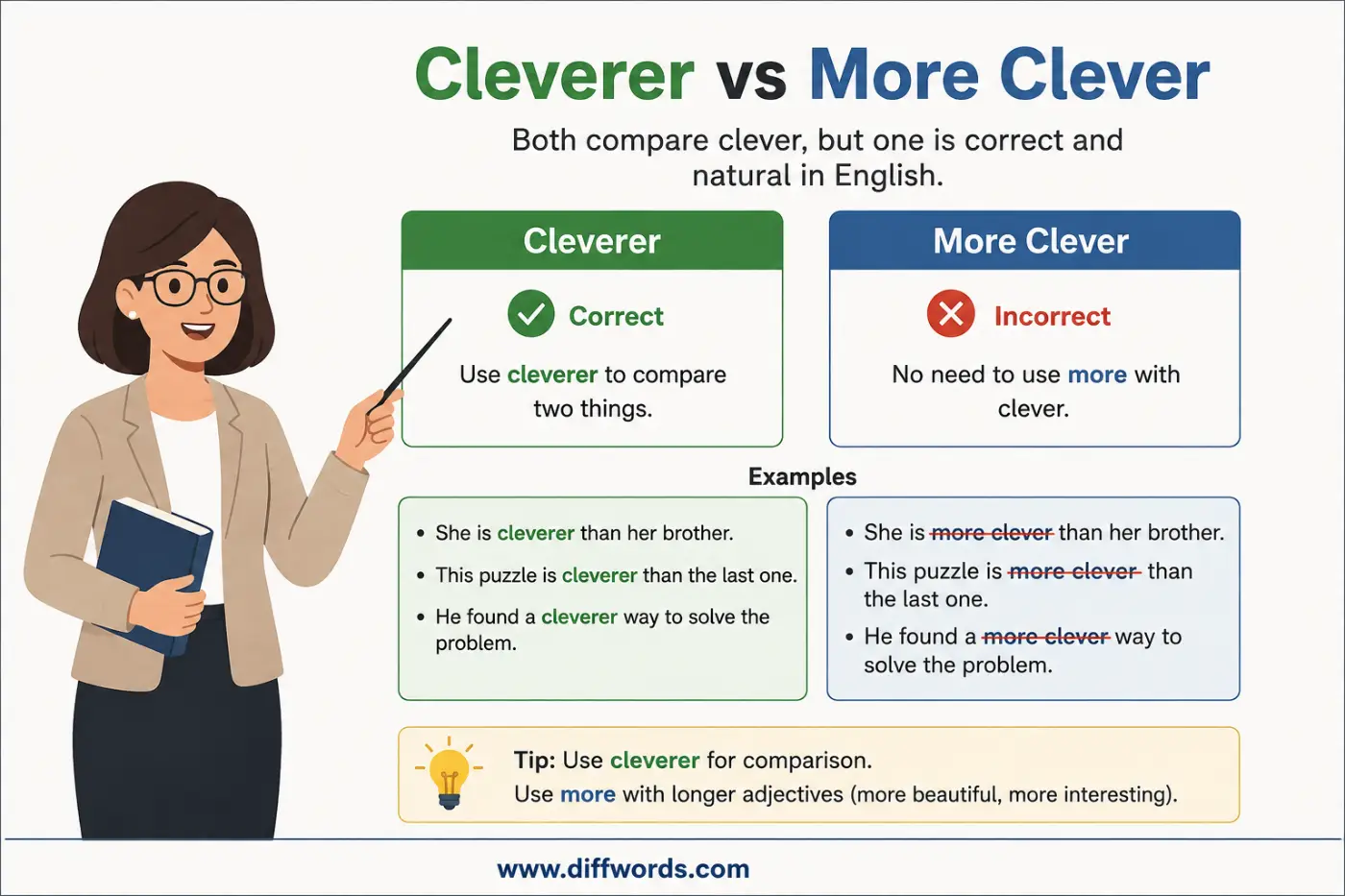
When you’re writing an email, essay, resume, or text, you may pause over cleverer vs more clever. Both forms can sound natural, but you may wonder whether one is grammatically better. The answer isn’t as complicated as it first seems.
Both “cleverer” vs “more clever” are grammatically correct ways to form the comparative of “clever.” “Cleverer” is the traditional one-word comparative, while “more clever” is also widely used, especially when speakers want a clearer or more natural-sounding phrase.
The adjective clever has more than one shade of meaning. It can describe someone who is intelligent, quick to understand things, skillful, or good at finding practical solutions. Because of this, the best comparative form can depend on the sentence and the style you’re using.
This guide explains the grammar, word history, pronunciation, US and UK usage, synonyms, examples, common mistakes, and the best choice for different types of writing. You’ll also learn how cleverer compares with words such as smarter, wiser, and shrewder.
Which is correct: orientated or oriented? Explore their meanings, usage, and differences in American English.
What is the difference between cleverer vs more clever?
The short answer is that both forms are correct.
Cleverer is the comparative form made by adding -er to clever:
Mia is cleverer than Tom.
More clever uses the word more before the adjective:
Mia is more clever than Tom.
Both sentences compare Mia’s cleverness with Tom’s.
| Form | Correct? | Example |
|---|---|---|
| cleverer | Yes | She is cleverer than her brother. |
| more clever | Yes | She is more clever than her brother. |
| most clever | Yes, but less common | She was the most clever student in the group. |
| cleverest | Yes | She was the cleverest student in the group. |
There isn’t a strict grammar rule saying that clever must always take -er or must always use more.
In everyday American English, cleverer is perfectly grammatical, but more clever can sound more natural to some speakers. In British English, cleverer is especially common.
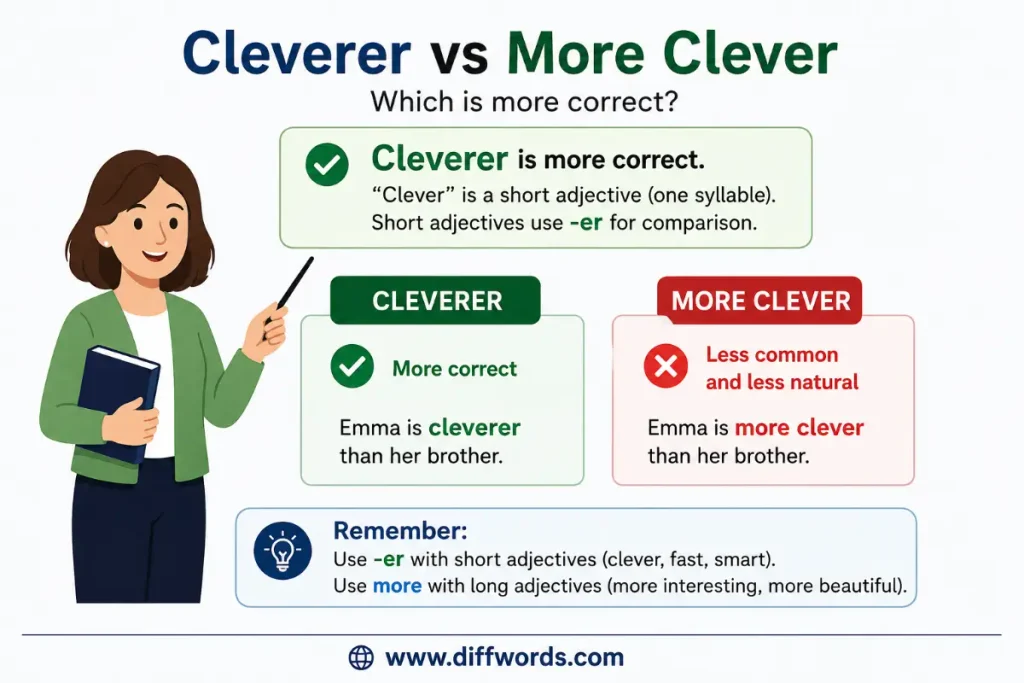
Is cleverer vs more clever more correct?
Neither is automatically more correct.
The choice depends on style, rhythm, regional preference, and the sentence.
For example:
That was a cleverer solution.
sounds natural and concise.
So does:
That was a more clever solution.
However, many speakers would prefer the first sentence because cleverer follows the common comparative pattern used with short adjectives.
There are also situations where more clever sounds better because the phrase is long or because the speaker wants to emphasize the comparison.
For example:
The new strategy was more clever than the original one.
This sounds completely natural.
A useful rule is:
Use “cleverer” when you want the standard short comparative. Use “more clever” when it sounds smoother in the sentence.
What does clever mean in plain English?
Clever usually means intelligent, quick-thinking, or good at solving problems.
For example:
She’s a clever student.
This could mean she learns quickly and understands things well.
But clever can also mean skillful or inventive:
That was a clever way to fix the problem.
Here, the person doesn’t necessarily need to be highly intelligent in every area. The solution itself was smart and effective.
The word can also have a slightly negative meaning:
He’s too clever for his own good.
In this expression, clever can suggest someone is trying to be too smart or is using intelligence in a way that causes problems.
What does cleverer mean?
Cleverer is the comparative form of clever.
It means:
- more intelligent
- more skillful
- better at solving problems
- more inventive
- quicker to understand something
For example:
Emma is cleverer than I expected.
This means Emma showed more intelligence or skill than the speaker expected.
Another example:
We need a cleverer solution.
This means we need a solution that is more intelligent, creative, or effective.
The exact meaning depends on context.
What does more clever mean?
More clever has essentially the same meaning as cleverer.
For example:
We need a more clever solution.
This can mean a solution that is more intelligent, creative, efficient, or skillful.
The difference is mainly grammatical form and style, not meaning.
Compare:
He found a cleverer way to solve the puzzle.
He found a more clever way to solve the puzzle.
Both mean that his solution was cleverer than another possible solution.
Why can clever take either -er or more?
English has flexible rules for forming comparative adjectives.
With many short adjectives, we normally add -er:
- fast → faster
- small → smaller
- smart → smarter
- kind → kinder
- bright → brighter
With longer adjectives, we generally use more:
- beautiful → more beautiful
- interesting → more interesting
- difficult → more difficult
- expensive → more expensive
Clever sits in a flexible area because it is a short, two-syllable adjective that can naturally work with either construction.
That’s why both forms appear in real English.
Where does the word clever come from?
The history of clever is interesting because its meaning has changed over time.
The word appeared in English centuries ago. Its earlier uses were connected with ideas such as being skillful, handy, or capable.
Over time, its meaning expanded to include intelligence and quick thinking.
Today, clever can describe:
- a person
- an idea
- a solution
- a joke
- a design
- a trick
- an argument
For example:
She’s clever.
describes a person.
But:
That’s a clever idea.
describes an idea.
This broad meaning helps explain why the comparative can be used in many different situations.
How do you form the comparative of clever?
There are two standard patterns:
Add -er
clever → cleverer
Example:
This student is cleverer than the others.
Use more
clever → more clever
Example:
This is a more clever approach.
Both forms work.
The same basic choice appears with several other two-syllable adjectives, although usage differs from word to word.
Examples include:
- narrow → narrower
- quiet → quieter
- simple → simpler
- polite → politer / more polite
- common → commoner / more common
English doesn’t always offer one rule that covers every two-syllable adjective perfectly.
What is the superlative of clever?
The two common superlative forms are:
- cleverest
- most clever
For example:
She is the cleverest student in the class.
Or:
She is the most clever student in the class.
Both can be grammatical.
However, cleverest is the more direct one-word form.
In American English, most clever may sometimes sound more natural depending on the sentence.
For example:
That was the most clever solution we found.
This sounds perfectly acceptable.
What are the main synonyms for clever?
The best synonym depends on what kind of cleverness you mean.
| Group | Word | Meaning | Tone | Example |
|---|---|---|---|---|
| Simple | smart | Intelligent or sensible | Everyday | She’s a smart student. |
| Simple | bright | Quick to learn | Friendly | He’s a bright child. |
| Simple | sharp | Quick to understand | Informal | She’s very sharp. |
| Simple | wise | Shows good judgment | Neutral | He made a wise choice. |
| Simple | skillful | Good at doing something | Neutral | She’s a skillful designer. |
| Simple | able | Capable of doing something well | Neutral | He’s an able worker. |
| Everyday | quick-witted | Fast at thinking or responding | Everyday | She’s quick-witted and funny. |
| Everyday | inventive | Good at creating new ideas | Neutral | He has an inventive approach. |
| Everyday | creative | Good at producing new ideas | Everyday | That’s a creative solution. |
| Everyday | resourceful | Good at solving problems with what is available | Positive | She’s very resourceful. |
| Everyday | astute | Good at understanding situations | Formal | He made an astute observation. |
| Everyday | shrewd | Good at judging people or situations | Neutral/Formal | She made a shrewd business decision. |
| Formal | intelligent | Having strong mental ability | Formal | He is highly intelligent. |
| Formal | perceptive | Good at noticing and understanding things | Formal | She’s very perceptive. |
| Formal | insightful | Showing deep understanding | Formal | The report was insightful. |
| Formal | ingenious | Exceptionally inventive | Strong/Formal | It was an ingenious solution. |
| Formal | brilliant | Extremely intelligent or impressive | Strong | He developed a brilliant strategy. |
| Formal | sagacious | Showing excellent judgment | Formal | The leader was sagacious. |
| Formal | cunning | Clever in a strategic way | Neutral/Negative | The fox was cunning. |
| Formal | strategic | Carefully planned to reach a goal | Formal | She took a strategic approach. |
| Slang/Informal | brainy | Very intelligent | Informal | He’s a brainy kid. |
| Slang/Informal | sharp-minded | Mentally quick | Informal | She’s sharp-minded. |
| Slang/Informal | switched-on | Alert and intelligent | Informal | He’s a switched-on employee. |
| Slang/Informal | smart | Intelligent or capable | Informal | That’s a smart move. |
| Slang/Informal | savvy | Practical and knowledgeable | Informal | She’s tech-savvy. |
| Slang/Informal | street-smart | Good at handling real-world situations | Informal | He’s street-smart and practical. |
Not all of these words mean exactly the same thing.
For example, wise is about judgment, while clever can be about quick thinking. Cunning can suggest intelligence used to deceive someone. Creative focuses on producing original ideas.
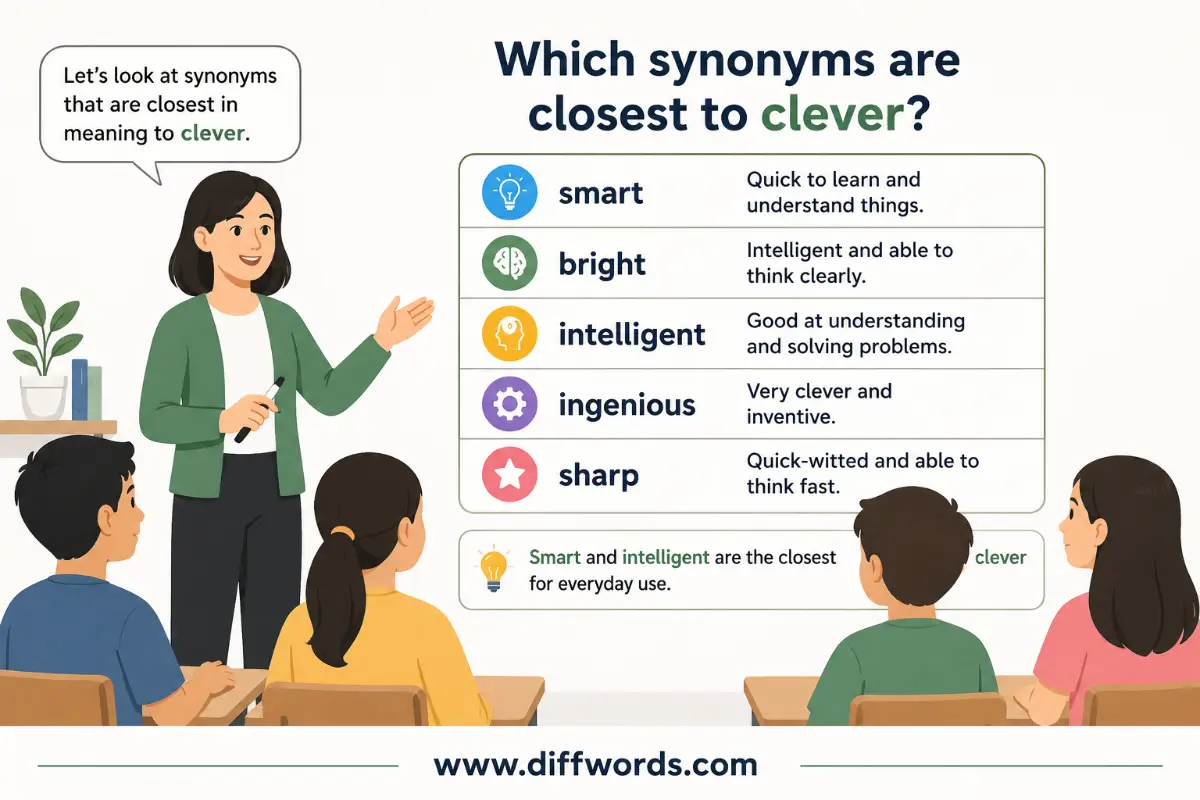
Which synonyms are closest to clever?
The closest everyday alternatives are:
- smart
- bright
- sharp
- intelligent
- quick-witted
- inventive
- resourceful
- skillful
But each word adds a slightly different meaning.
Clever vs smart
Smart is broader and more common in American English.
She’s smart.
This usually means she’s intelligent.
She’s clever.
This can mean she’s intelligent, but it may also suggest creativity or skill in solving a particular problem.
Clever vs intelligent
Intelligent is more direct and formal.
He is intelligent.
This describes mental ability.
He is clever.
This can describe mental ability, but it may also suggest practical skill or inventive thinking.
Clever vs wise
Wise is about good judgment and experience.
She made a wise decision.
This doesn’t necessarily mean she is academically intelligent.
Clever vs ingenious
Ingenious describes something especially creative or skillful.
It was an ingenious solution.
This is often stronger than clever.
What are clever synonyms from mild to strong?
There isn’t a perfect scale because different words emphasize different kinds of ability. But you can think of them roughly like this.
Mild
- capable
- bright
- smart
- skillful
These are generally positive but not extremely strong.
Moderate
- clever
- sharp
- perceptive
- resourceful
- inventive
- astute
These suggest noticeable ability.
Strong
- brilliant
- ingenious
- exceptionally intelligent
- highly perceptive
- exceptionally resourceful
These suggest unusually high ability.
Potentially negative
Some words can describe cleverness with a negative or suspicious tone:
- cunning
- crafty
- sly
- calculating
- manipulative
For example:
He found a clever solution.
is positive.
But:
He found a cunning way to avoid the rules.
suggests strategy that may not be completely honest.
What part of speech is clever?
Clever is an adjective.
It describes a noun.
Examples:
- a clever student
- a clever idea
- a clever answer
- a clever solution
- a clever design
Its comparative forms are also adjectives:
- cleverer
- more clever
Its superlative forms are:
- cleverest
- most clever
You can also use cleverly, an adverb:
She cleverly solved the problem.
And cleverness, a noun:
His cleverness impressed the team.
What is the adverb form of clever?
The common adverb is cleverly.
Example:
She cleverly avoided the problem.
It means she did something in a clever or skillful way.
You wouldn’t normally use more cleverly to form the comparative of the adjective itself. But more cleverly can be used when comparing how actions were performed:
She solved the problem more cleverly than I did.
Here, cleverly is an adverb, and more cleverly is its comparative form.
What is the noun form of clever?
The noun is cleverness.
Example:
His cleverness helped the team solve the puzzle.
Cleverness refers to the quality of being clever.
Other related words include:
- intelligence
- skill
- creativity
- ingenuity
- wisdom
- sharpness
Again, these aren’t perfect synonyms because they emphasize different qualities.
Is cleverer more common in American or British English?
Both forms are understood in American and British English.
However, cleverer has a particularly natural place in British English.
American English often uses more clever, especially in some conversational or descriptive contexts, although cleverer is not wrong.
For example, an American speaker might naturally say:
That’s a more clever way to do it.
A British speaker may be more likely to say:
That’s a cleverer way to do it.
This isn’t a strict regional rule. Individual speakers have their own preferences.
Is cleverer correct in American English?
Yes.
Cleverer is grammatically correct in American English.
For example:
She’s cleverer than her brother.
There is nothing grammatically wrong with that sentence.
However, some American speakers may prefer:
She’s more clever than her brother.
If you’re writing for an American audience, either can work. Choose the form that sounds most natural in your sentence.
Is more clever correct in British English?
Yes.
More clever is also grammatically correct in British English.
For example:
That was a more clever solution.
A British writer might choose cleverer instead, but more clever isn’t automatically wrong.
This is important because comparative forms can vary by speaker and context.
Which form sounds more natural?
There is no universal answer.
Consider these examples:
He became cleverer with experience.
He became more clever with experience.
Both work.
But some people find cleverer slightly awkward to pronounce, especially when the next word begins with a similar sound.
In those situations, more clever may flow better.
For example:
We need a more clever explanation.
Some speakers may prefer this because it feels easier to say than:
We need a cleverer explanation.
Neither is grammatically broken.
Which word should you use in a resume:Cleverer vs More Clever
For a resume, the answer depends on the message.
If you’re describing intelligence, clever itself may not be the best professional word.
Instead, consider:
- analytical
- resourceful
- strategic
- innovative
- perceptive
- problem-solving
- intelligent
- creative
For example, instead of:
I am cleverer than other applicants.
write:
I use creative and analytical thinking to solve problems.
That’s more professional because it gives evidence of ability rather than simply making a comparison.
If you are comparing two solutions in a technical resume:
Developed a more clever approach to reduce processing time.
Even here, more efficient or more effective may communicate the result better.
Which word should you use in an essay:Cleverer vs More Clever
Both cleverer and more clever can work in an essay.
However, academic writing often benefits from greater precision.
Instead of:
The second argument is cleverer.
you might write:
The second argument is more convincing.
Or:
The second argument is more effective.
If you specifically mean intellectual creativity, cleverer can work:
The author develops a cleverer solution to the problem.
Choose the word that explains exactly what is better.
Which form works best in texting:Cleverer vs More Clever
In casual texting, either form is fine.
For example:
You’re cleverer than me 😂
or:
You’re more clever than me 😂
Both can sound natural.
In American casual speech, you might also simply say:
You’re smarter than me.
If you’re talking about a trick or idea:
That’s a cleverer way to do it.
or:
That’s a more clever way to do it.
The choice often comes down to personal preference.
Which form works best in email?
In professional email, both forms are grammatical, but the simplest alternative may be better.
Instead of:
We need a cleverer approach.
you could write:
We need a smarter approach.
Or:
We need a more effective approach.
If the idea specifically involves creativity or ingenuity, cleverer can be useful:
I think we can find a cleverer way to handle this issue.
More clever is also acceptable:
I think we can find a more clever way to handle this issue.
Which form works best in speaking?
Speech often favors more clever when the speaker wants an easy, natural rhythm.
But cleverer is also common, particularly among speakers who naturally use short comparative forms.
For example:
She’s cleverer than I am.
and:
She’s more clever than I am.
Both can sound natural.
If one feels awkward when you say it aloud, use the other.
Natural speech matters.
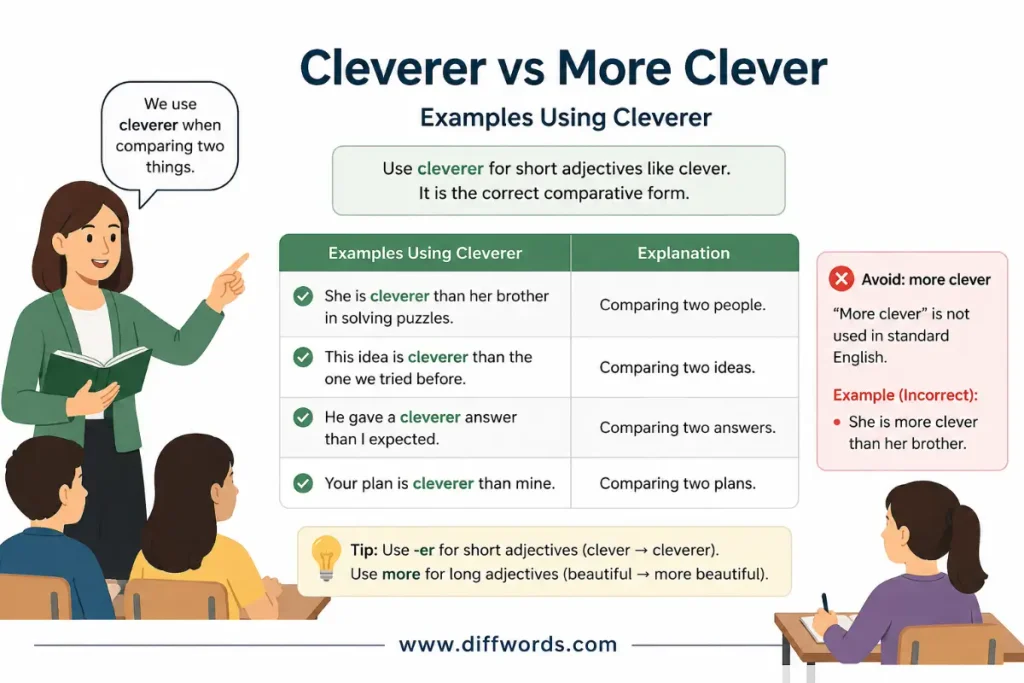
What are 15 original examples using cleverer?
- Maria is cleverer than she first appeared.
- We need a cleverer way to solve this problem.
- The new design is cleverer than the old one.
- He found a cleverer solution after studying the instructions.
- My brother is cleverer at puzzles than I am.
- That was a cleverer response than I expected.
- The second plan is cleverer because it uses fewer resources.
- She came up with a cleverer way to organize the files.
- The detective found a cleverer method of checking the evidence.
- We need a cleverer strategy before the competition begins.
- His latest invention is even cleverer than his previous one.
- The children found a cleverer way to complete the game.
- The revised argument is cleverer and easier to follow.
- The engineer designed a cleverer system for handling the data.
- The teacher suggested a cleverer approach to the experiment.
What are 15 original examples using more clever?
- We need a more clever solution to the problem.
- She came up with a more clever plan.
- The new system uses a more clever method of sorting information.
- He found a more clever way to explain the idea.
- This design is more clever than the original.
- The team developed a more clever strategy for the final round.
- I think there’s a more clever way to organize the schedule.
- The second proposal is more clever and more practical.
- She suggested a more clever response to the customer’s concern.
- The software uses a more clever approach to detect errors.
- We need something more clever than a simple replacement.
- His answer was more clever than mine.
- The new method is more clever but also harder to understand.
- They designed a more clever system for managing traffic.
- The author created a more clever ending for the story.
Which is better: cleverer or smarter?
Smarter is usually broader and more common in American English.
She’s smarter than her brother.
This normally means she has greater intelligence.
Cleverer can suggest a more specific kind of intelligence, especially quick thinking, creativity, or skill.
She’s cleverer at solving puzzles.
This focuses on her ability to find solutions.
So:
| Cleverer | Smarter |
|---|---|
| Often suggests ingenuity or quick thinking | Usually suggests general intelligence |
| Can describe an idea or solution easily | Usually describes a person or decision |
| Common in British English | Extremely common in US English |
| Can sometimes imply crafty behavior | Usually neutral or positive |
Which is better: cleverer or wiser?
These words describe different qualities.
Cleverer means more intelligent, inventive, or skillful.
Wiser means showing better judgment.
Compare:
He was cleverer and found the shortcut.
He solved the problem efficiently.
He was wiser and chose not to take the risk.
He made a better judgment.
Someone can be clever without being wise.
Which is better: cleverer or more intelligent?
More intelligent is more formal and precise when you mean mental ability.
The researcher is more intelligent than the average student.
Cleverer sounds less formal and may suggest practical or inventive thinking.
The researcher found a cleverer solution.
In academic or professional writing, more intelligent may be preferable when you’re making a serious claim about intelligence.
But don’t use it simply to sound formal. If you mean creative problem-solving, cleverer may be more accurate.
Which is better: cleverer or more inventive?
More inventive is more specific.
It focuses on the ability to create new ideas, methods, or solutions.
She is cleverer than her classmates.
means she may be more intelligent overall.
She is more inventive than her classmates.
means she is better at creating original ideas.
If creativity is the key point, more inventive is usually clearer.
Which is better: cleverer or more resourceful?
Resourceful describes someone who is good at solving problems with the materials, knowledge, or opportunities available.
For example:
She’s cleverer than her colleague.
This is a broad comparison.
She’s more resourceful than her colleague.
This specifically says she’s better at handling difficult situations.
Use resourceful when practical problem-solving is the main idea.
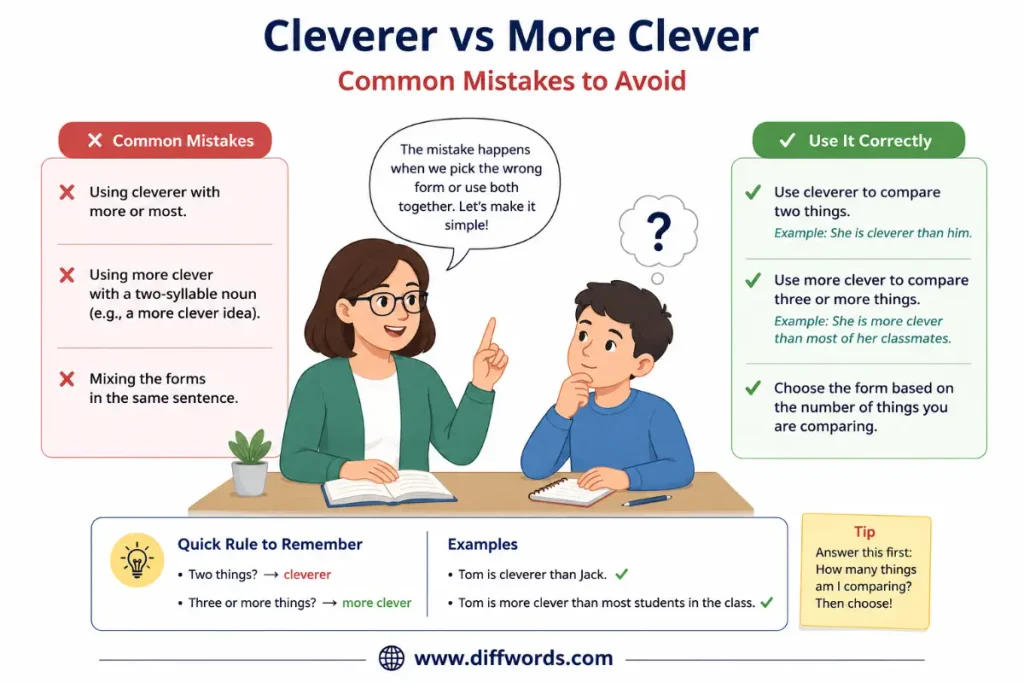
Common mistakes when using cleverer vs more clever
Mistake 1: Saying more cleverer
This is incorrect in standard English.
Don’t write:
He is more cleverer than me.
Choose one comparative structure:
He is cleverer than me.
or:
He is more clever than me.
Never combine more and -er for the same adjective.
Mistake 2: Saying most cleverest
The same rule applies to superlatives.
Don’t write:
She is the most cleverest student.
Use:
She is the cleverest student.
or:
She is the most clever student.
Mistake 3: Assuming more clever is wrong
It isn’t.
That is a more clever solution.
is grammatical.
Mistake 4: Assuming cleverer is wrong because it sounds unusual
It isn’t.
That is a cleverer solution.
is also grammatical.
Mistake 5: Using clever when you mean wise
Consider:
He was clever to avoid the argument.
This suggests skill or quick thinking.
If you mean he made a mature judgment:
He was wise to avoid the argument.
The second sentence focuses on judgment.
Mistake 6: Using clever when you mean intelligent
Clever and intelligent overlap, but they aren’t always interchangeable.
For a formal academic claim, intelligent may be more precise.
For a creative solution, clever may be better.
Mistake 7: Using clever when you mean effective
A solution can be clever without actually working well.
For example:
It was a clever idea, but it didn’t work.
If your main point is success, use:
- effective
- successful
- efficient
- practical
- useful
When should you NOT use cleverer?
Avoid cleverer if it doesn’t express the comparison you actually mean.
For example:
Our new software is cleverer.
This is vague.
What does cleverer mean here?
Does it mean:
- faster?
- more efficient?
- more accurate?
- easier to use?
- more creative?
- better at solving problems?
A more precise sentence would be:
Our new software is more efficient.
or:
Our new software solves problems more quickly.
Good writing isn’t just about grammar. It’s also about precision.
When should you NOT use more clever?
Avoid more clever if another adjective explains your meaning better.
For example:
This plan is more clever.
could be improved to:
This plan is more practical.
if practicality is the real advantage.
Or:
This plan is more efficient.
if it saves time or resources.
Or:
This plan is more creative.
if originality is what you mean.
Use more clever when cleverness itself is the quality you’re comparing.
What are the antonyms of clever?
Common opposites include:
- foolish
- unintelligent
- stupid
- dull
- slow
- unwise
- naive
- clueless
The best antonym depends on the meaning.
If clever means intelligent:
clever ↔ unintelligent
If it means wise or sensible:
clever ↔ foolish
Also if it means skillful:
clever ↔ clumsy
If it means inventive:
clever ↔ unimaginative
Because clever has several meanings, there isn’t one perfect opposite.
Is clever always a positive word?
No.
In many situations, clever is strongly positive:
That’s a clever idea.
But it can also be neutral or slightly negative.
For example:
Don’t get too clever.
This can mean someone is trying too hard to show intelligence.
Similarly:
He was being clever with the rules.
could suggest that he was finding a way around the rules.
Words such as cunning, crafty, and sly make this negative meaning clearer.
What does “too clever by half” mean?
Too clever by half is an expression meaning someone is trying to be smarter or more sophisticated than is useful.
For example:
His plan was too clever by half and ended up confusing everyone.
The phrase is especially associated with British English.
It suggests that excessive cleverness can create problems.
What does “clever move” mean?
A clever move is a smart or skillful action.
For example:
Signing that player was a clever move.
It means the decision was intelligent and likely to produce a good result.
You can use the phrase in:
- business
- sports
- games
- politics
- everyday decisions
What does “clever idea” mean?
A clever idea is an idea that shows intelligence, creativity, or practical skill.
For example:
Using recycled materials was a clever idea.
The phrase is usually positive.
However, depending on tone, clever idea can sometimes be sarcastic.
For example:
Well, that was a clever idea.
The speaker may actually mean the idea was foolish.
Tone and context matter.
What does “clever enough” mean?
Clever enough means sufficiently intelligent or skillful for a particular task.
For example:
She’s clever enough to solve the puzzle.
It doesn’t necessarily mean she’s exceptionally intelligent. It simply says her ability is sufficient.
You can also say:
He’s clever enough to know when to stop.
Here, clever enough suggests good judgment or awareness.
What does “clever with” mean?
Clever with can describe someone who is skilled at using something.
For example:
She’s clever with computers.
This means she is good at using computers.
You can also say:
He’s clever with his hands.
This means he is skillful at practical tasks.
In these cases, clever is closer to skillful than simply intelligent.
How should you choose between cleverer vs more clever?
Use these questions:
Are you writing American English?
Both are correct, but more clever may feel more natural to many American speakers.
Are you writing British English?
Cleverer is especially natural and common.
Does the sentence sound awkward with -er?
Try more clever.
Does the sentence sound wordy with more?
Try cleverer.
Are you writing formally?
Consider whether a more precise word such as intelligent, effective, inventive, or strategic would communicate the idea better.
Are you comparing people?
Either form can work:
She is cleverer than him.
She is more clever than him.
In formal writing, you may prefer:
She is cleverer than he is.
or:
She is more clever than he is.
Quick tips for choosing the right comparative
- Cleverer is correct.
- More clever is also correct.
- Don’t write more cleverer.
- Both forms mean essentially the same thing.
- Cleverer is especially common in British English.
- More clever is widely used in American English.
- Use cleverest or most clever, not most cleverest.
- Use smarter for broad everyday comparisons of intelligence.
- Use wiser when good judgment is the main idea.
- Use more inventive when creativity is the main idea.
- Use more resourceful when practical problem-solving is the main idea.
- Use more effective when you’re comparing results.
- Use more efficient when you’re comparing time, cost, or resources.
- Use more intelligent for a more formal comparison of mental ability.
- If a comparative sounds awkward, try the other form.
- Keep the meaning more important than the form.
- In a professional document, prefer precise language over vague praise.
- Always avoid more cleverer.
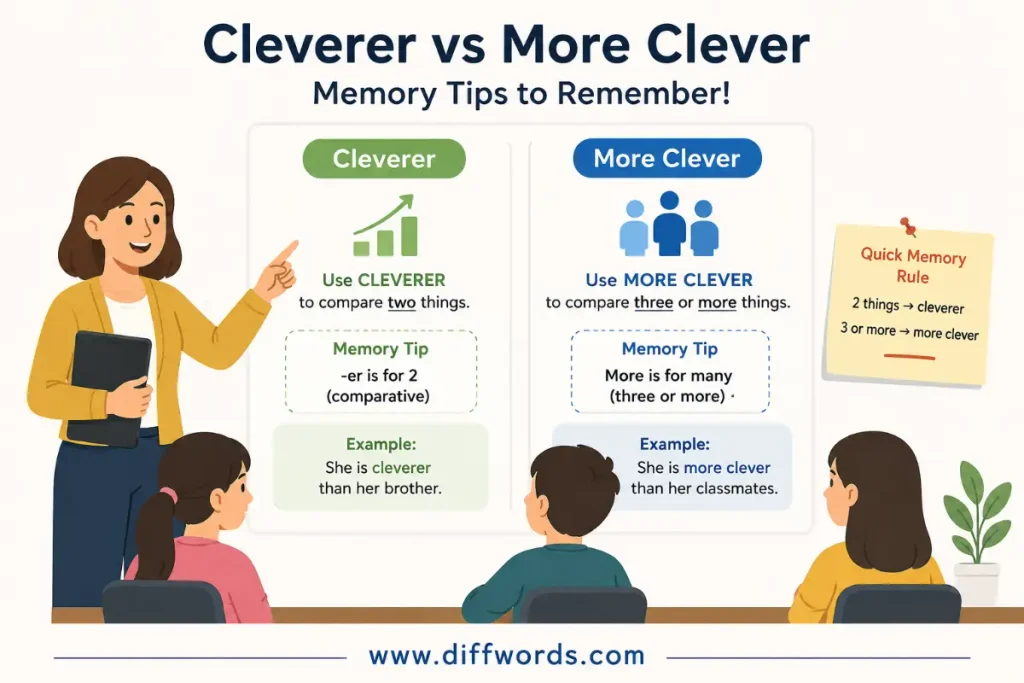
Conclusion
The choice between cleverer vs more clever is easier once you know that both forms are correct. Cleverer follows the traditional comparative pattern and is especially common in British English. More clever uses more and is also standard, with many American speakers finding it natural in everyday use.
The important thing is not to treat one form as a mistake. Instead, listen to how the sentence flows and consider your audience. If you’re writing for a US audience, either form can work. If you’re writing British English, cleverer may sound especially natural.
Also remember that clever can mean more than simply intelligent. It can describe creativity, practical skill, quick thinking, or even crafty behavior. When precision matters, words such as smarter, wiser, inventive, or resourceful may communicate your exact meaning better.
Frequently Asked Questions
Is cleverer vs more clever correct?
Both cleverer and more clever are correct comparative forms of clever. The choice often depends on regional preference, sentence rhythm, and personal style.
Is cleverer more British than American?
Cleverer is particularly common in British English, but it is also correct in American English. American speakers may often choose more clever instead.
Is more clever grammatically correct?
Yes, more clever is grammatically correct. It can be used wherever the comparative meaning of clever is needed.
What’s another way to say cleverer?
Smarter, more intelligent, more inventive, sharper, more resourceful, and more skillful can work depending on the exact meaning. Smarter is especially common in everyday American English.
Can I say “more cleverer”?
No, standard English does not use more and -er together for the same comparative. Say either cleverer or more clever.
Is cleverest or most clever correct?
Both forms can be correct. Cleverest uses the -est form, while most clever uses the superlative with most.
Which sounds better, cleverer vs more clever?
Neither is always better. Cleverer is concise and traditional, while more clever can sound smoother to many speakers, especially in American English.
1 thought on “Cleverer vs More Clever: The Best Simple Guide”