
If you’re writing an email, essay, resume, or text and stop to wonder about orientated vs oriented, you’re dealing with two forms that can both be correct. The tricky part is that their use depends on region, style, and the meaning you want to express.
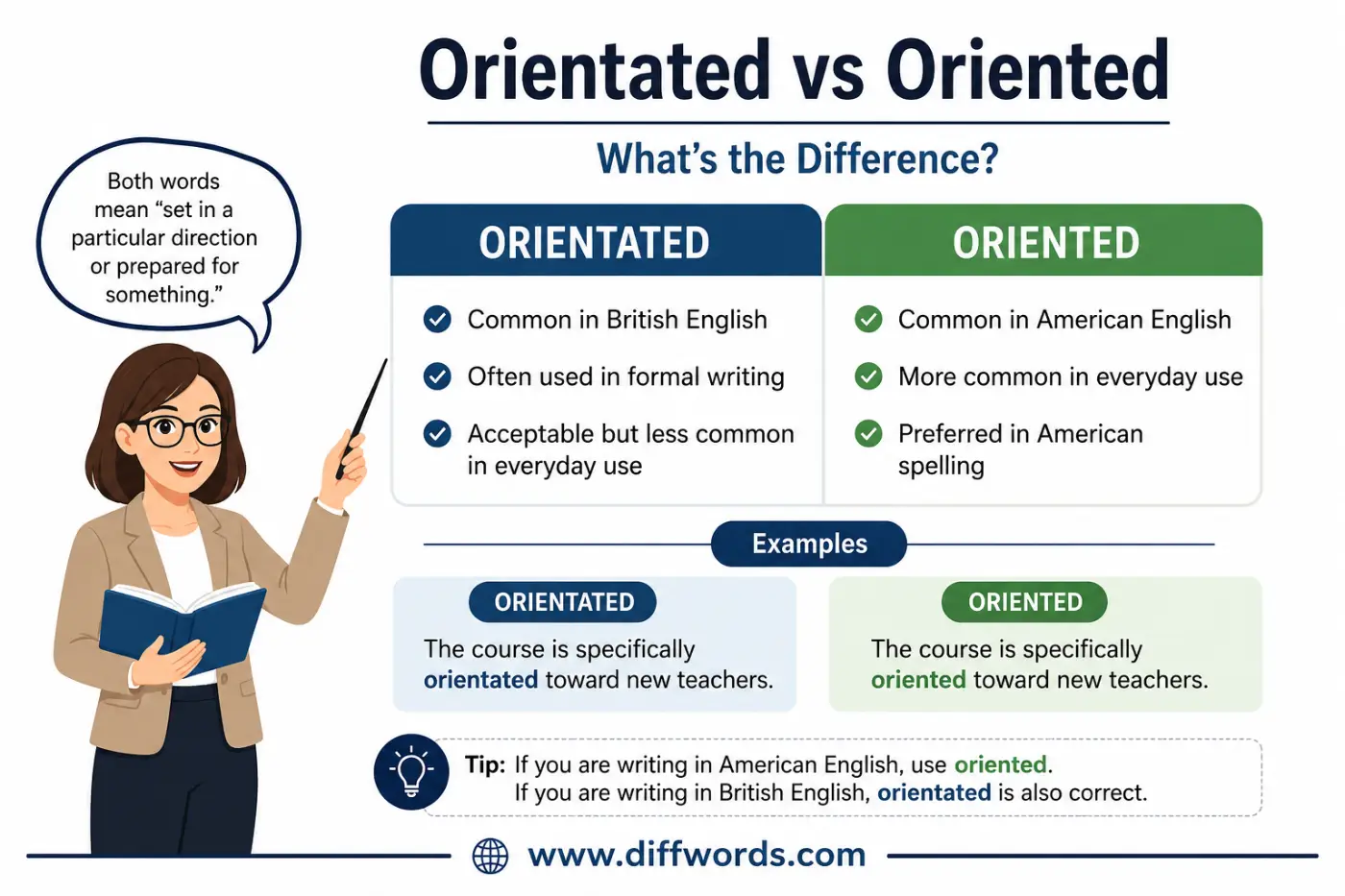
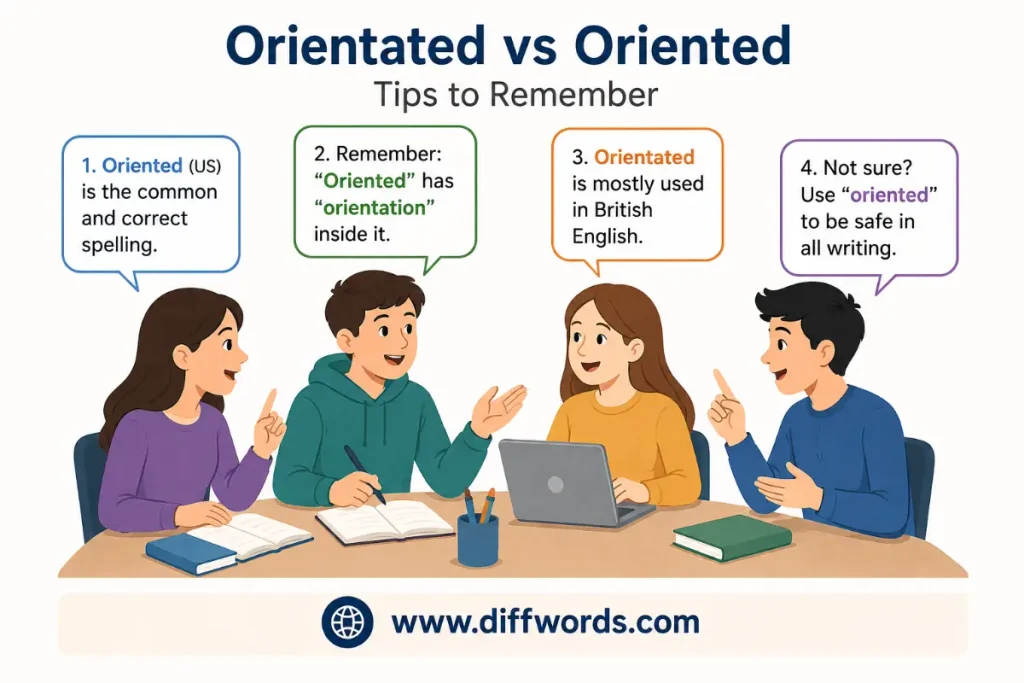
Oriented and orientated can both mean directed toward, focused on, or adjusted to something. “Oriented” is the standard and much more common choice in American English, while “orientated” is especially common in British English.
So, if you’re writing for a US audience, oriented is usually the safest choice. If you’re writing in British English, orientated is also accepted and widely used.
This guide explains the difference, word origins, synonyms, regional usage, common phrases, grammar, and examples. You’ll also see which form works best in resumes, essays, emails, texts, and everyday speech.
Is it grisly vs grizzly? Learn the difference between something horrifying and the animal’s name.
What is the difference between orientated vs oriented?
The main difference is usage and regional preference, not a major difference in meaning.
Both words can mean:
- directed toward something
- focused on something
- designed for a particular purpose
- interested in a particular goal
- adjusted to a situation or environment
The important distinction is frequency.
| Word | Meaning | Common usage |
|---|---|---|
| Oriented | Directed, focused, or adjusted toward something | Very common in US English; also common in UK English |
| Orientated | Same basic meaning as oriented | More common in British English and some other varieties |
For example:
The course is oriented toward practical skills.
This is standard in American English.
You may also see:
The course is orientated toward practical skills.
This is acceptable, especially in British English, although many US readers would prefer oriented.
Is oriented vs orientated correct?
Both can be correct. The choice usually depends on the variety of English you’re using.
For American English, oriented is the normal choice.
For British English, orientated is common and accepted, although oriented is also used.
So the question isn’t really about one word being correct and the other being wrong. It’s more about which form sounds natural to your audience.
What does oriented mean in plain English?
Oriented generally means directed toward, focused on, or designed around something.
For example:
The program is customer-oriented.
This means the program is designed around customers and their needs.
Another example:
She is career-oriented.
This means she is strongly focused on her career.
It can also mean physically positioned in a particular direction:
The building is oriented toward the river.
Here, the building’s position or direction is the focus.
There is another common meaning related to becoming familiar with a place or situation:
The new students were oriented to the campus.
This means they were helped to understand how the campus works and where things are.
What does orientated mean in plain English?
Orientated generally has the same meaning as oriented.
For example:
The training is orientated toward practical work.
This means the training is focused on practical work.
You might also see:
The company is customer-orientated.
That means the company focuses on customers.
The main difference is that orientated is less common in American English and more strongly associated with British English and some other varieties.
If you’re writing for a broad international audience, oriented is often the simpler choice because it is widely recognized.
Where did oriented come from?
The word oriented comes from the verb orient, which ultimately traces back to Latin oriens, meaning “rising” or “east.”
The connection comes from the sun rising in the east. Historically, orient became associated with finding or establishing one’s direction.
In English, the verb orient developed meanings related to:
- determining direction
- positioning something
- becoming familiar with a situation
- directing attention toward something
From orient, we get oriented.
For example:
She oriented herself using the map.
This means she figured out where she was and which direction she needed to go.
Over time, the word developed broader figurative meanings:
The course is oriented toward technology.
Now the word doesn’t necessarily involve physical direction. It means the course is focused on technology.
Where did orientated come from?
Orientated is formed by adding the -ate ending to orient before forming the past participle.
English has several verbs that can appear in related forms, and orientate developed as a variant of orient.
The form became particularly established in British English and related varieties.
This means orientated isn’t simply a misspelling of oriented.
It is a genuine word.
For example:
The organization is orientated toward community service.
That sentence is grammatically acceptable.
However, American English strongly favors:
The organization is oriented toward community service.
So if your target readers are in the United States, oriented is usually the better option.
Why are orientated vs oriented so easy to confuse?
The confusion comes from the fact that both forms are built from the same base word:
- orient
- oriented
- orientated
The extra -at- in orientated makes the word look longer, but it doesn’t create a completely different meaning.
Similar differences occur with other verbs and regional preferences in English.
Another reason for confusion is that people sometimes assume one form must be a mistake. That’s not the case here.
Both forms have legitimate usage.
The real question is:
Which form sounds natural and appropriate for my audience?
For US readers, the answer is usually oriented.
For UK readers, orientated can be perfectly natural.
What are the main synonyms for:
orientated?
Because these words have several meanings, the best synonym depends on context.
| Group | Word | Meaning | Tone | Example |
|---|---|---|---|---|
| Simple | directed | Pointed toward something | Simple | The program is directed toward beginners. |
| Simple | aimed | Designed for a goal or group | Simple | The lesson is aimed at children. |
| Simple | centered | Mainly concerned with something | Simple | The discussion is centered on safety. |
| Simple | prepared | Made ready for something | Simple | The students were prepared for the test. |
| Everyday | targeted | Designed for a particular group | Everyday | The campaign is targeted at young adults. |
| Everyday | directed | Focused toward a particular goal | Everyday | The project is directed toward research. |
| Everyday | aligned | Made consistent with a goal | Everyday | Our plans are aligned with company goals. |
| Everyday | attuned | Aware of or responsive to something | Everyday | The team is attuned to customer needs. |
| Everyday | adjusted | Changed to fit circumstances | Everyday | The settings were adjusted for users. |
| Formal | positioned | Placed or presented in a particular way | Formal | The brand is positioned as premium. |
| Formal | structured | Organized around a purpose | Formal | The course is structured around research. |
| Formal | dedicated | Strongly committed to something | Formal | She is dedicated to public service. |
| Formal | specialized | Designed for a particular field | Formal | The service is specialized for businesses. |
| Formal | strategic | Planned around a specific goal | Formal | The company took a strategic approach. |
| Slang/Informal | tuned in | Very aware or attentive | Informal | She’s tuned in to what customers want. |
| Slang/Informal | geared up | Ready or prepared | Informal | The team is geared up for the event. |
| Slang/Informal | locked in | Extremely focused | Informal | The players were locked in for the final. |
These aren’t all exact replacements in every sentence. For example, positioned works well when talking about a brand, while focused is usually better when talking about a person’s attention.
Which synonyms are best for different meanings?
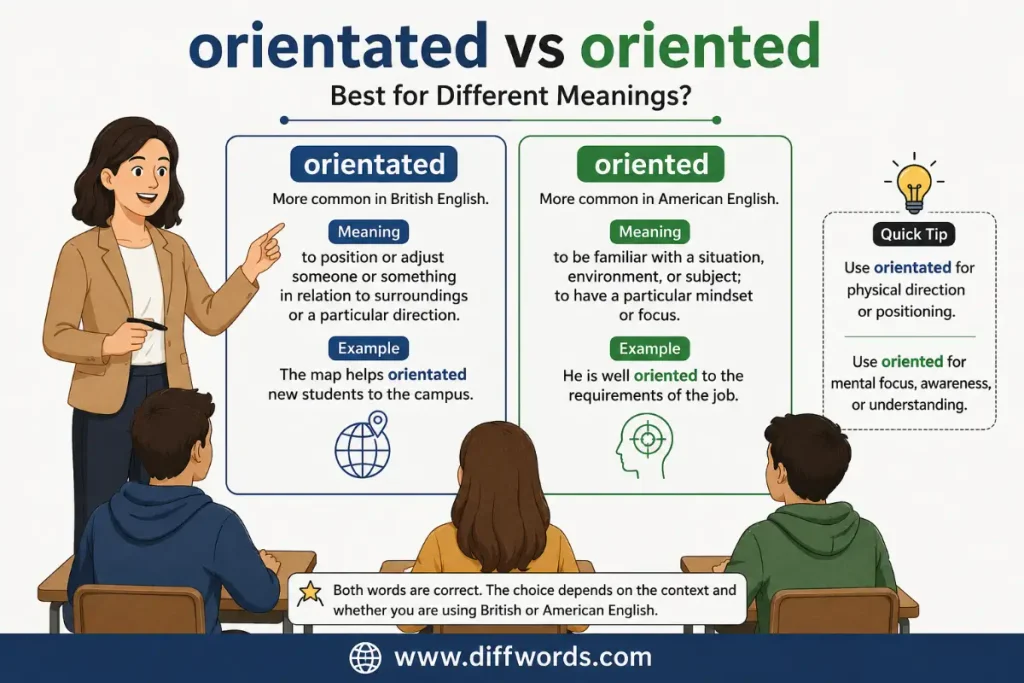
Oriented has several meanings, so replacing it with the wrong synonym can change your sentence.
When oriented means “focused”
Use:
- focused
- centered
- directed
- aimed
- concentrated
Example:
The program is oriented toward practical learning.
Possible replacement:
The program is focused on practical learning.
When oriented means “designed for”
Use:
- designed
- geared
- targeted
- aimed
- intended
Example:
The course is oriented toward beginners.
Possible replacement:
The course is designed for beginners.
When oriented means “aware of”
Use:
- aware
- attuned
- responsive
- informed
- familiar
Example:
The company is highly oriented toward customer needs.
Depending on the intended meaning, you might write:
The company is highly responsive to customer needs.
When oriented means “positioned”
Use:
- positioned
- placed
- aligned
- arranged
- directed
Example:
The house is oriented toward the south.
Possible replacement:
The house is positioned toward the south.
What are synonyms for oriented from mild to strong?
The word oriented itself isn’t really an intensity word. Its strength depends on what follows it.
Still, related words can suggest different levels of focus.
Mild focus
- aware
- interested
- responsive
- attentive
Example:
The team is attentive to customer concerns.
Moderate focus
- directed
- aimed
- focused
- aligned
- targeted
Example:
The campaign is targeted at local customers.
Strong focus
- dedicated
- committed
- specialized
- purpose-driven
- concentrated
Example:
The organization is dedicated to improving access to education.
Choose the word based on what you actually mean. Don’t use dedicated simply because it sounds stronger if the subject isn’t truly committed to the goal.
Is oriented an adjective or a verb form?
Oriented can function as both a verb form and an adjective.
As a verb form:
She oriented herself to the new environment.
Here, oriented is the past tense or past participle of orient.
As an adjective:
She is highly career-oriented.
Here, career-oriented describes her.
It is also common in compound adjectives:
- customer-oriented
- goal-oriented
- results-oriented
- service-oriented
- detail-oriented
- research-oriented
- career-oriented
- family-oriented
- community-oriented
- solution-oriented
These compounds are extremely common in professional English.
Is orientated an adjective or a verb form?
Orientated can also function as a verb form or adjective.
For example:
The students were orientated to the new system.
Here, it is a verb form.
As an adjective:
The company is environmentally orientated.
This means the company is focused on environmental concerns.
In American English, however, you would normally see:
The company is environmentally oriented.
What is the difference between oriented and focused?
Focused and oriented often overlap, but they aren’t identical.
Focused usually emphasizes attention or concentration.
Oriented often emphasizes direction, purpose, design, or a general tendency.
| Oriented | Focused |
|---|---|
| Can describe direction or purpose | Usually emphasizes attention |
| Common in compound adjectives | Very common in everyday speech |
| Can describe systems, organizations, and products | Often describes people, attention, and activities |
| Sounds somewhat formal | Usually more direct |
Compare:
The company is customer-oriented.
This means the company is designed or organized around customers.
The manager is focused on customers.
This means the manager is paying particular attention to customers.
The meanings overlap, but the first emphasizes an overall approach, while the second emphasizes attention.
What is the difference between oriented and directed?
Directed usually emphasizes movement, control, or a specific target.
Oriented can be broader.
For example:
The building is oriented toward the sea.
This describes its position.
The manager directed the team toward the main goal.
This emphasizes an active action by the manager.
In professional writing:
The program is oriented toward research.
sounds natural.
The program is directed toward research.
is also possible but can sound more formal or deliberate.
What is the difference between oriented and aligned?
Aligned means consistent with or matching something.
Oriented means directed or focused toward something.
Compare:
Our strategy is oriented toward long-term growth.
The strategy focuses on long-term growth.
Our strategy is aligned with our long-term goals.
The strategy matches or supports those goals.
These words often appear together in business writing, but they aren’t exact synonyms.
What is the difference between oriented and targeted?
Targeted is more specific.
If something is targeted, it is deliberately aimed at a particular person, group, problem, or result.
If something is oriented, it may simply be designed or focused around something.
Compare:
The course is oriented toward beginners.
This describes its general design.
The advertisement is targeted at beginners.
This suggests a deliberate marketing focus on that audience.
What is the difference between oriented and geared toward?
Geared toward is a natural, slightly more conversational alternative to oriented toward.
Compare:
The workshop is oriented toward new teachers.
The workshop is geared toward new teachers.
Both mean the workshop is designed with new teachers in mind.
Geared toward often sounds more relaxed and natural in everyday American English.
Oriented toward is common in professional, academic, and technical writing.
How is oriented used in American English?
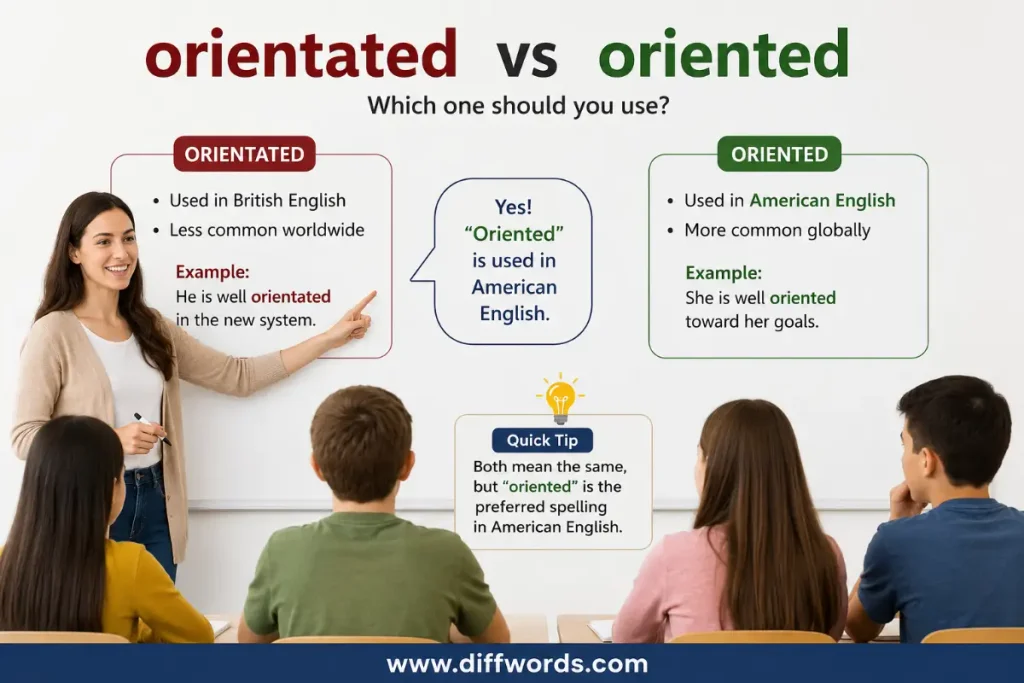
Oriented is the standard and strongly preferred form in American English.
Americans commonly write:
- customer-oriented
- goal-oriented
- results-oriented
- detail-oriented
- career-oriented
- service-oriented
- community-oriented
- research-oriented
They also use:
The course is oriented toward practical skills.
The company is oriented toward innovation.
The building is oriented toward the east.
While orientated isn’t impossible in American English, it is much less common and may sound unusual to many US readers.
If you’re writing for an American audience, oriented is the safest choice.
Is orientated more common in British English?
Yes. Orientated has a stronger presence in British English and some other varieties influenced by British usage.
For example:
The course is orientated towards practical skills.
This can sound completely natural in British English.
However, oriented is also used in British English. So British writers aren’t required to use orientated.
This means the regional rule isn’t:
American = oriented, British = orientated.
It’s more accurate to say:
Oriented is strongly preferred in American English, while both forms are used in British English, with orientated having a particularly established place there.
Should you use “toward” or “towards” with oriented?
Both forms are correct.
American English generally prefers toward:
The program is oriented toward students.
British English often uses towards:
The program is orientated towards students.
But there is no absolute rule. Toward is also found in British English, and towards can appear in American English.
If you’re writing consistently in US English, oriented toward is a natural combination.
Which word is best for a resume?
For a US resume, oriented is the better choice.
You will often see compound forms such as:
- results-oriented
- customer-oriented
- detail-oriented
- goal-oriented
- team-oriented
- solution-oriented
For example:
Results-oriented professional with strong communication skills.
Or:
Customer-oriented employee with experience in service and support.
Oriented is concise and standard in American professional writing.
If you’re writing a British CV, orientated may also be acceptable, but oriented remains widely understood.
Is “results-oriented” correct?
Yes. Results-oriented is a common compound adjective.
It means strongly focused on achieving results.
Example:
Results-oriented professional with experience in project management.
The same applies to:
goal-oriented
customer-oriented
detail-oriented
career-oriented
These forms are especially common in resumes and job descriptions.
Which word is best for an essay: Orientated vs Oriented:
For an American academic essay, oriented is generally the better choice.
For example:
The education system is increasingly oriented toward practical skills.
Or:
The novel is oriented around themes of identity and belonging.
However, choose a simpler word if it makes the sentence clearer.
Instead of:
The essay is oriented toward an examination of social inequality.
You might write:
The essay focuses on social inequality.
Both are grammatical, but focuses on is more direct.
Which word is best for texting:Orientated vs Oriented
In casual texting, oriented is more likely to appear because it is shorter and more familiar to American readers.
For example:
The app is really oriented toward students.
But you might naturally say:
The app is really designed for students.
or:
The app is mainly for students.
Texting usually favors simpler expressions.
Orientated isn’t wrong, but it may sound more formal or regional than necessary.
Which word is best for email?
For a professional email to a US audience, use oriented.
For example:
The new training program is oriented toward practical workplace skills.
You could also write:
The new training program is designed for practical workplace skills.
The second version may sound more natural if you’re aiming for plain English.
For British readers, orientated is also acceptable.
Which word is best for speaking:Orientated vs Oriented
In everyday American speech, oriented is the more natural form.
For example:
The course is oriented toward beginners.
But many speakers would simplify it:
The course is designed for beginners.
In British speech, orientated is also common.
The best choice depends on the speaker’s regional variety and the level of formality.
What are 15 original example sentences with oriented?
- The training program is oriented toward practical skills.
- Our customer service team is strongly oriented toward solving problems.
- The building is oriented toward the main road.
- The course is oriented toward students with little experience.
- The company is oriented toward long-term growth.
- The new software is oriented toward small businesses.
- She is highly oriented toward achieving her career goals.
- The research project is oriented toward improving public health education.
- The workshop is oriented toward hands-on learning.
- The organization is community-oriented and locally managed.
- The manager is results-oriented and highly organized.
- The school has developed a student-oriented approach.
- The program is designed to be user-oriented.
- The building was carefully oriented to make better use of natural light.
- The company has become more environmentally oriented in recent years.
What are 15 original example sentences with orientated?
- The course is orientated towards practical training.
- The program is orientated towards new employees.
- The company is strongly customer-orientated.
- The training is orientated towards workplace skills.
- The service is orientated towards the needs of local families.
- The organization is community-orientated.
- The research is orientated towards solving local problems.
- The project is orientated towards long-term development.
- The school has become more student-orientated.
- The campaign is orientated towards younger audiences.
- The team is highly results-orientated.
- The business is increasingly environmentally orientated.
- The course was orientated towards students with limited experience.
- The new system is orientated towards improving efficiency.
- The organization has adopted a more customer-orientated approach.
These examples are especially natural in British English and related varieties.
What are common mistakes with oriented vs orientated?
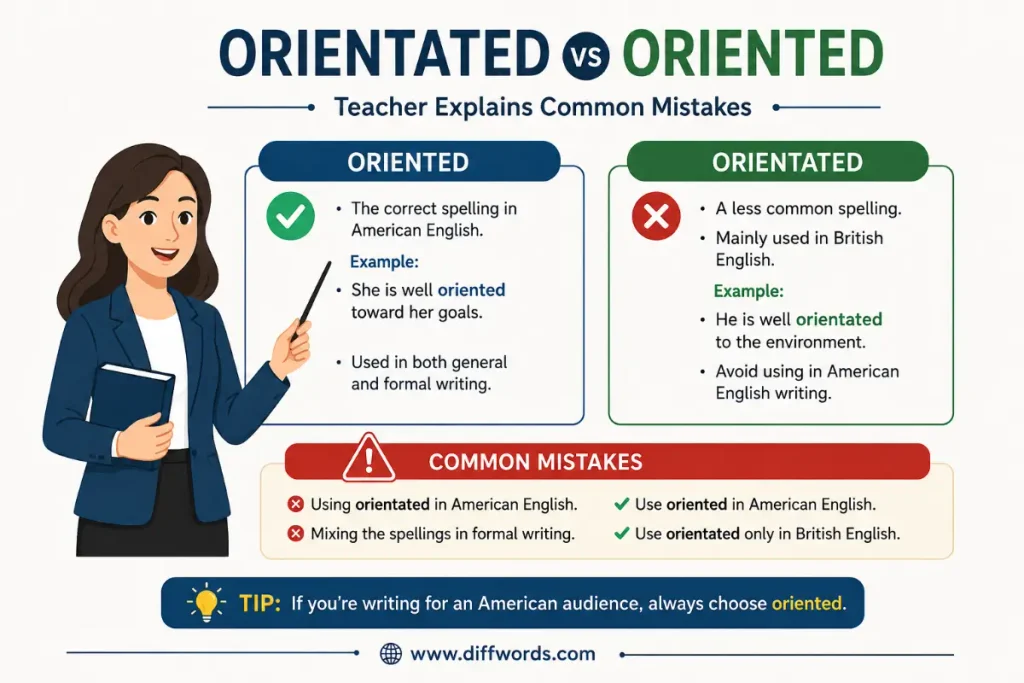
Mistake 1: Assuming orientated is always wrong
It isn’t.
Orientated is a real English word. It is particularly common in British English.
Mistake 2: Assuming oriented is only American
It isn’t.
Oriented is also used in British English and is widely understood internationally.
Mistake 3: Using both forms in the same document
Consistency matters.
If you’re writing in American English, use:
customer-oriented
rather than switching between customer-oriented and customer-orientated.
If you’re following British English style and have chosen orientated, keep your usage consistent.
Mistake 4: Thinking oriented always means “interested”
It can mean focused on something, but the exact meaning depends on context.
For example:
The building is oriented toward the east.
This is about physical direction, not interest.
Mistake 5: Using oriented when “familiar with” is clearer
Sometimes oriented is used to mean familiar with a place or situation.
The students were oriented to the new campus.
But in plain English, you might write:
The students became familiar with the new campus.
Choose the clearest expression for your audience.
Mistake 6: Overusing oriented in business writing
Professional writing often contains phrases such as:
- results-oriented
- customer-oriented
- goal-oriented
- solution-oriented
These are correct, but using too many of them can make a resume or report sound generic.
Whenever possible, show the actual result.
Instead of:
Results-oriented employee.
You could write:
Increased customer response rates by improving follow-up procedures.
The second version gives the reader useful information.
When should you NOT use orientated?
Don’t automatically choose orientated simply because it sounds more formal.
For a US audience, oriented is usually more natural.
For example, instead of:
The program is orientated toward beginners.
write:
The program is oriented toward beginners.
Also avoid orientated if your publication or organization follows a style guide that specifically prefers oriented.
Consistency with the rest of your document matters.
When should you NOT use oriented?
Don’t use oriented when a more precise word communicates your meaning better.
For example:
The advertisement is oriented toward teenagers.
This is grammatical.
But:
The advertisement is targeted at teenagers.
may be more precise because targeted emphasizes a deliberate audience.
Likewise:
She is oriented toward her career.
may be less natural than:
She is focused on her career.
Good writing isn’t just about choosing a technically correct word. It’s about choosing the word that best communicates the idea.
What are the antonyms of oriented?
The opposite depends on the meaning.
If oriented means focused or directed, possible contrasts include:
- unfocused
- distracted
- aimless
- undirected
- scattered
- unfixed
If oriented means familiar with a place or situation, possible contrasts include:
- unfamiliar
- confused
- disoriented
- lost
- uncertain
For example:
The new employee was oriented to the system.
Opposite idea:
The new employee was unfamiliar with the system.
When oriented refers to physical direction, the opposite might simply be:
- misaligned
- incorrectly positioned
- turned away
There isn’t one universal antonym.
What is the difference between oriented and disoriented?
These words are closely related.
Oriented can mean aware of where you are or how something is arranged.
Disoriented means confused about your location, direction, or situation.
Compare:
After studying the map, I felt oriented.
After waking up in the unfamiliar room, I felt disoriented.
This is one of the clearest ways to understand the original idea of orient: finding your direction.
What does “goal-oriented” mean?
Goal-oriented means focused on achieving a particular goal.
For example:
She is a goal-oriented student.
This suggests that she actively works toward specific objectives.
Other common compounds include:
Customer-oriented
Focused on customers and their needs.
The company takes a customer-oriented approach.
Results-oriented
Focused on achieving measurable results.
The team has a results-oriented culture.
Detail-oriented
Careful about small details.
She’s very detail-oriented.
Career-oriented
Focused strongly on career development.
He is highly career-oriented.
Service-oriented
Focused on providing services or meeting service needs.
The business uses a service-oriented model.
Solution-oriented
Focused on finding solutions rather than only discussing problems.
Try to take a solution-oriented approach.
Is “people-oriented” correct?
Yes. People-oriented is a common compound adjective.
It generally means focused on people, relationships, or human needs.
For example:
She’s a people-oriented manager.
This suggests that she values communication, relationships, and the needs of others.
In American English, people-oriented is the standard spelling.
Is “detail-oriented” correct?
Yes.
Detail-oriented means careful about small details.
Example:
We need a detail-oriented employee for this position.
This phrase is especially common in job descriptions and resumes.
In American English, use detail-oriented rather than detail-orientated if you want the standard US form.
Is “customer-oriented” correct?
Yes.
Customer-oriented means designed around or focused on customers and their needs.
Example:
Our company takes a customer-oriented approach.
A British writer may use:
customer-orientated
Both are legitimate, but customer-oriented is the safer choice for American English.
Is “oriented toward” better than “oriented towards”?
Neither is universally better.
American English generally favors:
oriented toward
British English commonly uses:
oriented towards
Both are grammatically acceptable.
The important thing is consistency.
If you’re writing an American article, use toward throughout.
If you’re writing British English, towards may fit your preferred style.
Is “orientated toward” correct?
Yes.
Orientated toward is grammatically possible.
For example:
The program is orientated toward practical skills.
You may also see:
The program is orientated towards practical skills.
The second version is especially natural in British English.
For American English, however, oriented toward is much more common.
Is “oriented towards” correct?
Yes.
Oriented towards is correct English.
It is common in British English and is also understood elsewhere.
For example:
The course is oriented towards practical training.
American writers would usually choose:
The course is oriented toward practical training.
Notice that the difference here is not only oriented/orientated, but also toward/towards.
Which form”Orientated vs Oriented” should you use for SEO and web content?
If your website targets US readers, oriented is usually the better primary form.
It is more familiar to American users and appears frequently in professional and general writing.
If your website targets British readers, orientated can be useful as a regional variant.
A good article can mention both forms naturally while choosing one as its main style.
For example:
American English generally prefers “oriented,” while British English also commonly uses “orientated.”
This gives readers the information they need without treating one valid form as an error.
How can you remember orientated vs oriented?
Use this simple rule:
US English → oriented
British English → oriented vs orientated
If you’re unsure and writing for an international or American audience, choose oriented.
Another memory trick is:
Oriented = the shorter, more common form.
You can also remember the common US compounds:
- goal-oriented
- results-oriented
- customer-oriented
- detail-oriented
- career-oriented
If you’re writing a US resume, these are the forms you’ll normally want.
What should you use in formal writing?
For American formal writing, oriented is usually the best choice.
Examples:
The policy is oriented toward improving workplace safety.
The research is oriented toward practical applications.
The program is student-oriented.
For British formal writing, orientated is also acceptable:
The policy is orientated towards improving workplace safety.
The important thing is not to mistake regional variation for an error.
What should you use in casual writing?
In casual American writing, oriented is more natural.
However, simpler alternatives may be even better:
- focused on
- designed for
- aimed at
- made for
- centered on
For example:
The app is oriented toward students.
could become:
The app is designed for students.
The second sentence is shorter and easier to understand.
What should you use when speaking to an international audience?
Oriented is often the safest choice because it is widely recognized and especially common in American English.
However, clarity matters more than choosing a particular regional variant.
If your listeners understand both forms, either can work.
If you’re teaching English to learners, it’s useful to explain that orientated is not simply “wrong.” It’s a recognized variant, especially in British English.
Quick tips for choosing the right word:Orientated vs Oriented
- Use oriented for standard American English.
- Use orientated if it fits your British English style.
- Remember that both forms can be grammatically correct.
- Don’t call orientated a spelling mistake.
- Don’t assume oriented is limited to American English.
- Use oriented toward in standard US writing.
- Use oriented towards if that matches your regional style.
- Use focused on when you want simple, direct language.
- Use designed for when describing who something is made for.
- Use aimed at when describing a target audience.
- Use targeted at when the audience is deliberately selected.
- Use aligned with when something matches a goal or plan.
- Use dedicated to when strong commitment is the main idea.
- Keep compound adjectives consistent: customer-oriented, goal-oriented, detail-oriented.
- On a US resume, oriented is usually the safest form.
- On a British CV, orientated is acceptable.
- Don’t use a more formal word when a simpler one is clearer.
- Check your audience before choosing the regional variant.
Conclusion
The key to orientated vs oriented is understanding that both forms are legitimate, but they have different levels of regional popularity. Oriented is the clear favorite in American English and is also widely used internationally. Orientated is especially established in British English and can be used naturally there.
For a US resume, essay, website, email, or business document, oriented is usually the safest choice. You can also replace it with a simpler word such as focused, designed, aimed, or centered when that makes your sentence clearer.
Don’t treat regional variation as a spelling error. Instead, think about your audience and choose consistently. If you’re writing for Americans and you’re unsure, oriented is the easy choice.
Frequently Asked Questions
Is oriented vs orientated correct?
Both are correct forms. American English strongly prefers oriented, while orientated is especially common in British English and some other varieties.
Is orientated more British than oriented?
Yes, orientated has a stronger association with British English. However, British speakers and writers also use oriented, so the distinction isn’t absolute.
Which is correct in American English: oriented vs orientated?
Oriented is the standard and much more common choice in American English. For US writing, use forms such as customer-oriented, goal-oriented, and results-oriented.
What’s another way to say oriented?
Focused, directed, aimed, centered, geared, targeted, or designed can replace oriented depending on the sentence. For plain English, focused on and designed for are often excellent choices.
Is it customer-oriented or customer-orientated?
Both are valid, but customer-oriented is preferred in American English. Customer-orientated is common enough in British English and related varieties.
Should I use oriented toward or oriented towards?
Both are correct. Toward is more common in American English, while towards is especially common in British English.
Is “orientated” a bad word to use?
No, orientated isn’t a bad or incorrect word. It’s a recognized variant, but American readers generally expect oriented, so choose the form that matches your audience.
1 thought on “Orientated vs Oriented: The Ultimate Simple Guide”