
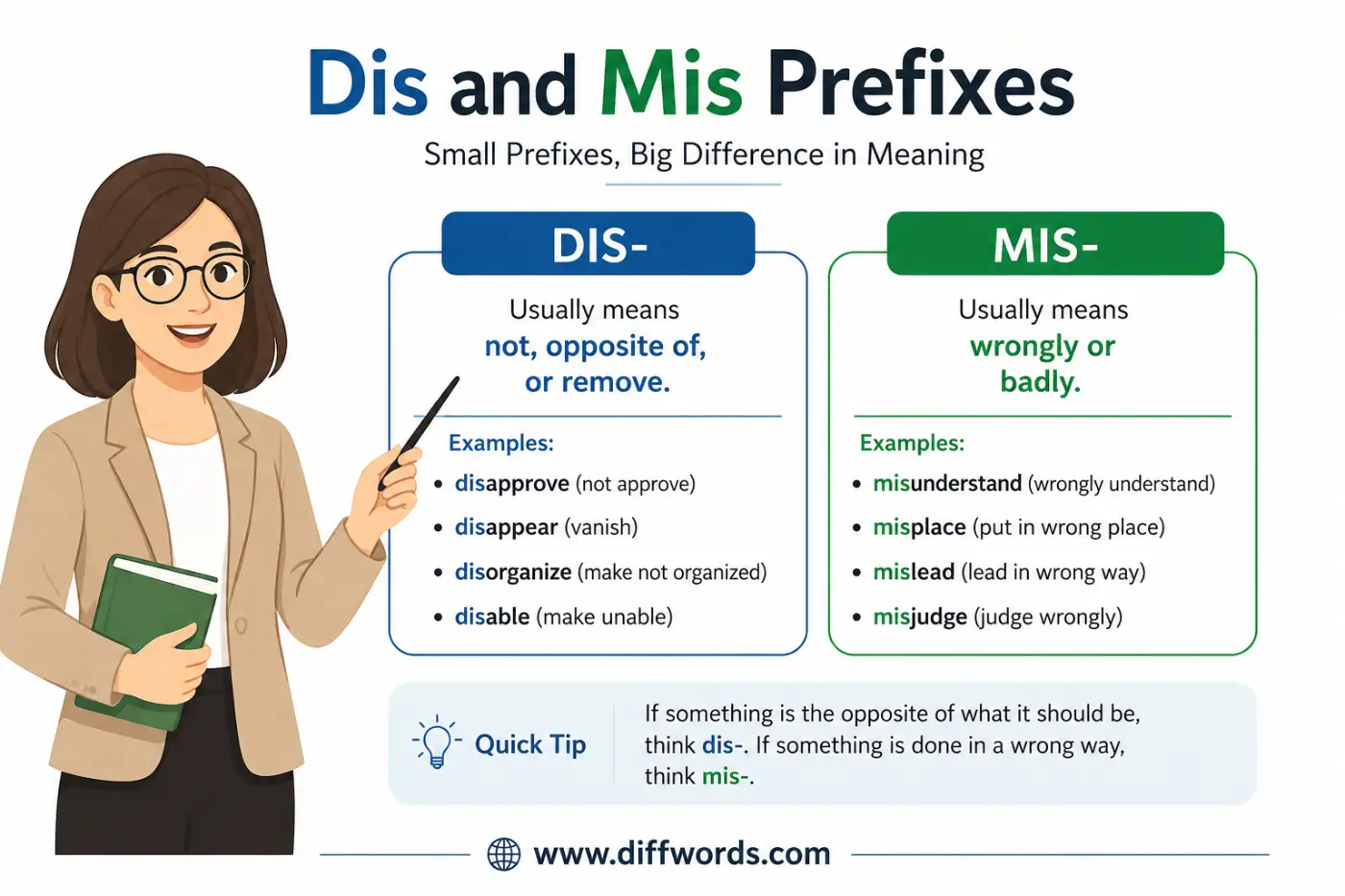
When you’re writing an essay, email, resume, or text, prefixes can make a big difference in meaning. Two prefixes that often cause confusion are dis- and mis-. They can both create words with negative meanings, but they don’t mean the same thing.
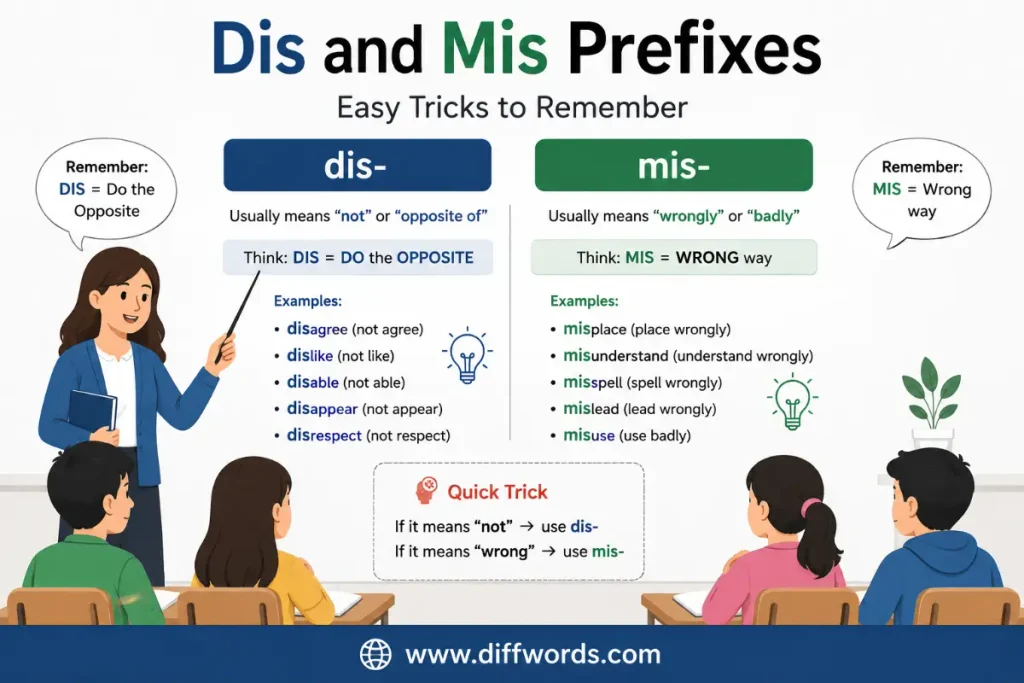
The prefix dis- usually means “not,” “opposite of,” “apart,” or “away,” while mis- usually means “wrong,” “badly,” or “incorrectly.”
For example, disagree means “not agree,” while misunderstand means “understand incorrectly.” Knowing this small difference can help you figure out unfamiliar words and avoid spelling or vocabulary mistakes.
This guide explains dis and mis prefixes from the ground up. You’ll learn their origins, meanings, word patterns, examples, common mistakes, related words, and easy ways to decide which prefix fits.
Should half day have a hyphen? Learn when to write half-day , half day or half-day as a modifier.
What do dis- and mis- prefixes mean?
The simplest way to remember dis and mis prefixes is this:
- dis- = not, opposite, apart, away, or lack of
- mis- = wrongly, incorrectly, badly, or mistakenly
Compare these examples:
| Word | Prefix | Meaning |
|---|---|---|
| disagree | dis- | not agree |
| disconnect | dis- | separate or break a connection |
| dislike | dis- | not like |
| dishonest | dis- | not honest |
| misunderstand | mis- | understand wrongly |
| misread | mis- | read incorrectly |
| mislead | mis- | lead someone wrongly |
| misplace | mis- | put something in the wrong place |
| misuse | mis- | use incorrectly |
The difference is easier when you ask a simple question:
Does the word mean “not/opposite/separate” or “wrongly/incorrectly”?
If the first idea fits, dis- may be appropriate. If the second fits, mis- may be the right choice.
Where does the prefix dis- come from?
The prefix dis- has a long history in English. It came into English through Latin and French and has several related meanings.
The Latin prefix dis- could express ideas such as:
- apart
- away
- in different directions
- not
- opposite
- separation
English inherited this prefix in many words.
For example:
- disconnect = separate a connection
- disjoin = separate things that are joined
- disagree = not agree
- disapprove = not approve
- disobey = not obey
This history explains why dis- doesn’t have only one meaning.
Sometimes it creates a direct opposite:
agree → disagree
Sometimes it suggests separation:
connect → disconnect
Also sometimes it expresses removal or reversal:
engage → disengage
So you shouldn’t assume that dis- always means exactly “not.”
Where does the prefix mis- come from?
The prefix mis- comes from an old Germanic source and has been used in English for centuries.
Its central idea is wrongness or error.
It can mean:
- wrongly
- incorrectly
- badly
- mistakenly
- improperly
Consider:
understand → misunderstand
To misunderstand something is to understand it incorrectly.
Or:
spell → misspell
To misspell a word is to spell it incorrectly.
The prefix therefore often tells you that an action wasn’t performed correctly.
What is the plain-English meaning of dis-?
In simple English, dis- often means “not,” “opposite,” or “apart.”
Examples:
Disagree
I disagree with your answer.
You do not agree.
Disconnect
Please disconnect the cable.
Separate the connection.
Dislike
I dislike noisy places.
I do not like them.
Disappear
The sun disappeared behind the clouds.
It went out of sight or away.
Disapprove
Her parents disapprove of the decision.
They do not approve.
The exact meaning depends on the base word.
What is the plain-English meaning of mis-?
Mis- usually means that something was done wrongly, incorrectly, or badly.
Examples:
Misread
I misread the instructions.
I read them incorrectly.
Misunderstand
You misunderstood my question.
You understood it incorrectly.
Misplace
I misplaced my keys.
I put them somewhere and now can’t find them.
Misuse
Don’t misuse the equipment.
Don’t use it incorrectly or improperly.
Misjudge
I misjudged the distance.
I judged it incorrectly.
The idea of error is central to many mis- words.
How are dis and mis prefixes different?
The most useful distinction is:
dis- often changes something into its opposite or indicates separation, while mis- usually shows that something was done incorrectly.
Look at these pairs:
| With dis- | Meaning | With mis- | Meaning |
|---|---|---|---|
| disagree | not agree | misunderstand | understand wrongly |
| distrust | not trust | mistrust | have doubts or lack trust |
| disapprove | not approve | misjudge | judge wrongly |
| disconnect | separate | misconnect | connect incorrectly |
| disuse | no longer use | misuse | use incorrectly |
| displace | move from the proper place | misplace | put in the wrong place |
The distinction isn’t always perfect, especially because English vocabulary has developed over many centuries. Still, it is a useful starting rule.
What are the main words formed with dis-?
Here are common dis- words worth learning:
| Word | Meaning |
|---|---|
| disagree | not agree |
| dislike | not like |
| disapprove | not approve |
| distrust | not trust |
| disobey | not obey |
| dishonest | not honest |
| disloyal | not loyal |
| disconnect | separate a connection |
| disappear | go out of sight |
| disarm | remove weapons or make unable to use them |
| disable | make unable to function |
| disband | break up an organized group |
| discourage | reduce someone’s confidence or willingness |
| disqualify | make someone ineligible |
| disorganize | make something less organized |
| displease | fail to please |
| disrepair | poor condition from lack of maintenance |
| disorder | lack of order |
| dissimilar | not similar |
| disadvantage | unfavorable condition |
| discontent | lack of satisfaction |
| dishonest | not truthful |
| disrespect | lack of respect |
| disconnection | lack of connection |
| disagreement | lack of agreement |
| disbelief | lack of belief |
| discomfort | lack of comfort |
These words don’t all work in exactly the same way. Some express negation, some separation, and others a negative condition.
What are the main words formed with mis-?
Here are common mis- words:
| Word | Meaning |
|---|---|
| misunderstand | understand wrongly |
| misread | read incorrectly |
| misspell | spell incorrectly |
| mispronounce | pronounce incorrectly |
| miscalculate | calculate incorrectly |
| misjudge | judge incorrectly |
| mislead | lead someone wrongly |
| misinform | give incorrect information |
| misinterpret | interpret incorrectly |
| misrepresent | represent inaccurately |
| misplace | put somewhere incorrectly |
| misuse | use incorrectly |
| mismanage | manage badly |
| misbehave | behave badly |
| misdirect | direct incorrectly |
| misidentify | identify incorrectly |
| misremember | remember incorrectly |
| misquote | quote incorrectly |
| misprint | print incorrectly |
| misapply | apply incorrectly |
| misconstruct | construct incorrectly |
| misclassify | classify incorrectly |
| miscount | count incorrectly |
| misfire | fail to fire or work correctly |
| misfortune | bad luck |
| mistake | an error |
These words generally have a clear connection to error, incorrect action, or poor performance.
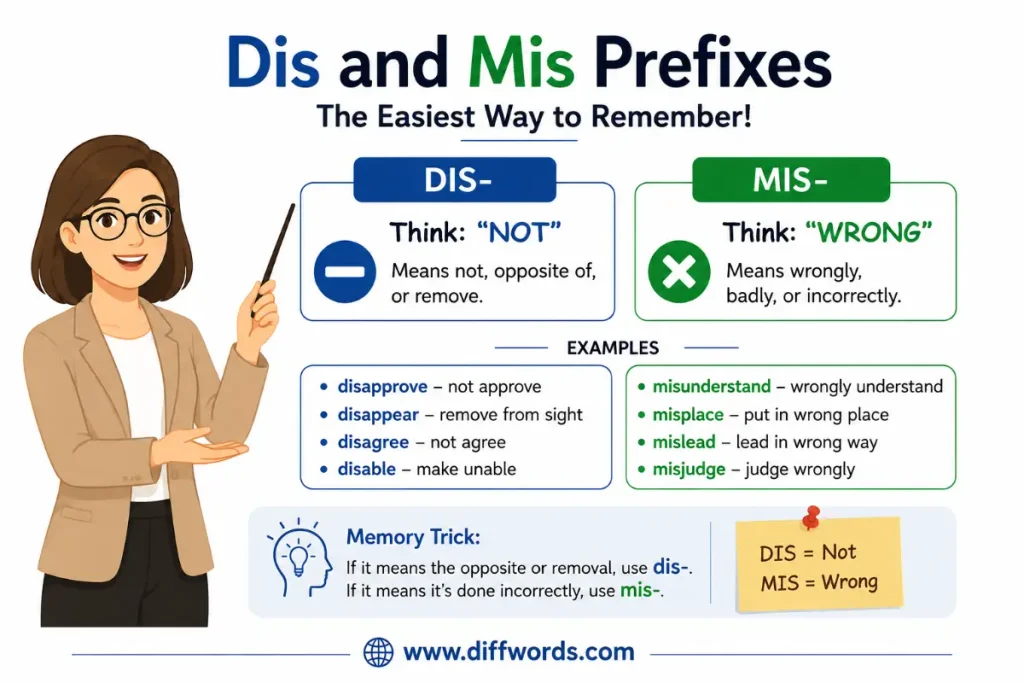
What is the easiest way to remember dis and mis prefixes?
Try this memory rule:
DIS = different, opposite, or apart
Think:
disagree = not agree
disconnect = separate
dislike = not like
MIS = mistake
Think:
misread = read incorrectly
mishear = hear incorrectly
miscalculate = calculate incorrectly
A useful memory sentence is:
DIS changes direction; MIS makes a mistake.
It isn’t a perfect rule for every English word, but it’s an excellent guide for learners.
What are 20+ related words for dis- and mis- prefixes?
Because prefixes aren’t synonyms in the same way adjectives or verbs are, it’s better to look at the meaning ideas they create.
| Word | Meaning | Tone | Example |
|---|---|---|---|
| disagree | not agree | Everyday | We disagree about the plan. |
| dislike | not like | Everyday | I dislike crowded places. |
| distrust | not trust | Neutral | They distrust the company. |
| disapprove | not approve | Formal | Her parents disapprove. |
| disobey | refuse to obey | Neutral | The child disobeyed the rule. |
| disconnect | separate | Everyday | Disconnect the device. |
| disappear | go out of sight | Everyday | The clouds disappeared. |
| discourage | reduce confidence | Neutral | Don’t discourage her. |
| disable | make unable to work | Formal | The update disabled the feature. |
| disorder | lack of order | Formal | The files were in disorder. |
| disrespect | lack of respect | Neutral | His comment showed disrespect. |
| dishonest | not honest | Negative | The statement was dishonest. |
| misunderstand | understand wrongly | Everyday | I misunderstood you. |
| misread | read incorrectly | Everyday | I misread the number. |
| misspell | spell incorrectly | Everyday | I misspelled her name. |
| mispronounce | pronounce incorrectly | Everyday | He mispronounced the word. |
| misjudge | judge incorrectly | Neutral | I misjudged the distance. |
| mislead | lead someone wrongly | Negative | The advertisement misled customers. |
| misinform | give incorrect information | Formal | The article misinformed readers. |
| misinterpret | interpret incorrectly | Formal | She misinterpreted his comment. |
| misplace | put in the wrong place | Everyday | I misplaced my phone. |
| misuse | use incorrectly | Formal | Don’t misuse the equipment. |
| mismanage | manage badly | Negative | The funds were mismanaged. |
| misbehave | behave badly | Everyday | The children misbehaved. |
| miscalculate | calculate incorrectly | Formal | We miscalculated the cost. |
| misremember | remember incorrectly | Everyday | I must have misremembered. |
| misquote | quote incorrectly | Formal | The speaker was misquoted. |
| misidentify | identify incorrectly | Formal | Police initially misidentified the object. |
| misapply | apply incorrectly | Formal | The rule was misapplied. |
| misdirect | direct incorrectly | Formal | The question misdirected the discussion. |
This table also shows why simply saying that dis- and mis- both mean “bad” isn’t enough. Their meanings can be quite different.
How do dis- words differ by intensity?
Not every dis- word has the same emotional strength.
Mild dis- words
These can simply express a difference or lack:
- disagree
- dislike
- dissimilar
- discomfort
- disinterest
Example:
I disagree with that point.
This doesn’t necessarily express anger.
Stronger dis- words
Some can express a serious negative judgment:
- dishonesty
- disrespect
- disloyalty
- disobedience
- distrust
For example:
The manager viewed the behavior as disrespectful.
The word carries a stronger negative judgment.
How do mis- words differ by intensity?
The intensity of mis- words depends on the base verb.
Mild errors
- misread
- mishear
- misremember
- misspell
- miscount
Example:
I misread the date.
This could be a simple mistake.
More serious errors
- misjudge
- mismanage
- misinform
- misrepresent
- mislead
These can have greater consequences.
For example:
The report misrepresented the results.
That suggests a serious problem with accuracy.
Which words can use both dis- and mis- prefixes?
Some base words can take both prefixes, but the meanings can change.
This is where learners need to be careful.
Trust: distrust vs mistrust
Distrust means a general lack of trust.
I distrust people who repeatedly lie.
Mistrust can also mean a lack of trust or suspicion.
She mistrusted his motives.
These two words overlap heavily, and in many situations either can work.
Use: disuse vs misuse
These are very different.
Disuse means something is no longer being used.
The old building fell into disuse.
Misuse means something is being used incorrectly or improperly.
Misuse of the equipment can cause problems.
This is a great example of why the prefix matters.
Place: displace vs misplace
Displace means to move something or someone from the usual or proper position.
The flood displaced hundreds of families.
Misplace means to put something somewhere and then be unable to locate it.
I misplaced my keys.
These words look related but have clearly different meanings.
Displace vs misplace: what’s the difference?
This is one of the most useful comparisons.
| Displace | Misplace |
|---|---|
| Move from a position or home | Put somewhere incorrectly |
| Often involves people, objects, or groups | Usually involves objects |
| Can be deliberate or caused by events | Usually accidental |
| More formal | Everyday |
Examples:
The war displaced thousands of families.
I misplaced my wallet.
You wouldn’t normally say:
I displaced my wallet.
if you simply mean you can’t remember where you put it.
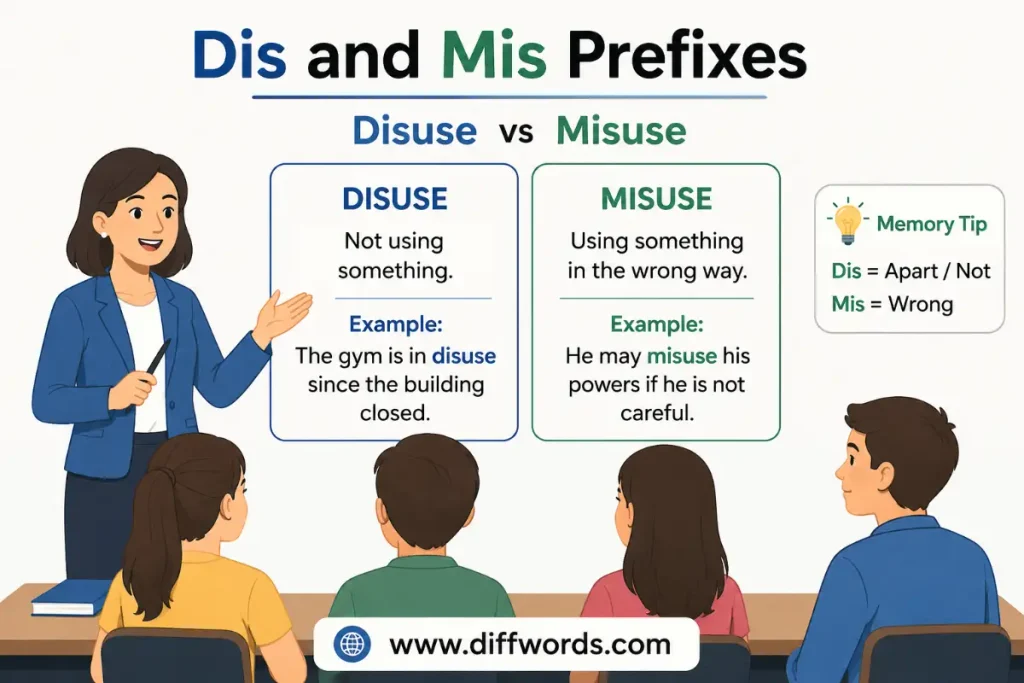
Disuse vs misuse: what’s the difference?
These two words are easy to confuse.
Disuse = not being used.
Misuse = being used wrongly.
Compare:
The machine fell into disuse.
The machine isn’t being used anymore.
The machine was damaged through misuse.
The machine was used incorrectly.
A simple memory trick:
DIS-use = no use
MIS-use = wrong use
Disagree vs misunderstand: what’s the difference?
These words are especially important in conversations.
Disagree means you have a different opinion.
Misunderstand means you don’t understand the other person’s meaning correctly.
Compare:
I disagree with your conclusion.
I understand your conclusion but have a different opinion.
I misunderstood your conclusion.
I didn’t understand what you meant.
Someone can disagree without misunderstanding.
That’s an important difference.
Disapprove vs misjudge: what’s the difference?
Disapprove means not to approve of something.
Misjudge means to judge something incorrectly.
For example:
My parents disapprove of my decision.
They don’t support it.
I misjudged the situation.
My judgment was wrong.
One expresses a negative opinion. The other describes an error in judgment.
Misunderstand vs misinterpret: what’s the difference?
These words overlap, but misinterpret often focuses on the meaning or explanation someone gives to information.
I misunderstood your instructions.
I didn’t understand them correctly.
She misinterpreted his silence.
She gave his silence the wrong meaning.
Misunderstand is more common in everyday speech.
Misinterpret often sounds more precise or formal.
Dis and mis prefixes by part of speech
Both prefixes can appear in different kinds of words.
Dis- with verbs
Examples:
- disagree
- disapprove
- disconnect
- disobey
- dislike
- disappear
- discourage
- disqualify
Example:
They disagreed with the proposal.
Dis- with adjectives
Examples:
- dishonest
- disloyal
- disrespectful
- dissatisfied
- dissimilar
- uncomfortable
Example:
The information was dishonest.
Dis- with nouns
Examples:
- disagreement
- disbelief
- discomfort
- disadvantage
- disorder
- disrespect
- distrust
Example:
There was a disagreement between the teams.
Mis- with verbs
This is the most common pattern.
Examples:
- misread
- misunderstand
- misjudge
- misplace
- misuse
- miscalculate
- mismanage
- mislead
Example:
I misread the instructions.
Mis- with adjectives and nouns
There are also words such as:
- misguided
- mistaken
- misleading
- misfortune
- misconduct
- misinformation
- misconception
- misbehavior
Example:
The article contained misinformation.
Are dis- and mis- prefixes used the same way in US and UK English?
The basic meanings and common words are largely the same in US and UK English.
Words such as these are standard in both varieties:
- disagree
- dislike
- disconnect
- dishonest
- misunderstand
- misread
- misspell
- misuse
- mislead
There are occasional differences in pronunciation, spelling preferences, or which words are more common in a particular region, but there isn’t a major US-versus-UK rule that changes the basic meaning of these prefixes.
For English learners, the same core rule works in both varieties:
dis- often expresses opposition, separation, or lack; mis- often expresses error or incorrect action.
Which prefix should you use in a resume:Dis and Mis prefixes?
A resume usually doesn’t require you to choose between the prefixes directly, but understanding them can help you avoid vocabulary mistakes.
For example:
I mismanaged the project.
This is grammatically correct, but it may not be the best way to describe your experience on a resume.
Instead, a professional resume might say:
Improved project management processes.
The key lesson is that mis- words can describe errors, but resumes usually focus on skills and achievements.
Words with dis- can also appear:
Resolved disagreements between team members.
That’s a natural professional use.
Which prefix should you use in an essay:Dis and Mis prefixes ?
Both prefixes are common in academic writing.
Examples:
The two researchers disagree about the cause.
The results were misinterpreted by the media.
The policy disadvantaged rural communities.
The data was misrepresented in the report.
Academic writing often uses mis- words because they can describe errors in reasoning, interpretation, or reporting.
Which prefix works best in texting?
In texting, both are very common.
For example:
I misunderstood you.
I disagree 😂
I misplaced my phone again.
Don’t misread my message.
These words are natural because they describe everyday communication problems.
Which prefix works best in emails?
In a professional email, mis- words can be useful when admitting or explaining an error.
For example:
I apologize. I misunderstood the deadline.
Or:
I may have misread your previous email.
These phrases are polite because they explain the mistake without blaming the other person.
Dis- words also appear naturally:
I disagree with that proposal.
or:
There seems to be a disconnect between the two teams.
Which prefix works best in speaking?
Both prefixes are common in everyday speech.
Use dis- when you mean:
- not
- opposite
- separation
Use mis- when you mean:
- wrongly
- incorrectly
- accidentally
For example:
I disagree with you.
versus:
I misunderstood you.
The difference is small but important.
20 example sentences with dis-?
- I disagree with your conclusion.
- She dislikes waking up early.
- Please disconnect the charger before cleaning the device.
- The manager disapproved of the proposal.
- He was accused of being dishonest.
- The two colors look dissimilar.
- The workers disobeyed the safety instructions.
- The old factory fell into disrepair.
- The accident caused a major disruption.
- The students showed disrespect toward the speaker.
- The system automatically disconnected after ten minutes.
- She felt discouraged after receiving the result.
- The evidence created disbelief among the audience.
- There was a serious disagreement between the partners.
- The company tried to discourage customers from returning the product.
- The illness left him with temporary discomfort.
- The new rule created a clear disadvantage for small businesses.
- The lights suddenly disappeared.
- The organization decided to disband the committee.
- His actions showed a lack of discipline.
What are 20 examples sentences with mis-?
- I misread the question.
- She misunderstood the instructions.
- He misspelled my name.
- I misplaced my keys.
- We miscalculated the total cost.
- The reporter misquoted the actor.
- She mispronounced the word.
- I misjudged the distance.
- The advertisement misled customers.
- The manager mismanaged the budget.
- He misused the equipment.
- I misremembered the date.
- The article misrepresented the research.
- The teacher said the rule had been misapplied.
- The website contained misinformation.
- The speaker was misinterpreted by several listeners.
- We misidentified the address.
- The driver misjudged the turn.
- The child misbehaved during the lesson.
- The company was accused of misleading its customers.
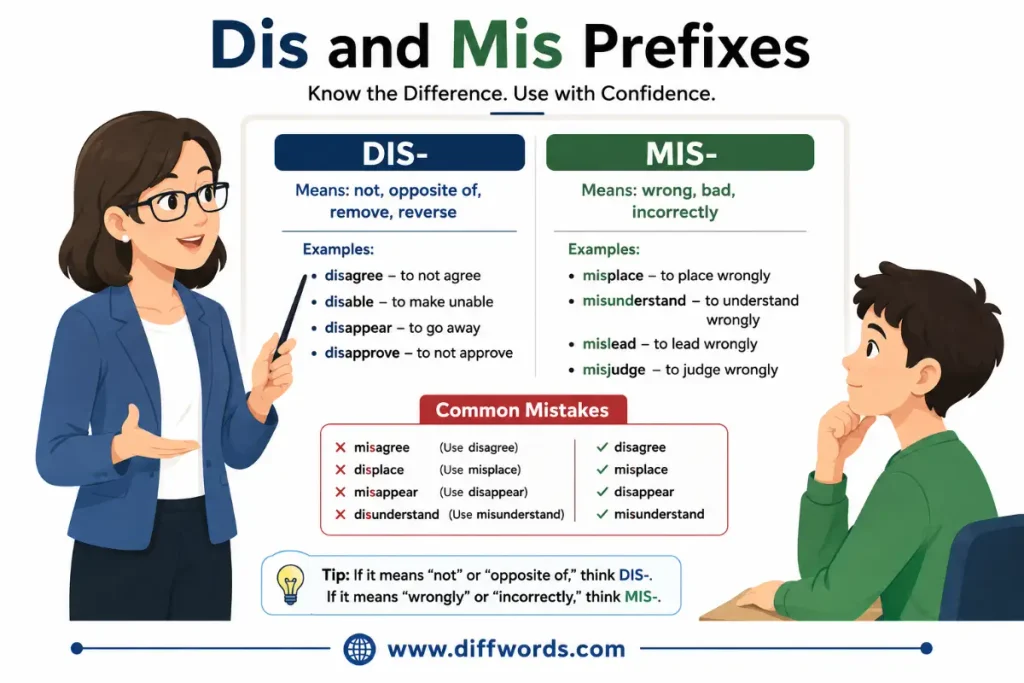
What are the most common mistakes with dis- and mis- prefixes?
Mistake 1: Thinking both prefixes mean “not”
This is the biggest problem.
Dis- can mean “not,” but mis- generally means “wrongly.”
Compare:
disagree = not agree
misunderstand = understand wrongly
Mistake 2: Assuming any negative word can take either prefix
English doesn’t let you freely add dis- or mis- to every word.
For example, we say:
misunderstand
not:
disunderstand
We say:
disagree
not:
misagree
Prefixes are part of established vocabulary. You can’t always create a valid English word simply by attaching one.
Mistake 3: Confusing misuse with disuse
Remember:
misuse = wrong use
disuse = no use
Mistake 4: Confusing misplace with displace
Remember:
misplace = put in the wrong place
displace = move from the proper place
Mistake 5: Confusing disagreement with misunderstanding
A disagreement is a difference of opinion.
A misunderstanding is a failure to understand correctly.
You can understand someone perfectly and still disagree with them.
Mistake 6: Treating mis- as always intentional
A mis- word doesn’t necessarily mean someone deliberately did something wrong.
For example:
I misread the email.
This is normally an accidental error.
But:
The company misled customers.
can suggest a more serious or deliberate problem depending on context.
When should you NOT use dis-?
Don’t add dis- simply because you want to create a negative word.
For example, you can’t automatically turn every adjective into its opposite with dis-.
English uses different negative prefixes:
- unhappy
- impossible
- incorrect
- illegal
- irregular
- dishonest
- dissatisfied
The correct prefix depends on the word.
You should learn common forms rather than assuming one prefix works everywhere.
When should you NOT use mis-?
Don’t use mis- simply because something is negative.
The prefix usually carries an idea of error or incorrect action.
For example, if someone doesn’t like a decision, you wouldn’t normally say they mislike it.
We say:
They dislike it.
If someone uses something incorrectly:
They misuse it.
The difference comes down to meaning, not just whether the word sounds negative.
What are the antonyms of dis- words?
The opposite depends on the base word.
| Dis- word | Possible opposite |
|---|---|
| disagree | agree |
| dislike | like |
| disconnect | connect |
| disapprove | approve |
| distrust | trust |
| disobey | obey |
| disappear | appear |
| discourage | encourage |
| disadvantage | advantage |
| disrespect | respect |
| dishonest | honest |
The prefix often gives you a clue about the opposite.
What are the antonyms of mis- words?
Again, the opposite usually removes the idea of error.
| Mis- word | Possible opposite |
|---|---|
| misunderstand | understand |
| misread | read correctly |
| misspell | spell correctly |
| mispronounce | pronounce correctly |
| misjudge | judge correctly |
| miscalculate | calculate correctly |
| misplace | place correctly |
| misuse | use correctly |
| mismanage | manage properly |
| mislead | guide correctly |
| misinform | inform accurately |
| misinterpret | interpret correctly |
This makes mis- especially useful for vocabulary building.
How can you tell which prefix is correct?
Use these questions:
Question 1: Does it mean “not” or “opposite”?
Try dis-.
agree → disagree
approve → disapprove
like → dislike
Question 2: Does it mean “wrongly”?
Try mis-.
read → misread
understand → misunderstand
calculate → miscalculate
Question 3: Does it mean “apart” or “separate”?
Dis- may be appropriate.
connect → disconnect
join → disjoin
Question 4: Does it describe an error?
Mis- is often appropriate.
judge → misjudge
quote → misquote
identify → misidentify
Question 5: Is the word already established?
Check a reliable dictionary if you’re unsure. English prefixes aren’t completely predictable.
Why doesn’t mis- always mean “bad”?
Because mis- is more specifically about wrongness or error.
For example:
misread
doesn’t mean “bad read.”
It means:
read incorrectly.
Likewise:
miscalculate
means:
calculate incorrectly.
And:
misinterpret
means:
interpret incorrectly.
The result may be bad, but the core meaning is that the action was wrong.
Why doesn’t dis- always mean “not”?
Because dis- has several historical meanings.
For example:
disagree = not agree
but:
disconnect = separate
and:
displace = move from a position
So the prefix can express:
- negation
- opposition
- separation
- reversal
- removal
- lack
The base word helps determine the exact meaning.
What does “dis-” mean in adjectives?
In adjectives, dis- often expresses a negative quality or lack.
Examples:
dishonest = not honest
disloyal = not loyal
dissatisfied = not satisfied
dissimilar = not similar
disrespectful = lacking respect
This makes dis- useful for forming words that contrast with a positive quality.
What does “mis-” mean in adjectives?
In adjectives, mis- can indicate that something is wrong, unsuitable, or based on an error.
Examples include:
- misguided
- misleading
- mistaken
- misinformed
- misplaced
For example:
That was a misguided decision.
It suggests that the decision was based on poor judgment.
The article was misleading.
It gave readers an incorrect impression.
What does “misinformation” mean?
Misinformation means incorrect or false information, especially information that is inaccurate.
For example:
The website spread misinformation about the event.
The word contains mis- because the information is wrong or inaccurate.
This doesn’t automatically tell us whether the person spreading it intended to deceive anyone.
That distinction is important.
What does “disinformation” mean?
Disinformation generally refers to false or misleading information that is deliberately spread to deceive.
Compare:
misinformation = incorrect information, not necessarily intentional
disinformation = deliberately deceptive false information
This is one of the clearest examples of how the two prefixes can produce different meanings.
Misinformation vs disinformation: what’s the difference?
| Misinformation | Disinformation |
|---|---|
| Incorrect information | False or misleading information |
| May be shared accidentally | Usually shared deliberately |
| Intent to deceive isn’t required | Intent to deceive is central |
| Example: sharing a wrong date by mistake | Example: deliberately creating a false story |
For example:
I shared misinformation because I misunderstood the date.
versus:
The group created disinformation to deceive the public.
The distinction is about intent as well as accuracy.
What are some useful dis- and mis- word families?
Learning words in families can make vocabulary easier.
Agree family
- agree
- disagreement
- disagree
- agreeable
Connect family
- connect
- connection
- disconnect
- disconnection
Understand family
- understand
- misunderstanding
- misunderstand
Use family
- use
- misuse
- misused
- misuse
Place family
- place
- misplaced
- misplace
- displace
- displacement
Trust family
- trust
- distrust
- mistrust
- trustworthy
Learning these groups helps you see how prefixes affect meaning.
Quick comparison of dis and mis prefixes
| Feature | dis- | mis- |
|---|---|---|
| Main idea | Not, opposite, apart | Wrongly, incorrectly |
| Common use | Negation/separation | Error/mistake |
| Example | disagree | misunderstand |
| Another example | disconnect | misconnect |
| Often describes | Opposition or separation | Incorrect action |
| Can indicate error? | Sometimes indirectly | Yes, commonly |
| Used in nouns? | Yes | Yes |
| Used in adjectives? | Yes | Yes |
| Used in verbs? | Yes | Yes |
| Main memory word | opposite | mistake |
Quick tips for choosing the right prefix:Dis and Mis
- Think DIS = different, opposite, or apart.
- Think MIS = mistake.
- Disagree means you don’t agree.
- Misunderstand means you understand incorrectly.
- Disconnect means separate.
- Misplace means put something in the wrong place.
- Disuse means no longer being used.
- Misuse means being used incorrectly.
- Disapprove means not approve.
- Misjudge means judge incorrectly.
- Don’t attach either prefix to every word automatically.
- Learn common prefix-and-word combinations as vocabulary units.
- If you’re unsure, check a dictionary rather than guessing.
- Pay attention to the base word because it determines the final meaning.
- Remember that dis- often changes the relationship, while mis- often describes an error.
Conclusion
Understanding dis and mis prefixes becomes much easier once you focus on the main idea behind each one. Dis- often signals opposition, negation, separation, or a lack of something. Mis- usually points to an error, incorrect action, or improper result. Words such as disagree, disconnect, and dishonest show the first pattern, while misread, misjudge, and misuse show the second.
Still, English prefixes aren’t mathematical formulas. You can’t always create a new word simply by adding dis- or mis- to a base word. The safest approach is to learn common word families and check unfamiliar forms in a dictionary. When you see a new word, ask whether it suggests “opposite/apart” or “wrong/mistaken.” That quick test will help you understand and remember many vocabulary words.
Frequently Asked Questions
What do dis and mis prefixes mean?
Dis- usually means “not,” “opposite,” “apart,” or “away,” while mis- usually means “wrongly,” “incorrectly,” or “badly.” The exact meaning depends on the word that follows the prefix.
What is the difference between dis- and mis-?
Dis- often expresses opposition, negation, or separation, while mis- usually indicates an error or incorrect action. For example, disagree means “not agree,” while misunderstand means “understand incorrectly.”
What’s another way to remember dis and mis prefixes?
Remember “DIS = opposite or apart” and “MIS = mistake.” This simple rule works for many common words, such as dislike, disconnect, misread, and misplace.
Is mis- always a negative prefix?
Mis- usually creates a word involving an error, wrong action, or bad result, but it doesn’t simply mean “negative.” For example, misread means “read incorrectly.”
Does dis- always mean “not”?
No, dis- can also mean “apart,” “away,” or “separate.” For example, disconnect means to separate a connection rather than simply “not connect.”
What is the difference between misuse and disuse?
Misuse means using something incorrectly, while disuse means something is no longer being used. For example, a machine can be damaged by misuse or become rusty through years of disuse.
Why do misinformation and disinformation mean different things?
Misinformation is incorrect information that may be shared accidentally, while disinformation generally involves deliberately spreading false or misleading information. The distinction often depends on the speaker’s intent.