
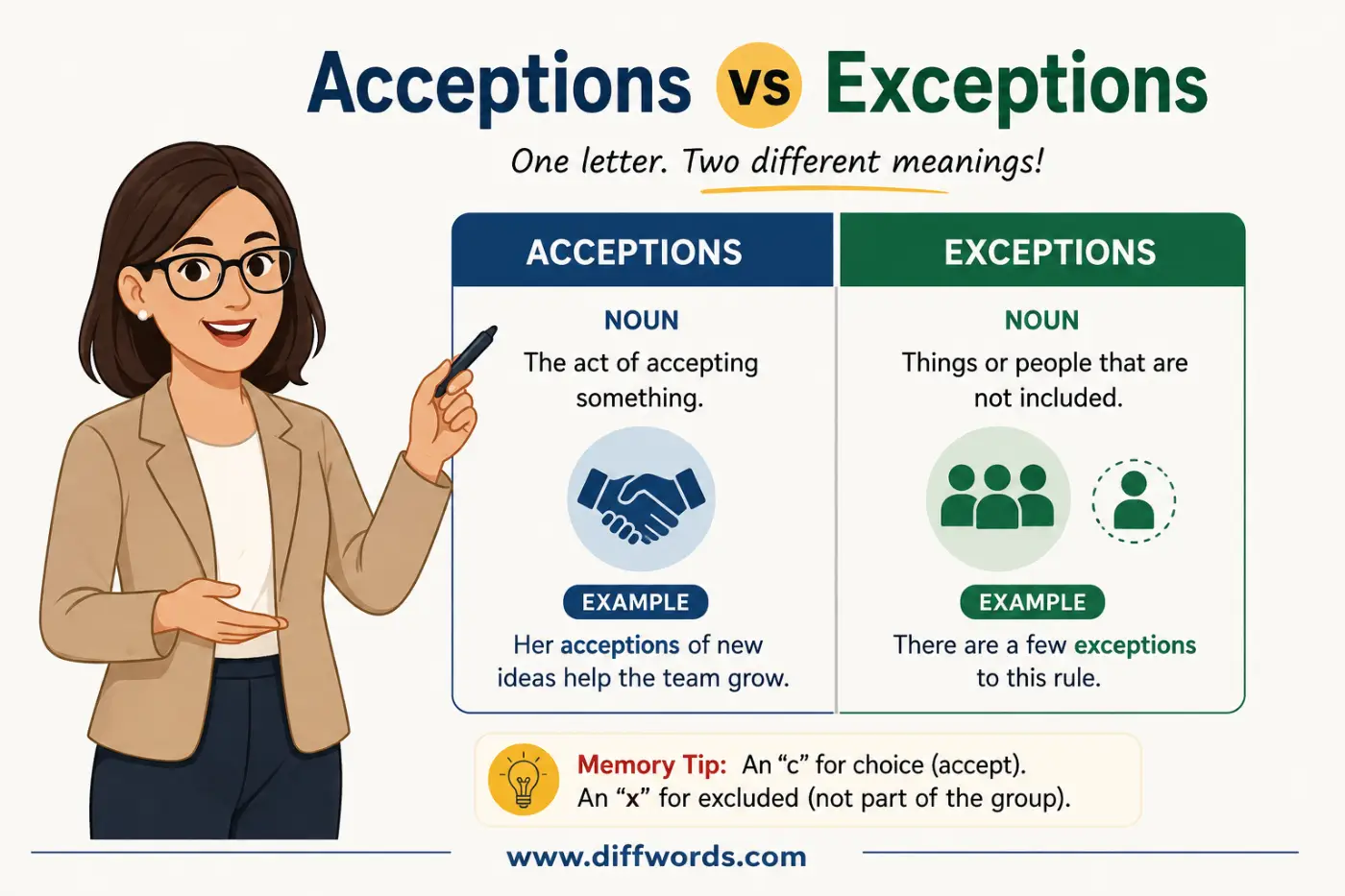
If you’re writing an email, essay, resume, or text and pause over acceptions vs exceptions, you’re dealing with two real English words that look and sound surprisingly similar. But they don’t mean the same thing, and one is far less common in modern English.
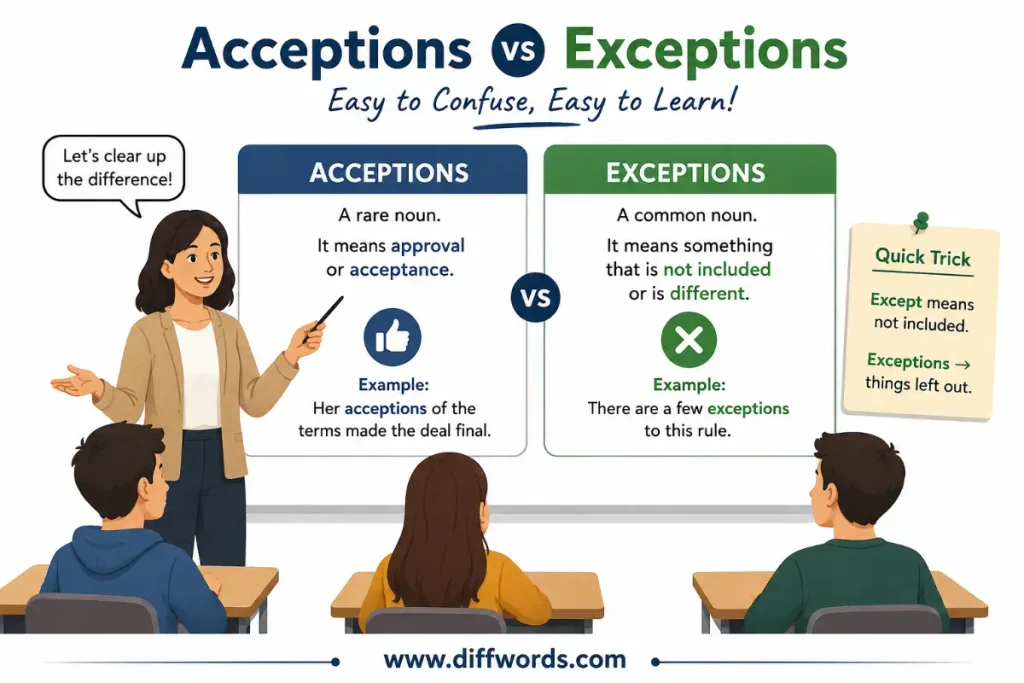
“Exceptions” is the common word for things that don’t follow a general rule. “Acceptions” is a rare word referring to particular meanings or senses given to a word or expression.
This difference matters because exception is an everyday word, while acception mainly appears in specialized discussions about language, meaning, philosophy, or older texts. If you’re talking about a rule, unusual case, or something left out, you almost certainly need exceptions.
This guide explains the meanings and origins of both words, gives you useful synonyms, compares related terms, covers US and UK usage, and shows which word works best in essays, emails, resumes, texts, and conversation. You’ll also find examples, common mistakes, and quick memory tips.
Wondering whether to write laser or lazer? Discover the correct spelling and its origin.
What do acception vs exception mean?
The easiest way to understand acceptions vs exceptions is to start with the singular forms:
- acception → a particular meaning or interpretation of a word or expression
- exception → something that doesn’t follow a rule or general statement
The plural forms are:
- acceptions
- exceptions
The two words share a similar ending, but their meanings are very different.
What does acception mean?
Acception is a rare noun used mainly to describe a particular meaning, sense, or interpretation of a word or phrase.
For example:
The word has several acceptions in older English texts.
Here, acceptions means different senses or meanings of the word.
You may encounter this word in historical dictionaries, philosophy, linguistics, theology, literary criticism, or older academic writing.
In modern everyday English, however, people usually say:
- meanings
- senses
- interpretations
- uses
- definitions
So instead of:
The term has several acceptions.
A modern writer might say:
The term has several meanings.
What does exception mean?
An exception is something that doesn’t follow a general rule, pattern, or expectation.
For example:
Everyone passed the test except one student.
That student is an exception to the general result.
Another example:
The store is open every day, with the exception of Sunday.
Here, Sunday doesn’t follow the usual schedule.
The word is extremely common in everyday English.
What is the easiest way to remember the difference between “acceptions vs exceptions”?
Use this simple rule:
Acception = a meaning or sense.
Exception = something that doesn’t follow a rule.
You can remember acception by connecting it with words such as acceptation, meaning, and sense in historical or specialized usage.
For exception, think about the phrase:
“There is an exception to the rule.”
That’s one of the most common uses of the word.
Compare:
| Word | Main idea | Example |
|---|---|---|
| Acception | A particular meaning or sense | The word has several acceptions. |
| Exception | Something outside a rule or general pattern | There is one exception to the rule. |
If you’re talking about rules, unusual cases, exclusions, or things that don’t fit, use exception.
If you’re talking about the different meanings of a word, acception may be technically appropriate, but meaning or sense will usually sound more natural today.
Where does the word acception come from?
Acception comes from the Latin acceptio, related to the idea of receiving or taking something in a particular way. It entered English through French and Latin-influenced vocabulary.
Historically, acception was used to describe a particular sense in which a word or expression was understood.
This is why the word appears in older works dealing with:
- language
- interpretation
- theology
- philosophy
- law
- rhetoric
- literature
Over time, everyday English largely moved toward simpler terms such as meaning, sense, and interpretation.
The word hasn’t disappeared completely. It can still be found in specialized dictionaries and historical discussions. But it isn’t a common word in ordinary conversation.
That difference between historical vocabulary and modern everyday vocabulary is important when deciding whether to use it.
Where does the word exception come from?
Exception comes from Latin exceptio, meaning a taking out, exclusion, or objection. It entered English through French and developed into the modern idea of something excluded from a general rule.
The basic idea has remained fairly stable:
Something is left outside the usual rule or category.
That’s why we have expressions such as:
- an exception to the rule
- make an exception
- without exception
- with the exception of
- no exceptions
- exceptional circumstances
The related verb is except, meaning to leave something or someone out.
For example:
Everyone was invited except Tom.
The noun is:
Tom was an exception.
The relationship between except and exception makes this word easier to remember.
Why are acception vs exception easy to confuse?
The words”acceptions vs exceptions” look similar because they share a common Latin-influenced structure.
They also have similar pronunciation patterns:
- acception
- exception
The first letters create the main visual difference:
Acception
Exception
But their meanings are far apart.
Another reason for confusion in”acceptions vs exceptions” is that acception is rare. Many people may encounter the word only while searching for a spelling or definition. Because exception is much more familiar, writers sometimes assume acception must be a variant spelling of it.
It isn’t.
The words”acceptions vs exceptions” are related historically, but they have separate meanings.
What are the main synonyms for acception?
Because acception is rare, its closest modern alternatives are mostly words about meaning and interpretation.
| Word | Meaning | Tone | Example |
|---|---|---|---|
| meaning | What a word or statement expresses | Simple | What is the meaning of this word? |
| definition | An explanation of a word’s meaning | Everyday | The dictionary gives a clear definition. |
| interpretation | An explanation of meaning | Neutral | Her interpretation differed from mine. |
| usage | The way a word is normally used | Formal | Modern usage has changed. |
| significance | Importance or meaning | Formal | The phrase has historical significance. |
| implication | An indirect meaning or result | Formal | The statement has a different implication. |
| definition | The stated meaning of a term | Formal | The legal definition is narrow. |
| interpretive sense | A particular understood meaning | Academic | The phrase has an interpretive sense. |
| connotation | An associated or suggested meaning | Academic | The word has a negative connotation. |
| denotation | The direct or literal meaning | Academic | The denotation is easy to identify. |
| signification | Meaning or significance | Formal | The term has several historical significations. |
| reference | What a word or expression points to | Formal | The reference of the term changed. |
| sense | A specific meaning within a word’s range | Linguistic | This sense appears in older texts. |
| interpretation | A particular understanding of a text | Formal | Several interpretations are possible. |
| conception | An idea or understanding of something | Formal | They had different conceptions of justice. |
| notion | An idea or understanding | Everyday/Formal | He had a different notion of the term. |
| usage meaning | Meaning based on actual use | Technical | The usage meaning has changed. |
| semantic sense | A meaning recognized in language study | Technical | The word has several semantic senses. |
| interpretive meaning | Meaning based on interpretation | Academic | The passage has an interpretive meaning. |
Not all of these are exact synonyms in every context. Acception is especially close to sense or meaning when discussing the different meanings of a word.
What are the main synonyms for exception?
Exception has many more everyday synonyms because the concept is common.
| Word | Meaning | Tone | Example |
|---|---|---|---|
| irregularity | Something that doesn’t follow the usual pattern | Formal | The result was an irregularity. |
| anomaly | Something unusual or unexpected | Formal | The data contained one anomaly. |
| deviation | A departure from the normal pattern | Formal | The result was a deviation from the average. |
| outlier | Something far outside a typical range | Technical | The final score was an outlier. |
| departure | A move away from the normal practice | Formal | This was a departure from tradition. |
| special case | A situation treated differently | Neutral | This is a special case. |
| qualification | A condition that limits a statement | Formal | There is one qualification to the rule. |
| reservation | A condition or limitation | Formal | He agreed, with one reservation. |
| exemption | Freedom from a rule or requirement | Formal | The law provides an exemption. |
| escape clause | A condition allowing someone to avoid a requirement | Informal/Legal | The contract contains an escape clause. |
| exclusion | Something intentionally omitted | Formal | The policy lists several exclusions. |
| anomaly | An unusual case | Technical | The result appears to be an anomaly. |
| oddity | Something unusual | Everyday | The result was an oddity. |
| abnormality | Something outside the normal range | Formal | The test showed an abnormality. |
| variation | A change from a standard form | Everyday | The rule has a small variation. |
| departure | A change from accepted practice | Formal | The policy was a major departure. |
| outlier | An unusually high or low example | Technical | One result was an outlier. |
| irregular case | A case that doesn’t follow the norm | Neutral | The court considered it an irregular case. |
| deviation | Movement away from an expected standard | Formal | The deviation was recorded. |
| exceptional case | A case outside the usual rule | Formal | The judge treated it as an exceptional case. |
| special provision | A specific rule for a special situation | Formal | The policy contains a special provision. |
| exemption | Permission not to follow a requirement | Formal | Students received an exemption. |
| out-of-pattern case | A case that differs from the usual pattern | Plain | This is an out-of-pattern case. |
Again, context matters. Exemption is not always a direct synonym for exception. An exemption specifically means freedom from a rule or obligation.
What are synonyms for acception from simple to formal?
Because acception is unusual in modern writing, the best replacement often depends on how technical your audience is.
Simple
Use:
- meaning
- sense
- idea
- use
Example:
The word has two meanings.
This is much more natural than:
The word has two acceptions.
Everyday
Use:
- interpretation
- understanding
- definition
- usage
- sense
Example:
The phrase has several possible interpretations.
Formal or academic
Use:
- semantic sense
- denotation
- connotation
- interpretation
- signification
- reading
Example:
The term has several distinct senses in medieval texts.
A specialized word is useful when precision matters. Otherwise, simpler language usually communicates better.
What are synonyms for exception from mild to strong?
Not every exception is equally unusual.
A useful scale is:
variation → special case → exception → irregularity → anomaly → extreme outlier
Mild difference
A variation may be a normal difference that doesn’t violate a rule.
The design allows some variation.
Special case
A special case is handled differently because its circumstances are different.
This application is a special case.
Exception
An exception doesn’t follow the general rule.
There is one exception to the policy.
Irregularity
An irregularity suggests that something doesn’t follow an expected pattern.
The audit found an irregularity.
Anomaly
An anomaly is something unusual or unexpected, especially in data or technical work.
The scientist noticed an anomaly in the results.
Extreme outlier
An outlier is a value or case far outside the normal range.
The unusually high result was an outlier.
These words overlap, but they aren’t interchangeable in every situation.
What parts of speech are acception vs exception?
Both acception vs exception are nouns.
Their related forms are different.
Acception family
- acception — noun
- accept — verb, but not a direct grammatical form of acception
- acceptance — noun
- acceptable — adjective
Be careful here: acception does not simply mean acceptance.
Exception family
- exception — noun
- except — preposition, conjunction, or verb depending on use
- exceptional — adjective
- exceptionally — adverb
For example:
Everyone came except John.
John was the exception.
It was an exceptional result.
The words are connected in meaning and history.
Is acception the same as acceptance?
No. This is another important distinction.
Acceptance usually means receiving or agreeing to something.
The university sent her an acceptance letter.
Acception, in its rare linguistic sense, refers to a particular meaning or sense of a word or expression.
The term has several acceptions in historical texts.
These are very different meanings.
| Word | Meaning | Example |
|---|---|---|
| Acceptance | Agreement, approval, or receiving something | He received acceptance into the program. |
| Acception | A particular meaning or sense | The word has several acceptions. |
If you’re talking about approval or agreement, use acceptance, not acception.
Is acception the same as meaning?
In some specialized contexts, acception can be replaced by meaning or sense.
For example:
The word has several acceptions.
can be expressed more naturally as:
The word has several meanings.
or:
The word has several senses.
Meaning is much more common and easier for a general audience to understand.
If you’re writing a specialized linguistic or historical discussion, acception may be appropriate. Otherwise, meaning is usually the better choice.
Is exception the same as exclusion?
Not exactly.
An exception is something that doesn’t follow a general rule.
An exclusion is something deliberately left out.
Compare:
The policy applies to everyone, with one exception.
This means one case is treated differently.
The policy includes an exclusion for temporary workers.
This means temporary workers are specifically left outside the policy.
There is overlap, but the focus differs.
| Word | Main idea | Example |
|---|---|---|
| Exception | A case that doesn’t follow a general rule | There is one exception to the rule. |
| Exclusion | Something deliberately left out | The policy has an exclusion for contractors. |
Exception vs exemption — what’s the difference?
These words are often confused.
An exception is a case that doesn’t follow a general rule.
An exemption is official permission to be free from a rule, requirement, payment, or obligation.
For example:
Children under five are an exception to the age rule.
This says they are treated differently.
Children under five have an exemption from the fee.
This specifically says they don’t have to pay the fee.
| Word | Meaning | Example |
|---|---|---|
| Exception | A case that differs from the general rule | This is an exception to the rule. |
| Exemption | Freedom from a requirement | She received an exemption from the fee. |
In legal, tax, school, and workplace contexts, exemption can be much more precise.
Exception vs anomaly — what’s the difference?
An exception is usually defined in relation to a rule.
An anomaly is something unusual or unexpected compared with a pattern.
For example:
This student is an exception to the school’s usual attendance pattern.
The student is a specific case that doesn’t fit the general pattern.
But:
The unusually high measurement was an anomaly.
The measurement is unexpected, especially in a dataset.
Think of it this way:
- exception → different from a rule
- anomaly → unusual compared with a pattern
What does “with the exception of” mean?
With the exception of means excluding or apart from.
For example:
Everyone attended the meeting, with the exception of Maria.
This means Maria did not attend.
You could write more simply:
Everyone attended the meeting except Maria.
Both are correct.
The phrase is common in formal writing, while except is often shorter and more direct.
More examples:
The store is open every day with the exception of Christmas Day.
All applicants were accepted, with the exception of two candidates.
The report is complete, with the exception of the final section.
What does “make an exception” mean?
Make an exception means to allow someone or something to be treated differently from the usual rule.
For example:
We normally don’t accept late applications, but we’ll make an exception this time.
The normal rule remains in place, but one case receives different treatment.
This phrase is common in everyday English.
Other examples:
My teacher made an exception and allowed me to submit the assignment late.
The restaurant doesn’t usually take large groups, but the manager made an exception.
What does “the exception proves the rule” mean?
The exception proves the rule is a traditional expression. It is often misunderstood.
People sometimes use it to mean that an exception somehow proves a general rule is true. More precisely, the saying can refer to an exception that highlights or implies that a rule exists.
For example, if a sign says:
Parking allowed on Sundays.
That may imply that parking is restricted on other days.
In everyday conversation, however, people often use the expression loosely.
If you’re writing formal or academic content, it’s better to explain the actual relationship between the general rule and the unusual case rather than relying on the saying.
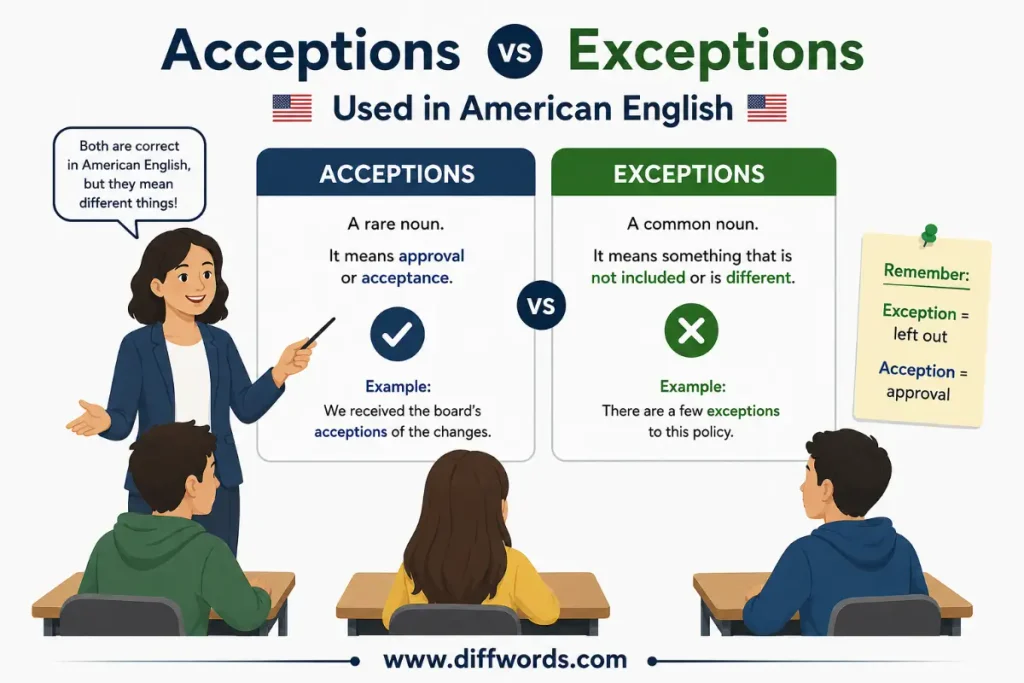
How is acception vs exception used in American English?
In American English, exception is common and familiar.
You will regularly see it in:
- school writing
- business writing
- contracts
- instructions
- news
- conversation
- technical writing
Acception, by contrast, is rare.
A typical American reader may understand it from context, but many readers would find meaning or sense more natural.
This isn’t a major US-versus-UK spelling issue. The main difference is one of frequency and style.
Is acception used more in British English?
The word acception can be found in British historical and academic writing, just as it can in American sources. But it isn’t an everyday British alternative to exception.
The key point is that acception remains specialized or uncommon in both major varieties of English.
Exception is standard and common in both.
So you shouldn’t choose acception simply because you’re writing for a British audience.
Which word”acceptions vs exceptions” should you use in a resume?
For a resume, exception is much more likely to be useful.
For example:
Processed applications according to company policy, including approved exceptions.
Or:
Reviewed unusual cases and documented exceptions to standard procedures.
Acception would be unusual on a resume unless you’re applying for a position involving historical linguistics, lexicography, philosophy of language, or a closely related field.
If you’re describing different meanings of a word in a language-related job, you could use sense, meaning, or interpretation instead.
For example:
Analyzed multiple senses of technical terms.
That is clearer for most employers.
Which word”acceptions vs exceptions” should you use in an essay?
The answer depends on the subject.
If your essay discusses rules or unusual cases:
There are several exceptions to this pattern.
Use exception.
If your essay discusses word meanings:
The term has several senses in historical English.
Usually, senses is better than acceptions for a general academic audience.
If you’re writing a specialized linguistics paper, acception may be appropriate when the source or field uses it precisely.
The key is to match the word to the topic.
Which word”acceptions vs exceptions” should you use in texting?
In texting, exception is natural.
Everyone is coming except Jake.
That’s the only exception.
You probably won’t need acception in a normal text.
If you’re discussing vocabulary, simply say:
That word has two meanings.
This is clearer than:
That word has two acceptions.
The second sentence is grammatically possible in specialized usage, but it sounds unusually formal for texting.
Which word”Acceptions vs Exceptions” should you use in an email?
For most emails, use exception when discussing rules and meaning or sense when discussing language.
For example:
There is one exception to the deadline.
Or:
This term has a different meaning in the legal context.
Using acception in an ordinary business email may make the sentence harder to understand without adding useful information.
Which word should you use when speaking?
In everyday speech, exception is common.
Acception is rare enough that it may sound unfamiliar or overly technical.
Instead of:
There are several acceptions of this term.
Say:
This term has several meanings.
Or:
This word has several senses.
The simpler option will usually be easier for your listener.
What are common mistakes with acception vs exception?
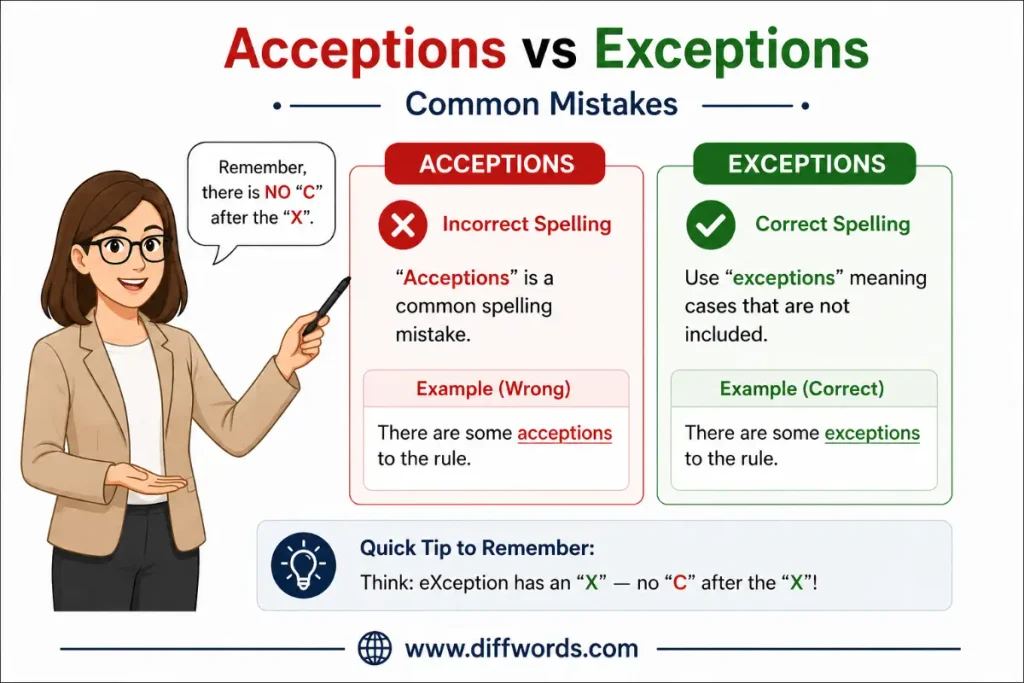
Mistake 1: Using acception for an unusual case
Incorrect:
This is an acception to the rule.
Correct:
This is an exception to the rule.
An unusual case is an exception, not an acception.
Mistake 2: Using exception for a word meaning
Incorrect:
The word has several exceptions.
if you mean the word has several meanings.
Better:
The word has several meanings.
Or, in specialized writing:
The word has several acceptions.
Mistake 3: Confusing acception with acceptance
Incorrect:
The university sent my acception letter.
Correct:
The university sent my acceptance letter.
Acceptance means approval or agreement.
Mistake 4: Assuming acception is a spelling variant
Acception and exception are not alternate spellings of the same word.
They have different meanings.
Mistake 5: Using exception when exemption is more precise
If someone is officially free from a requirement, exemption may be the better word.
She received an exemption from the requirement.
This is more precise than simply calling her situation an exception.
Mistake 6: Using acception in simple writing
Even when technically correct, acception may be unnecessarily difficult for general readers.
Instead of:
The phrase has several acceptions.
consider:
The phrase has several meanings.
Clear writing should usually win.
When should you NOT use acception?
Don’t use acception when you mean:
- exception
- exemption
- acceptance
- approval
- permission
- unusual case
- rule-breaking case
Use the appropriate word instead.
For example:
The school made an exception.
Not:
The school made an acception.
And:
She received acceptance into the program.
Not:
She received acception into the program.
Use acception only when you genuinely mean a particular sense or meaning of a word or expression and the specialized term fits your audience.
When should you NOT use exception?
Don’t use exception when you’re simply talking about the meaning of a word.
For example:
This word has three meanings.
Not:
This word has three exceptions.
Also, don’t use exception when exemption is the exact legal or administrative concept.
And don’t use exception for every unusual event. An anomaly, outlier, or variation may be more accurate depending on the situation.
What are the antonyms of exception?
There isn’t one universal antonym, but possible contrasts include:
- rule
- norm
- standard case
- typical case
- inclusion
- conformity
- regularity
For example:
An exception differs from the norm.
A typical case follows the general rule.
For acception, possible contrasts depend on the intended meaning. Since it refers to a particular sense or meaning, there isn’t a simple everyday antonym.
What are the related words for exception?
Understanding related words can make the concept easier to use.
Except
Except means leaving someone or something out.
Everyone came except John.
Exceptional
Exceptional means unusually good, unusual, or outside the ordinary range.
She showed exceptional skill.
Note that exceptional doesn’t simply mean “an exception.” It often carries a positive meaning when describing people or performance.
Exceptionally
This is the adverb.
The team performed exceptionally well.
Exempt
Exempt means not required to follow a particular rule.
Children under six are exempt from the fee.
Exemption
An exemption is the state or official permission of being exempt.
He received a tax exemption.
These related forms are much more common than acception.
What are the related words for acception?
Because acception is specialized, its closest related vocabulary is mostly about language and meaning.
Useful terms include:
- meaning
- sense
- interpretation
- definition
- usage
- denotation
- connotation
- signification
- semantic sense
- reading
For example:
The word has a different sense in this context.
This is usually more natural than:
The word has a different acception in this context.
Both can convey the idea, but the first is easier for most readers.
How can you choose the right word quickly with Acceptions vs Exceptions?
Ask one question:
Am I talking about a meaning, or am I talking about a rule?
If you’re talking about a meaning, consider:
- meaning
- sense
- interpretation
- definition
- usage
- acception
If you’re talking about a rule, consider:
- exception
- exemption
- exclusion
- special case
- deviation
- anomaly
This single test eliminates most confusion.
If the sentence involves “to the rule”
Use exception.
There is an exception to the rule.
If the sentence involves “meaning”
Use meaning, sense, or sometimes acception.
The word has several senses.
If the sentence involves official freedom from a requirement
Use exemption.
She received an exemption from the requirement.
If the sentence involves something being left out
Use exclusion or exception, depending on the exact meaning.
The policy contains an exclusion for contractors.
What are 15 example sentences using exception?
- There is one exception to the school rule.
- Everyone attended the meeting with the exception of two employees.
- The manager made an exception for the customer.
- This case is an exception to the usual pattern.
- The store is open every day, without exception.
- The policy applies to all workers, with a few limited exceptions.
- The unusually high score was an exception to the general trend.
- We normally require payment in advance, but we’ll make an exception this time.
- The rule has several important exceptions.
- No one is allowed inside, with the exception of authorized staff.
- The teacher explained that the irregular verb was an exception.
- The law contains an exception for emergency situations.
- Her case was unusual but not the only exception.
- The company rarely changes its policy, except in exceptional circumstances.
- The data showed one clear exception to the expected pattern.
What are 10 example sentences using acception?
Because acception is uncommon, these examples use it in specialized or language-focused contexts.
- The word has several acceptions in historical English.
- The dictionary records an older acception of the term.
- Scholars debated which acception of the word was intended.
- The passage uses the term in a different acception.
- The author gives the word a narrow acception in this chapter.
- Several acceptions of the phrase appear in medieval texts.
- The translator selected one acception based on the surrounding context.
- The philosophical text uses the term in a specialized acception.
- The older acception is rarely found in modern speech.
- Researchers compared the historical and modern acceptions of the term.
In everyday writing, you could usually replace these with meaning, sense, or interpretation.
Why is exception much more common than acception?
The concepts have very different places in everyday language.
People regularly need to talk about:
- rules
- policies
- unusual cases
- exclusions
- schedules
- requirements
- special situations
So exception is a useful everyday word.
People less often need a special noun for a particular meaning of a word. In ordinary conversation, meaning and sense already perform that job.
As a result, acception survives mainly in specialized or historical language.
This is an important lesson for vocabulary choice: a word can be valid English without being the best word for ordinary communication.
Should you use acception in modern writing?
Usually, no—not unless you have a specific reason.
If you’re writing for a general audience, meaning or sense will almost always be clearer.
For example:
The word has two meanings.
is more accessible than:
The word has two acceptions.
But if you’re writing a scholarly article about historical definitions, dictionaries, or the development of a word, acception may be useful.
The best vocabulary depends on the audience and subject.
Can acception and acceptance ever be confused?
Yes, especially because they look similar.
Compare:
acceptance = approval, agreement, or receiving something
acception = a particular meaning or sense
Examples:
Her acceptance into the university made her family proud.
The term has a different acception in this historical text.
The words aren’t interchangeable.
If you can replace the word with approval, you probably mean acceptance.
If you can replace it with meaning or sense, you may mean acception.
What should you remember about acception vs exception?
The biggest difference is the first part of each word.
Acception is connected with accepting a particular meaning or sense in specialized language.
Exception is connected with excluding something from a general rule.
A simple memory chart is:
| If you mean… | Use |
|---|---|
| A particular meaning of a word | acception |
| A normal modern synonym for that meaning | meaning / sense |
| Something outside a rule | exception |
| Freedom from a requirement | exemption |
| Approval or agreement | acceptance |
| Something deliberately left out | exclusion |
If you remember these six ideas, you’ll avoid most errors.
Quick tips for choosing the right word”Acceptions vs Exceptions”
- Use exception for something that doesn’t follow a rule.
- Use acception only when discussing a particular meaning or sense of a word.
- In general writing, prefer meaning or sense over acception.
- Don’t confuse acception with acceptance.
- Don’t confuse exception with exemption.
- Use exclusion when the main idea is deliberately leaving something out.
- Use anomaly for an unusual result or pattern.
- Use outlier for a value far outside a normal range.
- Use exceptional for something unusually good or unusual.
- Remember the phrase “an exception to the rule.”
- If your sentence is about language, ask whether you mean a meaning.
- If your sentence is about a rule, ask whether you mean a special case.
- Choose simple words when your audience doesn’t need specialized vocabulary.

Conclusion
The best way to understand acceptions vs exceptions is to separate the two ideas: acception is about meaning, while exception is about rules. An acception is a particular sense or interpretation of a word, but the term is uncommon in modern everyday English. In most situations, meaning or sense will be clearer.
Exception, by contrast, is a common word used when something doesn’t follow a general rule or pattern. It’s also the word in familiar phrases such as “an exception to the rule” and “with the exception of.”
Don’t confuse acception with acceptance, either. Acceptance means approval or agreement. If you keep these distinctions in mind, choosing the right word becomes much easier. When in doubt, ask whether you’re discussing a meaning or a rule. That quick check will usually point you to the right choice.
Frequently Asked Questions
What is the difference between acception vs exception?
Acception refers to a particular meaning or sense of a word, while exception refers to something that doesn’t follow a general rule. Exception is far more common in modern English.
Is acception a real English word?
Yes, acception is a real but uncommon English word. It is mainly used in specialized, historical, linguistic, philosophical, or literary contexts to mean a particular sense or meaning.
Is it acception vs exception to the rule?
The correct phrase is “exception to the rule.” You use exception when something doesn’t follow a general rule.
What’s another word for acception?
Meaning or sense is usually the best modern alternative to acception. Interpretation, definition, and usage can also work depending on the context.
Is acception the same as acceptance?
No, acception and acceptance have different meanings. Acceptance means approval or agreement, while acception can refer to a particular meaning or sense of a word.
When should I use exception instead of exemption?
Use exception for a case that differs from a general rule, and exemption when someone or something is officially freed from a requirement. For example, a person may receive an exemption from a fee.
Are acception vs exception spelled correctly?
Both “acceptions vs exceptions“are real spellings, but they represent different words. Acception is rare and relates to meaning or sense; exception is common and relates to rules, exclusions, and unusual cases.
Meta Description: Acceptions vs exceptions explained clearly: learn the meanings, differences, synonyms, examples, origins, and common mistakes.
1 thought on “Acceptions vs Exceptions: The Ultimate Simple Guide”