
You’re writing an email, essay, report, or resume, and you pause over two words that look almost identical: extent vs extant. They differ by just one letter, but their meanings are completely different. Choosing the wrong one can change your sentence or make your writing look careless.
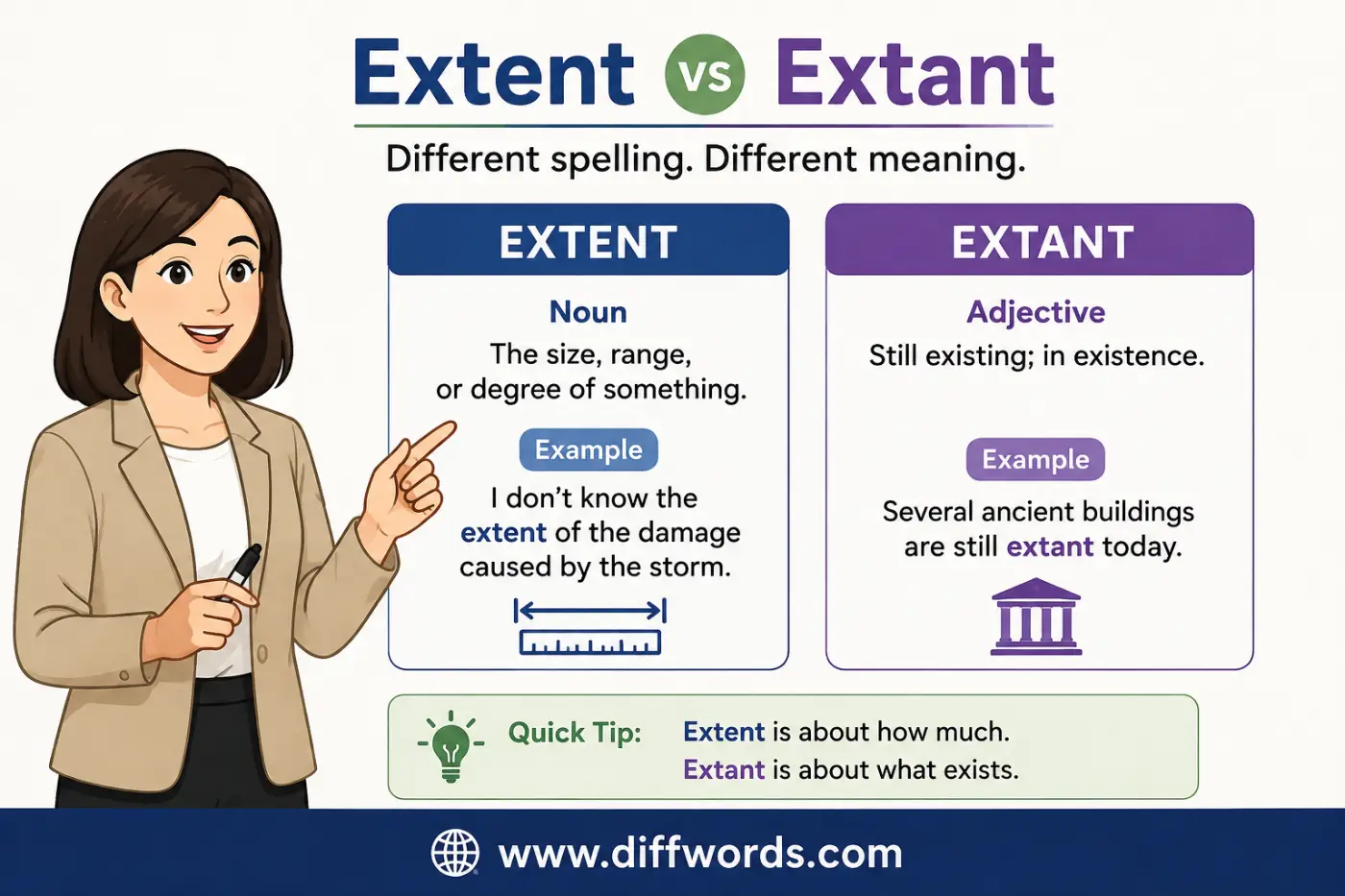
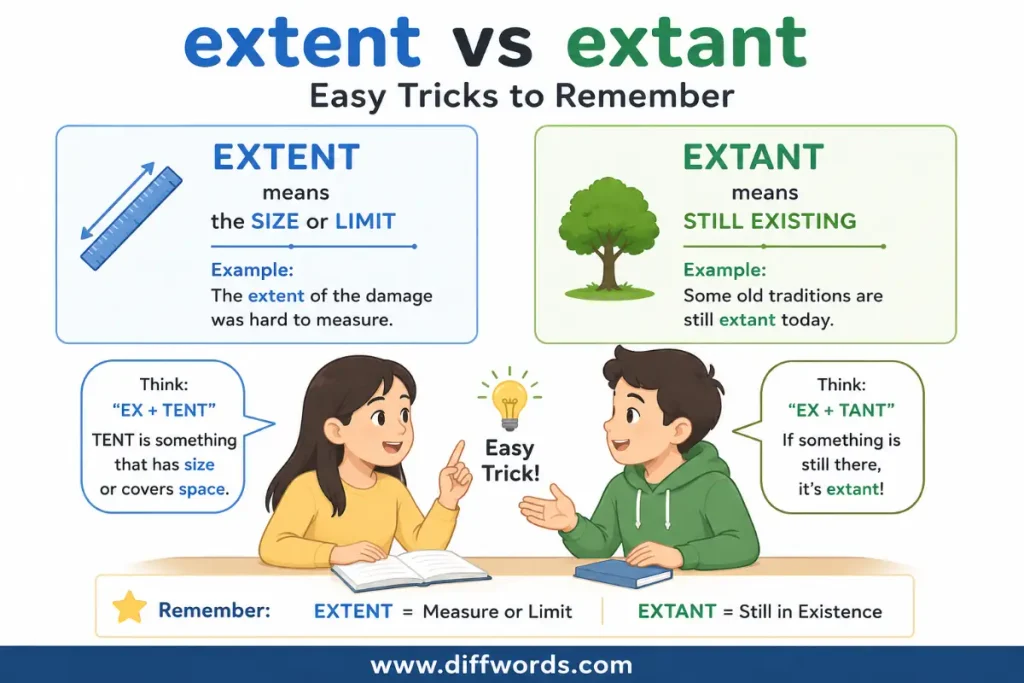
Extent means the size, degree, range, or limits of something. Extant means still existing, especially something that has survived from the past.
The easiest way to remember them is simple: extent is about how much, how far, or how large, while extant is about what still exists. For example, “the extent of the damage” asks how much damage there is, while “extant records” are records that still exist.
This guide explains the difference, word origins, meanings, synonyms, grammar, regional usage, examples, common mistakes, and the best word for different writing situations. By the end, you’ll know exactly when to use each word.
Should you write reinforce or reenforce? Find out which spelling is standard and how to use it.
What is the difference between extent vs extant?
The main difference between extent vs extant is their meaning and grammatical role.
Extent is a noun. It refers to the size, degree, range, scope, or limits of something.
“We don’t yet know the extent of the damage.”
Here, “extent” means how much damage occurred.
Extant is an adjective. It describes something that still exists, especially something that has survived from an earlier time.
“The museum contains several extant copies of the manuscript.”
Here, “extant” means copies that still exist.
| Word | Part of speech | Basic meaning | Example |
|---|---|---|---|
| extent | Noun | Size, degree, range, or limits | “The extent of the problem surprised us.” |
| extant | Adjective | Still existing or surviving | “Only a few extant copies remain.” |
A quick memory rule is:
Extent = how much or how far.
Extant = still existing.
What does extent mean in simple English?
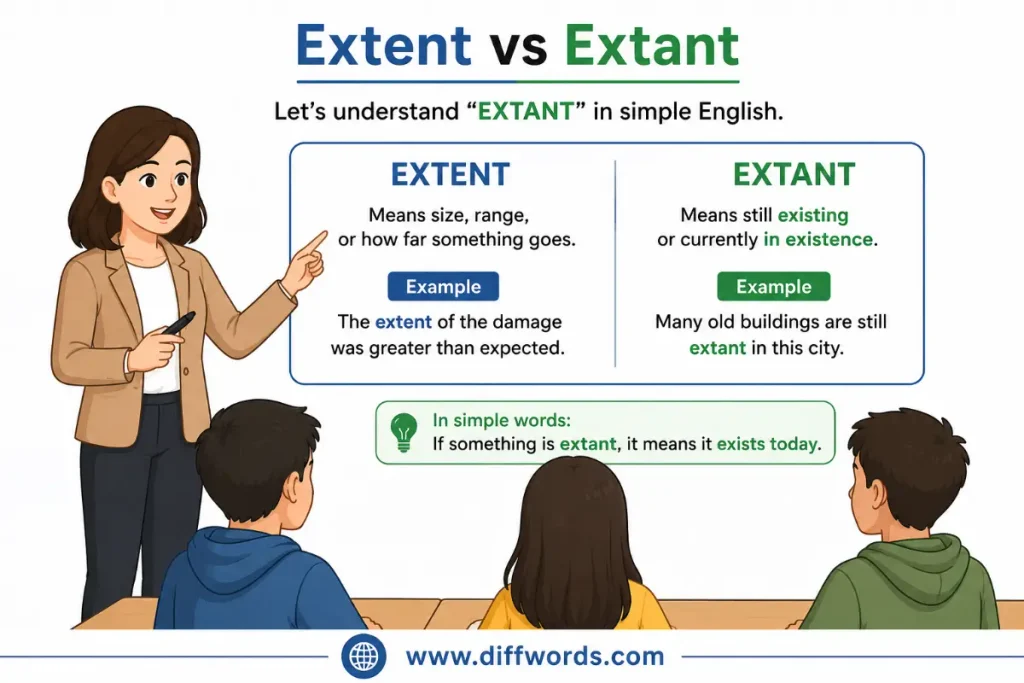
Extent means the amount, size, degree, range, or limits of something.
It often answers questions such as:
- How much?
- How large?
- How far?
- How serious?
- How wide?
- How broad?
- How significant?
For example:
“We need to understand the extent of the problem.”
This means:
“We need to understand how large or serious the problem is.”
You can use extent for physical things:
“The extent of the forest is difficult to measure.”
You can also use it for abstract ideas:
“The report examines the extent of poverty in the region.”
“The full extent of the damage wasn’t known until morning.”
“Scientists are studying the extent of the environmental impact.”
The word is common in formal, academic, business, and everyday English.
What are the most common meanings of extent?
Extent has several closely related meanings.
Extent as size or area
It can describe how large something is physically.
“The full extent of the property was difficult to see.”
Here, extent refers to the property’s size or boundaries.
Extent as degree
It can describe how strong, serious, or significant something is.
“The extent of the problem became clear later.”
Here, it means the degree or seriousness of the problem.
Extent as range
It can describe how far something reaches.
“The survey measured the extent of the changes.”
The word refers to the range or scope of the changes.
Extent as limits
It can refer to the boundaries of something.
“The law defines the extent of the government’s authority.”
Here, extent refers to the limits of that authority.
What does extant mean in simple English?
Extant means still existing, especially when something has survived from an earlier period.
It is an adjective, so it normally describes a noun.
For example:
“Several extant manuscripts provide clues about the author’s work.”
The manuscripts still exist.
Another example:
“Only a few extant buildings remain from the original settlement.”
The buildings have survived.
The word is especially useful when discussing:
- ancient texts,
- historical records,
- old buildings,
- manuscripts,
- artworks,
- extinct or nearly extinct traditions,
- historical evidence,
- surviving documents,
- ancient languages,
- scientific specimens.
You can think of extant as meaning:
existing now, especially despite the passage of time.
Why do extent vs extant look so similar?
The confusion comes from their spelling.
Both words begin with ext-, and both are pronounced differently enough that the distinction can disappear when you’re reading quickly.
Compare:
- extent → ex-TENT
- extant → EX-tant
Their meanings, however, are unrelated enough that you should treat them as separate vocabulary words.
A useful spelling association is:
extent → extend → how far or how much
The word extend is closely connected in meaning to extent.
For extant, think:
extant → existing
Both begin with ex, but the important point is meaning rather than spelling.
Where did the word extent come from?
Extent comes from Latin roots related to the idea of stretching or spreading out.
It is connected to the Latin verb extendere, meaning “to stretch out” or “to spread out.” English developed extend, extent, and related words from this family.
That history makes sense because extent often describes how far something stretches.
For example:
“The extent of the desert is enormous.”
You are asking how far the desert stretches.
The word later developed broader meanings involving degree, scope, and limits.
That’s why we can talk about:
- the extent of damage,
- the extent of a problem,
- the extent of someone’s authority,
- the extent of a person’s knowledge.
These uses all involve the idea of how far something reaches.
Where did the word extant come from?
Extant comes from Latin extare, meaning “to stand out,” “to stand forth,” or “to exist.”
Over time, English came to use extant for things that have survived and are still available or existing.
The word is particularly common when discussing things from the past.
For example:
“The researcher examined all extant copies of the document.”
This means the researcher examined all copies that still survive.
The word has a formal and somewhat academic tone, so you’re more likely to see it in history, literature, archaeology, law, research, and scholarly writing than in casual conversation.
What are the best synonyms for extent?
Because extent has several meanings, its synonyms depend on context.
Here is a broad list grouped by tone and use.
| Word | Meaning | Tone | Example |
|---|---|---|---|
| size | How large something is | Simple | “We measured the size of the area.” |
| degree | Level or intensity | Simple/Formal | “The degree of risk is unclear.” |
| scope | Overall range or coverage | Formal | “The scope of the project expanded.” |
| scale | Size or level | Everyday/Formal | “The scale of the problem is large.” |
| reach | How far something extends | Everyday | “The campaign has a wide reach.” |
| magnitude | Greatness or size | Formal | “Scientists measured the magnitude of the change.” |
| severity | Seriousness | Formal | “The severity of the damage was unclear.” |
| intensity | Strength or force | Formal | “The intensity of the storm increased.” |
| measure | Amount or degree | Formal | “We need to assess the measure of risk.” |
| proportion | Relative amount | Formal | “A large proportion of the area was affected.” |
| coverage | Area or subjects included | Everyday/Formal | “The report offers broad coverage.” |
| span | Distance or period covered | Everyday | “The study spans several decades.” |
| limit | Furthest point or boundary | Simple | “The law sets a limit.” |
| boundary | Edge or restriction | Everyday/Formal | “The agreement defines the boundaries.” |
| capacity | Maximum amount something can contain | Formal | “The system reached its capacity.” |
| volume | Amount or size | Everyday/Formal | “The volume of traffic increased.” |
| dimension | Measurable aspect of size | Formal | “The project has several dimensions.” |
| range | Area or variety covered | Everyday | “The store has a wide range of products.” |
| enormity | Great size or seriousness | Formal | “The enormity of the crisis became clear.” |
| expanse | Large continuous area | Formal/Literary | “The desert’s vast expanse was breathtaking.” |
| territory | Area covered or controlled | Everyday/Formal | “The company expanded into new territory.” |
| extent | Degree, size, or range | Neutral | “We don’t know the full extent of the damage.” |
Some of these words overlap, but they aren’t interchangeable in every sentence.
What are the best synonyms for extant?
Extant is easier to understand because its main meaning is “still existing.”
Possible alternatives include:
| Word | Meaning | Tone | Example |
|---|---|---|---|
| existing | Still present | Simple | “Existing records were reviewed.” |
| surviving | Still remaining | Everyday | “Surviving documents reveal new details.” |
| remaining | Still left | Simple | “The remaining buildings are protected.” |
| preserved | Kept in its original or useful state | Everyday/Formal | “The preserved manuscript is valuable.” |
| living | Still existing or practiced | Everyday | “The tradition remains a living practice.” |
| current | Existing now | Simple | “Current records show a different trend.” |
| present | Existing at this time | Simple | “The present evidence is limited.” |
| available | Still obtainable or accessible | Everyday | “Only a few copies are available.” |
| standing | Still upright or operating | Everyday | “Several standing structures remain.” |
| remaining | Still in existence | Simple | “The remaining evidence is limited.” |
| surviving | Having lasted until now | Everyday | “The surviving artwork is rare.” |
| preserved | Protected from destruction or decay | Formal | “The preserved text is centuries old.” |
| retained | Kept rather than lost | Formal | “Several records were retained.” |
| unextinct | Not extinct | Technical | “The species is still unextinct in this region.” |
| extant | Still existing | Formal | “Only three extant copies are known.” |
The closest everyday synonym is usually existing or surviving.
What are synonyms for extent by intensity?
The best synonym can change depending on the size or degree you’re describing.
Mild or limited extent
Use:
- amount
- degree
- level
- scope
- range
- size
Example:
“The degree of the change was small.”
Moderate extent
Use:
- scale
- breadth
- reach
- span
- scope
- magnitude
Example:
“The scale of the project is considerable.”
Very large extent
Use:
- vastness
- magnitude
- enormity
- expanse
- breadth
- enormous scale
Example:
“The enormous scale of the disaster surprised officials.”
You don’t always need a stronger synonym. Extent itself is neutral and works well when you don’t want to exaggerate.
What are synonyms for extant by degree of certainty?
When describing something that still exists, your word choice can show how certain or specific you are.
Clearly existing
Use:
- existing
- present
- current
- available
Example:
“The existing records are stored in the archive.”
Surviving from the past
Use:
- surviving
- preserved
- extant
Example:
“The surviving manuscripts offer valuable evidence.”
Still practiced or active
Use:
- living
- active
- continuing
- current
Example:
“The tradition remains a living cultural practice.”
“Extant” is especially useful when something has survived from an earlier period.
Are This is one of the easiest ways to separate the words.
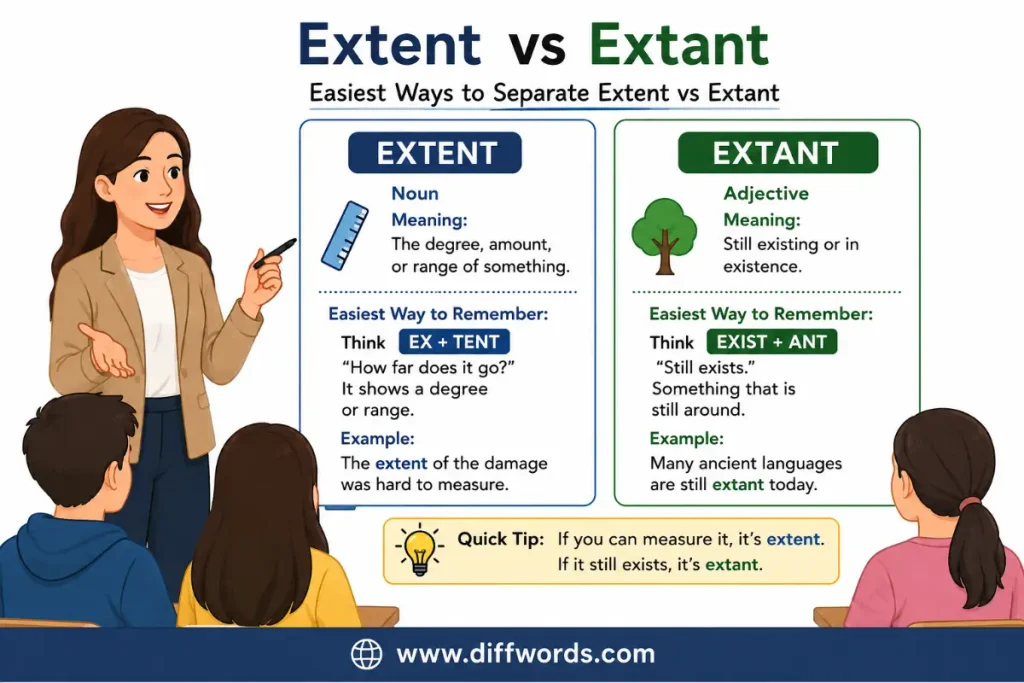
Extent is a noun
A noun names a thing, idea, place, person, or concept.
Examples:
“The extent of the damage is unknown.”
“We studied the extent of the problem.”
“The law limits the extent of government power.”
You can often put the before extent:
“the extent”
Common patterns include:
- the extent of
- to some extent
- to a certain extent
- to what extent
- the full extent
Extant is an adjective
An adjective describes a noun.
Examples:
“extant records”
“extant manuscripts”
“extant buildings”
“extant evidence”
You wouldn’t normally say:
“The extant of the problem…”
That’s incorrect.
And you wouldn’t normally use “extant” by itself as the noun meaning “amount.”
What does “to some extent” mean?
To some extent means partly, somewhat, or to a certain degree.
Examples:
“I agree with you to some extent.”
This means:
“I agree with you partly, but not completely.”
Another example:
“The new policy was successful to some extent.”
The policy had some success, but not complete success.
This is one of the most common expressions using extent.
What does “to a great extent” mean?
It means very much or to a large degree.
“The decision was influenced to a great extent by public opinion.”
What does “to a certain extent” mean?
It means partly, within some limits.
“The criticism is valid to a certain extent.”
What does “to what extent” mean?
It asks how much, how far, or how strongly something is true.
“To what extent did the policy improve public safety?”
This phrase is especially common in academic questions and essay prompts.
What does “the full extent” mean?
The full extent means the complete size, degree, range, or seriousness of something.
Examples:
“We don’t yet know the full extent of the damage.”
“The investigation revealed the full extent of the fraud.”
“Scientists are still studying the full extent of the environmental impact.”
This expression is especially common when the complete situation isn’t immediately known.
What are common phrases with extent?
Learning common word combinations can make your writing more natural.
The extent of
“The extent of the damage is still unknown.”
To some extent
“The plan worked to some extent.”
To a certain extent
“The criticism is fair to a certain extent.”
Also to a large extent
“The outcome depended to a large extent on timing.”
To what extent
“To what extent did the policy succeed?”
To the extent that
“The company improved to the extent that customer complaints declined.”
Full extent
“The full extent of the problem became clear later.”
Great extent
“The decision was influenced to a great extent by cost.”
These patterns are far more common than trying to use extent as a direct synonym for “size” in every sentence.
What are common phrases with extant?
Because extant is formal, it often appears in specific combinations.
Extant manuscripts
“Researchers compared several extant manuscripts.”
Extant records
“The extant records are incomplete.”
Also extant copies
“Only two extant copies are known.”
Extant texts
“The scholar studied all extant texts.”
And extant evidence
“The extant evidence suggests a different explanation.”
Extant species
“Several extant species are related to the ancient group.”
Extant literature
“The review examines the extant literature on the subject.”
The phrase extant literature is especially common in academic and research writing.
How is extent used in academic writing?
Extent is very common in essays, research papers, and academic discussions.
Examples:
“The study examines the extent to which social media affects learning.”
“Researchers measured the extent of the change.”
“The evidence shows the extent of the problem.”
“The essay evaluates the extent to which the policy was successful.”
One especially useful pattern is:
the extent to which
For example:
“The researchers examined the extent to which exercise affects memory.”
This means they studied how much exercise affects memory.
How is extant used in academic writing?
Extant is also common in academic writing, but in a different way.
Examples:
“The study reviews the extant literature.”
“Researchers examined extant historical records.”
“The few extant manuscripts provide valuable evidence.”
Here, extant means that the sources or materials still exist.
This distinction is important:
“The extent of the literature”
means the range or size of the literature.
“The extant literature”
means the literature that currently exists.
Those sentences can look similar but mean very different things.
What is the best word for a resume: extent vs extant?
For most resumes, extent is more likely to be useful than extant, but neither should be used simply to sound professional.
You might use extent when describing the scale or reach of an accomplishment.
For example:
“Expanded the extent of customer support coverage across three regions.”
However, a stronger resume often uses a direct measurement:
“Expanded customer support coverage from two regions to five.”
Extant is uncommon on resumes. It can sound overly academic unless you’re working in research, history, archaeology, literature, or another field where surviving materials matter.
For example, a historian might write:
“Cataloged extant archival materials from the 19th century.”
In most business resumes, simpler wording is better.
Which word works best in an essay: extent vs extant
Both words can work in essays, but they serve different purposes.
Use extent when discussing degree, scope, or impact:
“This essay examines the extent of the policy’s influence.”
Use extant when describing surviving sources or materials:
“The essay draws on several extant historical records.”
A useful academic distinction is:
- extent of the problem = how large or serious the problem is
- extant evidence = evidence that still exists
Don’t swap them.
Which word works best in texting?
Extent is much more likely to appear in texting than extant, although both are less common in casual messages than simpler words.
For example:
“I agree to some extent.”
This is understandable, though a friend might simply say:
“I agree a little.”
Extant is rare in casual texting.
Instead of:
“Are there any extant copies?”
a casual speaker might say:
“Are there any copies left?”
The formal word isn’t wrong. It just may not match the tone.
Which word works best in an email?
For a professional email, extent is useful when discussing scale, impact, or degree.
“We need to assess the extent of the issue before deciding what to do.”
Extant can be appropriate when discussing historical, legal, scientific, or archival materials.
“I’ve attached the extant records available in our archive.”
For ordinary workplace communication, however, existing or remaining may sound more natural than extant.
Which word works best when speaking: extent vs extant
In everyday conversation, extent is common.
You might say:
“I don’t know the full extent of the problem.”
You might also say:
“I agree to some extent.”
Extant is much less common in casual speech because it has a formal tone.
Instead of:
“What extant documents do you have?”
most people would say:
“What documents still exist?”
The meaning is similar, but the second version is easier and more natural in everyday conversation.
What are examples of extent and extant in real sentences?
Here are examples that show the difference in realistic situations.
- “The insurance company is investigating the extent of the damage.”
- “The museum protects several extant buildings from the colonial period.”
- “We don’t yet know the full extent of the problem.”
- “The researchers examined every extant copy they could locate.”
- “To some extent, I agree with your argument.”
- “The report measures the extent of water pollution.”
- “Only a handful of extant manuscripts contain the complete text.”
- “The storm’s full extent became clear after the roads reopened.”
- “The historian compared the extant records with later accounts.”
- “The company underestimated the extent of the market change.”
- “The archaeologists documented all extant structures at the site.”
- “The survey shows the extent to which people support the proposal.”
- “The library has several extant editions of the book.”
- “The manager wasn’t aware of the extent of the delays.”
- “The researchers reviewed the extant literature before beginning the study.”
- “The fire damaged the building to such an extent that it had to close.”
- “The team studied the extent of the environmental impact.”
- “Very few extant examples of the original design remain.”
- “The investigation revealed the extent of the financial losses.”
- “The historian searched for extant letters written by the author.”
- “The policy succeeded to a limited extent.”
- “The archaeologist recorded every extant wall at the site.”
- “The report explains the extent of the company’s responsibilities.”
- “Several extant species still show traits linked to their ancient relatives.”
- “The survey measured the extent of public concern.”
- “The archive contains most of the extant records from that period.”
These examples show why the words shouldn’t be treated as interchangeable.
Extent vs extant: which word describes size?
Use extent when you mean size, degree, range, or scope.
Correct:
“The extent of the forest is enormous.”
Incorrect:
“The extant of the forest is enormous.”
The second sentence uses an adjective where a noun is needed.
If you can replace the word with size, degree, range, or scope, extent is probably the right choice.
Extent vs extant: which word means existing?
Use extant when you mean still existing or surviving.
Correct:
“Only a few extant copies remain.”
Incorrect:
“Only a few extent copies remain.”
If you can replace the word with existing, surviving, or remaining, extant is probably the right choice.
Extent vs extant: what’s the easiest memory trick?
Try this simple association:
Extent = extend
Think:
extent → extend → how far
If something extends over a large area, you can talk about its extent.
Extant = existing
Think:
extant → existing
If something is extant, it still exists.
So:
extent = how far/how much
extant = still existing
This two-part rule covers most situations.
What are common mistakes with extent?
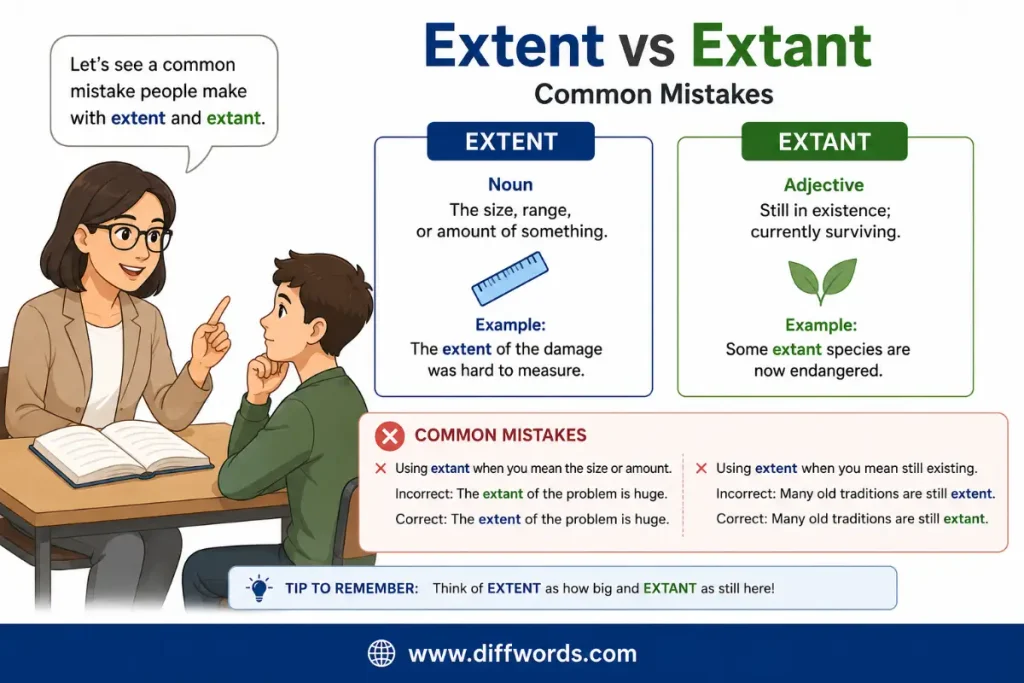
Mistake 1: Using extant to mean size
Incorrect:
“The extant of the damage was enormous.”
Correct:
“The extent of the damage was enormous.”
Damage has a degree or amount, so use extent.
Mistake 2: Using extent to mean existing
Incorrect:
“The extent manuscripts are rare.”
Correct:
“The extant manuscripts are rare.”
The manuscripts still exist, so use extant.
Mistake 3: Confusing “to some extent” with “existing”
“To some extent” has nothing to do with existence.
“I agree to some extent.”
It means:
“I agree partly.”
Mistake 4: Using extant in casual writing
The word isn’t incorrect, but it can sound unnecessarily formal.
Instead of:
“The extant documents are available.”
you might write:
“The existing documents are available.”
In academic or historical writing, however, extant can be the more precise choice.
When should you not use extent?
Don’t use extent when you simply mean that something exists.
Instead of:
“The extent records…”
write:
“The existing records…”
Don’t use it when you mean a specific object or item.
For example:
“The extent document was damaged.”
This is incorrect if you mean the document still exists.
Use:
“The existing document was damaged.”
Likewise, don’t use extent as a replacement for number when you’re counting individual things.
“The number of students increased.”
is better than:
“The extent of students increased.”
Extent refers to degree, range, size, or scope, not usually a simple count.
When should you not use extant?
Don’t use extant when you mean how much or how far.
Incorrect:
“The extant of the damage is unclear.”
Correct:
“The extent of the damage is unclear.”
Don’t use it when you mean degree:
“The extent of her influence was remarkable.”
not:
“The extant of her influence was remarkable.”
Also avoid using extant simply to make ordinary writing sound more sophisticated.
Instead of:
“Please review the extant files.”
a normal workplace email might say:
“Please review the existing files.”
Clear language is often better.
What are the antonyms of extent?
There isn’t one direct antonym for extent because its meaning changes with context.
Depending on the sentence, opposites may include:
- limitation
- restriction
- narrowness
- smallness
- lack
- reduction
- minimum
For example:
“The extent of the project is broad.”
The opposite might be:
“The scope of the project is limited.”
For physical size:
“The area has a limited extent.”
For degree:
“The effect was minimal.”
So choose the opposite based on the exact meaning.
What are the antonyms of extant?
Because extant means still existing, its natural opposites include:
- extinct
- vanished
- lost
- destroyed
- nonexistent
- disappeared
- obsolete
- defunct
Examples:
“The species is extinct.”
“The original document is lost.”
“The organization is now defunct.”
For historical materials, lost or no longer surviving may be more precise.
For living species, extinct is the standard opposite.
How does extent work with “to the extent that”?
The phrase to the extent that means to the degree that or as much as.
Example:
“The policy was successful to the extent that complaints decreased.”
This means the policy can be considered successful because complaints decreased.
Another example:
“The company improved its system to the extent that customers noticed the difference.”
The phrase is more formal than simply saying:
“The company improved its system so much that customers noticed the difference.”
Both can be correct, but the first is common in formal writing.
How does extent work with “to what extent”?
To what extent asks about the degree or amount of something.
For example:
“To what extent does exercise improve mental performance?”
This means:
“How much does exercise improve mental performance?”
Another example:
“To what extent was the decision influenced by cost?”
This asks:
“How much did cost influence the decision?”
You’ll often see this phrase in:
- essay questions,
- research questions,
- exams,
- academic discussions,
- surveys,
- formal reports.
How does extant work in history?
Extant is especially useful in historical writing.
Historians often deal with documents, buildings, records, artworks, and artifacts that may have disappeared over time.
For example:
“Only three extant copies of the treaty are known.”
This tells the reader that only three copies have survived.
Another example:
“The researcher compared the extant records with later sources.”
Here, the records still exist and can be examined.
This word is useful because “existing” doesn’t always capture the historical sense of survival.
Compare:
“existing documents”
This simply says the documents exist.
“extant documents”
This often suggests that they have survived from an earlier period.
How does extant work in literature?
Literary scholars often use extant to discuss surviving works.
For example:
“Only a few extant plays can be confidently attributed to the author.”
This means only a few plays by the author are known to have survived.
Another example:
“The scholar examined the extant versions of the poem.”
The word is particularly helpful when many original works have been lost.
A related phrase is:
extant literature
This means literature that currently survives or is available for study.
How does extant work in science?
In science, extant can describe species that still exist.
For example:
“Researchers compared the fossil species with extant relatives.”
Here, “extant relatives” means living relatives that still exist today.
This creates a useful contrast:
| Term | Meaning |
|---|---|
| extant species | A species that still exists |
| extinct species | A species that no longer exists |
| fossil species | A species known mainly from preserved remains |
In this context, extant is precise and useful.
What is the best word when writing about research?
If you’re discussing how much, how broad, or how serious something is, use extent.
“The study examines the extent of the problem.”
If you’re discussing research that currently exists, use extant.
“The study reviews the extant research.”
This is an important academic distinction.
Compare:
“The extent of existing research is limited.”
This means the amount or range of existing research is limited.
“The extant research is limited.”
This means the research that exists is limited.
Both sentences can be correct, but they communicate slightly different ideas.
What is the difference between extent and scope?
Extent and scope often overlap, but they aren’t identical.
Extent usually focuses on degree, size, range, or how far something reaches.
Scope focuses on what is included or covered.
Compare:
“The extent of the damage was severe.”
This focuses on how much damage occurred.
“The scope of the investigation was expanded.”
This focuses on what areas or subjects the investigation covers.
In project management:
“The scope of the project”
is usually better than:
“The extent of the project.”
In discussing damage:
“The extent of the damage”
is much more natural than:
“The scope of the damage.”
What is the difference between extent and degree?
Degree is one of the closest synonyms for extent, especially when discussing intensity.
Compare:
“The extent of the problem is unknown.”
“The degree of the problem is unknown.”
The first sounds more natural in many contexts.
But degree can be useful when talking about levels or intensity:
“The degree of difficulty varies.”
“The degree of risk is high.”
A useful rule is:
- Use extent for range, size, or overall reach.
- Use degree for level or intensity.
There is some overlap, so context matters.
What is the difference between extant and existing?
These words are very close.
Existing simply means that something is present or available now.
Extant also means existing, but it often carries the idea that something has survived from an earlier time.
Compare:
“Existing records show that the company changed its policy.”
This is neutral.
“Extant records from the 18th century show how the policy developed.”
This emphasizes surviving historical records.
In ordinary writing, existing is usually easier.
In scholarly writing about surviving historical materials, extant can be more precise.
What is the difference between extant and surviving?
Surviving is more common and conversational.
“Several surviving buildings remain.”
Extant is more formal.
“Several extant buildings remain.”
The meaning is close, but the tone differs.
If you’re writing for a general audience, surviving is often clearer.
If you’re writing an academic paper, historical study, or research article, extant may fit better.
What is the difference between extant and extinct?
These words are almost opposites.
Extant means still existing.
Extinct means no longer existing.
Compare:
“Several extant species live in the region.”
“Several related species are now extinct.”
For historical objects:
“Only a few extant copies remain.”
If no copies remain, they would be considered lost, rather than necessarily “extinct.”
So be careful: extinct is mainly used for species, though it can be used more broadly in certain contexts.
Quick tips for choosing extent or extant
Use these questions before choosing the word.
Ask: “Am I talking about how much?”
Use extent.
“What is the extent of the damage?”
Ask: “Am I talking about how far?”
Use extent.
“The extent of the forest is enormous.”
Ask: “Am I talking about the range or scope?”
Use extent.
“The study examines the extent of the problem.”
Ask: “Am I talking about something that still exists?”
Use extant.
“The museum contains several extant artifacts.”
Ask: “Can I replace the word with existing?”
If yes, extant may be correct.
Ask: “Can I replace it with size, degree, or scope?”
If yes, extent is probably correct.
Check the grammar
If you need a noun, extent is likely correct.
If you need an adjective before a noun, extant may be correct.
Compare:
“the extent of the damage”
versus:
“extant records”
This simple grammar check catches many errors.
Extent vs extant: a quick comparison chart
| Feature | Extent | Extant |
|---|---|---|
| Part of speech | Noun | Adjective |
| Main meaning | Size, degree, range, or limits | Still existing |
| Common question | How much? How far? | Does it still exist? |
| Common use | Problems, damage, scope, impact | Records, manuscripts, species |
| Everyday use | Common | Uncommon |
| Academic use | Very common | Common in specialized writing |
| Tone | Neutral | Formal |
| Related word | Extend | Existing |
| Example | “The extent of the damage” | “Extant records” |
| Opposite idea | Limitation/reduction | Extinct/lost |
A simple test for extent vs extant
When you’re unsure, replace the word.
Test for extent
Try:
“How much?”
“How far?”
“How large?”
“What degree?”
If one of these fits, use extent.
Example:
“The ___ of the damage is unclear.”
“How much damage?” fits.
So:
“The extent of the damage is unclear.”
Test for extant
Try:
“still existing”
“surviving”
“remaining”
If one fits, use extant.
Example:
“The ___ manuscripts are rare.”
“Surviving manuscripts” fits.
So:
“The extant manuscripts are rare.”
This test takes only a few seconds and works in most situations.
Conclusion
The key to extent vs extant is to focus on meaning rather than spelling. Extent is a noun connected with size, degree, range, scope, and limits. Extant is an adjective that means still existing or surviving, especially when talking about historical records, manuscripts, buildings, artworks, or species.
If you can replace the word with “how much,” “how far,” or “how large,” choose extent. If you can replace it with “existing,” “surviving,” or “remaining,” choose extant. In everyday writing, extent is much more common, while extant has a formal tone and is most useful in academic, historical, and scientific contexts. Once you connect extent with “extend” and extant with “existing,” the difference becomes much easier to remember and use correctly.
Frequently Asked Questions
What is the difference between extent vs extant?
Extent means the size, degree, range, or limits of something, while extant means still existing or surviving. They are different words with different grammatical roles.
Is extent a noun or an adjective?
Extent is a noun. It commonly appears in phrases such as “the extent of the damage” and “to some extent.”
Is extant a noun or an adjective?
Extant is an adjective. It describes something that still exists, especially something that has survived from an earlier period.
What’s another way to say “extant”?
Common alternatives include existing, surviving, remaining, preserved, and still available. “Existing” is usually the simplest choice.
When should I use extent instead of extant?
Use extent when you’re talking about how much, how far, how large, or how serious something is. Use extant when you’re describing something that still exists.
Is “extant” a common word in everyday English?
Extant is relatively uncommon in casual English. It’s more often used in academic, historical, scientific, legal, and literary writing.
Can extent vs extant be used interchangeably?
No, they cannot normally be used interchangeably. In extent vs extant, extent refers to degree or range, while extant refers to continued existence.
1 thought on “Extent vs Extant: The Ultimate Word Difference Guide”