
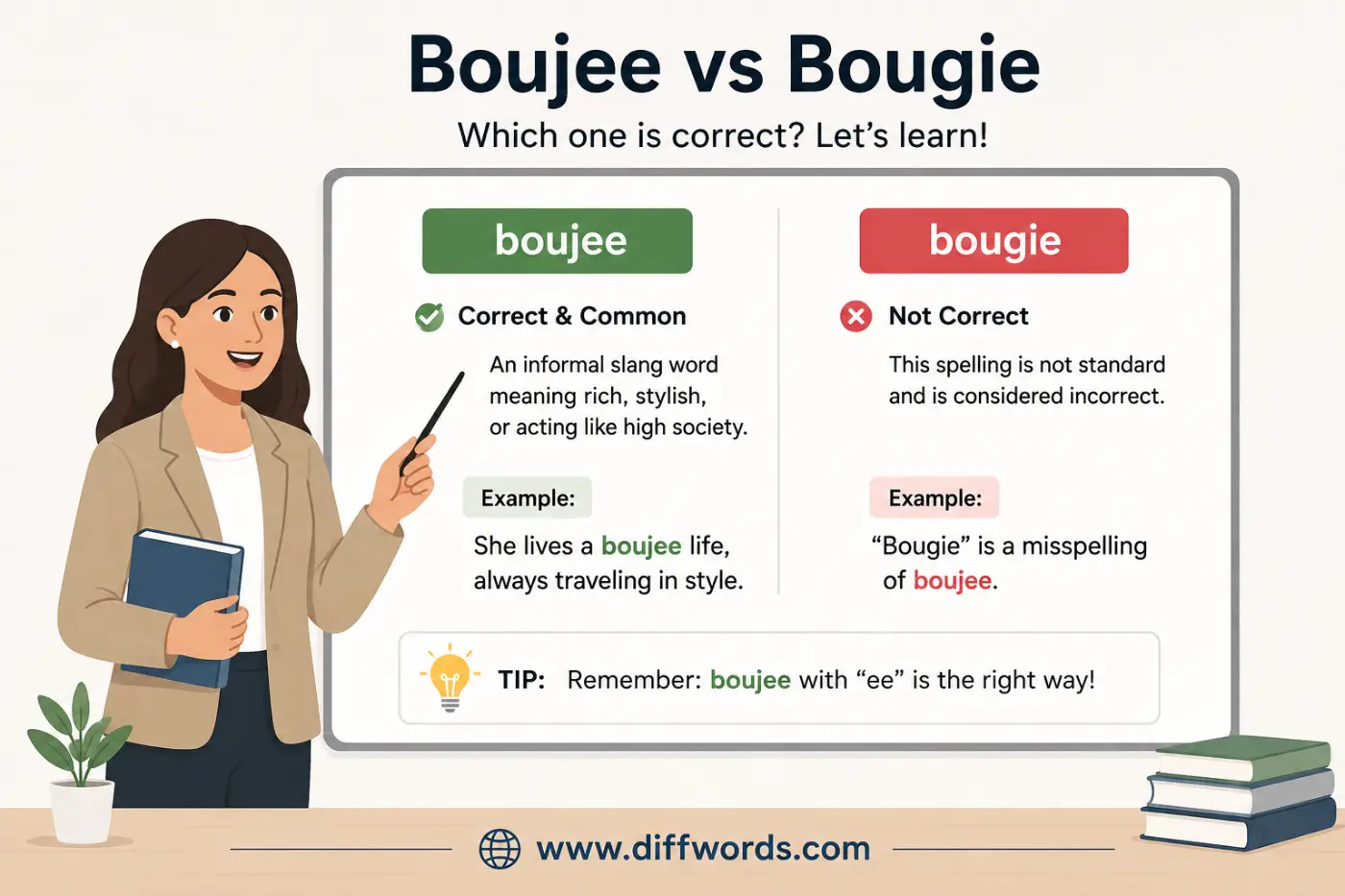
When you’re writing a text, caption, essay, or social media post, you may wonder about boujee vs bougie. Both spellings are common online, and both describe someone or something associated with luxury, wealth, or an upscale lifestyle. But they don’t always feel exactly the same.
Bougie is the older and more established spelling, while boujee is a popular modern variant that often gives the word a more playful, exaggerated, or slang-heavy feel.
You’ll see both forms in social media, music, pop culture, and casual conversation. The right choice depends on the tone you want. This guide explains where the words came from, what they mean, how they differ, which one works best in different situations, and how to avoid common mistakes.
Is it Phenix vs Phoenix? Find the standard spelling and learn why these two forms are confused.
What is the difference between boujee vs bougie?
The main difference is spelling, tone, and usage, rather than a completely different meaning.
| Word | Basic meaning | Typical tone | Common use |
|---|---|---|---|
| bougie | Upscale, fancy, materialistic, or pretentious | Slang/casual | Everyday slang, social media |
| boujee | Same general idea, often with a playful or exaggerated feel | Slang/playful | Social media, captions, pop culture |
Both can describe:
- expensive tastes
- fancy food
- luxury products
- upscale places
- a person who likes expensive things
- behavior that seems pretentious or overly sophisticated
For example:
This restaurant is so bougie.
and:
This restaurant is so boujee.
Both sentences can mean that the restaurant feels fancy or upscale.
The spelling boujee often feels more playful. Bougie is closer to the word’s historical form and is also widely used in modern slang.
Both bougie and boujee are used in modern informal English, but bougie is the more established spelling.
If you’re writing casual slang, either can work.
For example:
She loves bougie coffee shops.
or:
She loves boujee coffee shops.
If you’re writing a formal paper, neither is usually the best choice unless you’re discussing the word itself. Instead, use a more precise word such as:
- upscale
- luxurious
- pretentious
- affluent
- high-end
- sophisticated
The important point is that bougie and boujee are informal slang, not standard formal vocabulary.
Where does the word bougie come from?
The history of bougie is connected to the French word bourgeois, which originally referred to a member of the middle class or someone associated with the social class of property owners and business people.
Over time, bourgeois also developed a negative sense in some contexts. It could suggest someone who was overly concerned with:
- material comfort
- money
- social status
- conventional values
- possessions
The slang bougie developed from this idea.
It doesn’t always have a negative meaning today. Depending on the speaker, calling something bougie can be:
- an insult
- playful teasing
- a compliment
- self-description
Context matters a lot.
What does bougie mean in plain English?
In simple English, bougie means fancy, upscale, expensive, or concerned with luxury and status.
For example:
That hotel is pretty bougie.
This might mean the hotel is expensive, stylish, elegant, or designed to feel luxurious.
Another example:
He has a bougie coffee habit.
This suggests that he likes expensive or fashionable coffee.
The word can also suggest that someone is trying to appear richer, more sophisticated, or more refined than they really are.
For example:
She’s acting bougie because she won’t eat at the regular restaurant.
Here, the word has a more critical meaning.
What does boujee mean in plain English?
Boujee has essentially the same basic meaning as bougie.
It describes someone or something that seems:
- fancy
- luxurious
- expensive
- stylish
- high-end
- status-conscious
- sometimes pretentious
The spelling boujee often makes the word feel more playful or exaggerated.
For example:
We’re having a boujee dinner tonight.
This sounds casual and humorous.
You could also write:
We’re having a bougie dinner tonight.
The meaning is almost identical.
Why are there two spellings?
English slang often develops multiple spellings because people hear a word before they see it written.
Bougie and boujee are pronounced similarly, so different speakers began spelling the word in different ways.
The -ee ending in boujee makes the pronunciation feel more obvious to some English speakers.
Similar spelling variations are common in slang because informal language isn’t always controlled by one official spelling rule.
Social media has also helped spread alternate spellings quickly.
How do you pronounce bougie vs boujee?
In modern English slang, both are commonly pronounced approximately:
BOO-zhee
The middle sound is similar to the sound in beige for some speakers, though pronunciation can vary.
You may hear slight regional differences, but the two spellings generally refer to the same slang word.
The pronunciation doesn’t give you a reliable way to choose between the spellings.
If you’re writing the word, remember:
bougie and boujee are both used.
Is bougie a real word?
Yes. Bougie is a recognized informal English word.
It appears in dictionaries and modern usage references, although it is still considered informal or slang.
It has become common enough that many English speakers understand it immediately.
However, “real word” doesn’t mean “appropriate for every situation.”
You wouldn’t normally write:
The company’s bougie financial strategy…
in a formal business report.
You could instead write:
The company’s high-end marketing strategy…
or:
The company targets affluent consumers.
Is boujee a real word?
Yes, boujee is a widely used variant spelling of bougie.
It is especially common in:
- social media
- texting
- memes
- captions
- casual conversation
- popular culture
It is much more informal than words such as luxurious or affluent.
Because slang changes quickly, spelling preferences can also change over time.
Is bougie an insult?
Bougie can be an insult, but it doesn’t have to be.
The meaning depends on the speaker and context.
Negative use
He’s too bougie to shop at that store.
This suggests the person is snobbish or overly concerned with status.
Playful use
Look at me getting all bougie with my fancy coffee.
Here, the speaker is probably joking about their own expensive taste.
Positive or neutral use
This hotel is bougie, but I love it.
Here, bougie may simply mean stylish, luxurious, or upscale.
So don’t assume that bougie is always negative.
Is boujee a compliment?
Boujee can be a compliment when it means stylish, luxurious, or high-end.
For example:
Your new room looks so boujee!
This could mean the room looks elegant or expensive.
But the same word can be sarcastic:
Wow, someone’s feeling boujee today.
The speaker might be teasing someone for acting fancy.
Tone of voice and context are important.
Boujee vs bougie: which spelling is more common?
Bougie is generally the more established spelling, while boujee is a popular variant.
There isn’t a strict rule saying that one is always correct and the other is always wrong.
In casual online writing, both appear frequently.
A useful rule is:
Use bougie for the more established spelling; use boujee when you want a playful slang feel.
If you’re writing something formal, replace either word with a more precise standard-English term.
What are the synonyms for bougie?
There are many possible synonyms, but the best one depends on whether you mean luxurious, wealthy, or pretentious.
| Group | Word | Meaning | Tone | Example |
|---|---|---|---|---|
| Simple | fancy | More stylish or expensive than usual | Casual | That’s a fancy restaurant. |
| Simple | expensive | Costs a lot | Neutral | That watch is expensive. |
| Simple | nice | Pleasant or attractive | Casual | That’s a nice hotel. |
| Simple | upscale | High quality and expensive | Neutral | They live in an upscale area. |
| Simple | classy | Stylish and tasteful | Positive | The room looks classy. |
| Everyday | luxurious | Very comfortable and expensive | Positive | The hotel is luxurious. |
| Everyday | high-end | Designed for a wealthy market | Neutral | They sell high-end furniture. |
| Everyday | posh | Stylish and expensive | Informal | They stayed in a posh hotel. |
| Everyday | stylish | Fashionable or attractive | Positive | Her apartment is stylish. |
| Everyday | chic | Fashionable and elegant | Positive | It’s a chic little café. |
| Everyday | swanky | Stylish and impressive | Informal | They opened a swanky new club. |
| Everyday | ritzy | Very fancy or expensive | Informal | They stayed at a ritzy resort. |
| Formal | affluent | Having considerable wealth | Formal | The area has an affluent population. |
| Formal | opulent | Extremely luxurious | Formal | The palace has an opulent interior. |
| Formal | plush | Luxurious and comfortable | Formal/Neutral | The hotel has plush rooms. |
| Formal | sumptuous | Very rich or luxurious | Formal | They served a sumptuous meal. |
| Formal | ostentatious | Designed to show wealth | Formal/Negative | His jewelry was ostentatious. |
| Formal | pretentious | Trying to seem more important or sophisticated | Formal/Negative | The restaurant felt pretentious. |
| Formal | materialistic | Focused heavily on possessions | Formal/Negative | His lifestyle seemed materialistic. |
| Slang | boujee | Fancy or status-focused | Slang | That’s a boujee brunch spot. |
| Slang | fancy-schmancy | Overly fancy, often jokingly | Playful | It’s a fancy-schmancy restaurant. |
| Slang | swanky | Very stylish or upscale | Slang | They found a swanky hotel. |
| Slang | ritzy | Very expensive or glamorous | Slang | That’s a ritzy neighborhood. |
| Slang | extra | Excessive or over-the-top | Slang | That dessert is so extra. |
Notice that these aren’t perfect substitutes.
Luxurious is usually positive.
Pretentious is negative.
Bougie can be positive, negative, or playful.
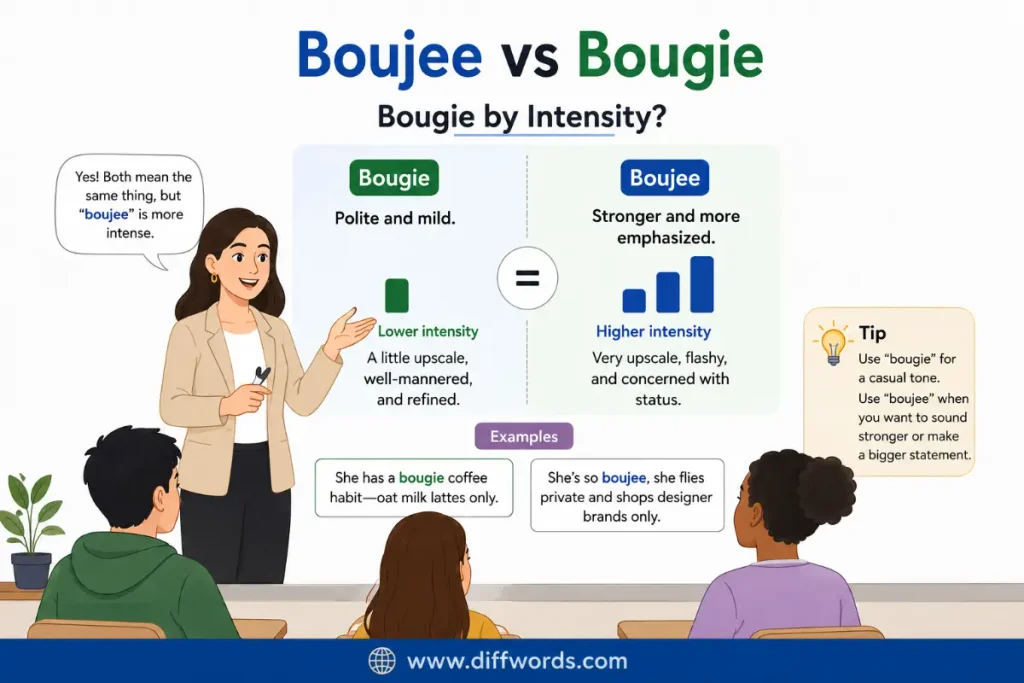
What are synonyms for bougie by intensity?
The word can express different levels of luxury or social pretension.
Mild
If you simply mean something is nicer or more expensive than average:
- nice
- fancy
- stylish
- upscale
- classy
Example:
It’s a nice restaurant.
Moderate
If you want to suggest clear luxury:
- high-end
- luxurious
- posh
- swanky
- ritzy
Example:
They booked a luxurious hotel.
Strong
If you want to emphasize excessive luxury or status:
- opulent
- extravagant
- ostentatious
- pretentious
- materialistic
Example:
The design was extravagant and overly flashy.
This distinction matters because bougie doesn’t always mean extremely wealthy. Someone might use it jokingly for something as simple as an expensive coffee.
What part of speech is bougie?
Bougie is mainly used as an adjective and noun in informal English.
As an adjective:
That’s a bougie restaurant.
It describes the restaurant.
As a noun:
He’s such a bougie.
This noun use is possible in slang, but it can sound less natural than using bougie as an adjective.
You may also see:
She loves being bougie.
Here, bougie functions in a descriptive way after the verb being.
The exact grammar can vary because slang doesn’t always follow the patterns of formal vocabulary.
What part of speech is boujee?
Boujee is also mainly used as an informal adjective.
For example:
We found a boujee café.
That’s a boujee outfit.
They booked a boujee hotel.
The word modifies a noun.
You may also see it used more loosely as a noun in casual speech, but adjective use is the clearest and most common.
Is bougie formal or informal?
Bougie is informal slang.
It’s appropriate for:
- texts
- social media
- casual conversation
- personal blogs
- humorous writing
- informal captions
It’s usually not appropriate for:
- academic essays
- legal documents
- formal business reports
- professional research
- official applications
Instead, choose a word that states exactly what you mean.
For example:
The restaurant is bougie.
could become:
The restaurant is upscale.
or:
The restaurant has a luxurious atmosphere.
Is boujee formal or informal?
Boujee is also informal slang.
In fact, the playful spelling often makes it feel even more casual.
For a social media caption:
Feeling boujee tonight ✨
works naturally.
For a formal report:
Consumers in this group prefer boujee products.
would usually be better as:
Consumers in this group prefer premium products.
What is the best word for a resume:boujee vs bougie
Neither bougie nor boujee is usually suitable for a resume.
Choose a professional word based on what you actually mean:
- upscale
- premium
- luxury
- high-end
- affluent
- sophisticated
For example:
Managed marketing campaigns for a luxury retail brand.
is much more professional than:
Managed marketing for a boujee brand.
What is the best word for an essay?
For an academic essay, avoid bougie and boujee unless your essay is specifically analyzing slang, culture, language, or social media.
Instead, consider:
- bourgeois
- affluent
- materialistic
- luxurious
- upper-class
- status-conscious
- pretentious
For example:
The character’s materialistic lifestyle reflects his concern with social status.
This is more precise than:
The character is bougie.
What is the best word for texting?
For texting, bougie and boujee both work.
Examples:
This place is so bougie 😂
We’re having a boujee dinner tonight.
Why does your coffee look so bougie?
If you’re joking with friends, the playful spelling boujee may fit particularly well.
What is the best word for an email?
For a casual personal email, either slang form can work if the relationship and context are informal.
For a professional email, use:
- upscale
- luxurious
- premium
- high-end
- sophisticated
Example:
We selected an upscale venue for the event.
is more professional than:
We picked a bougie venue.
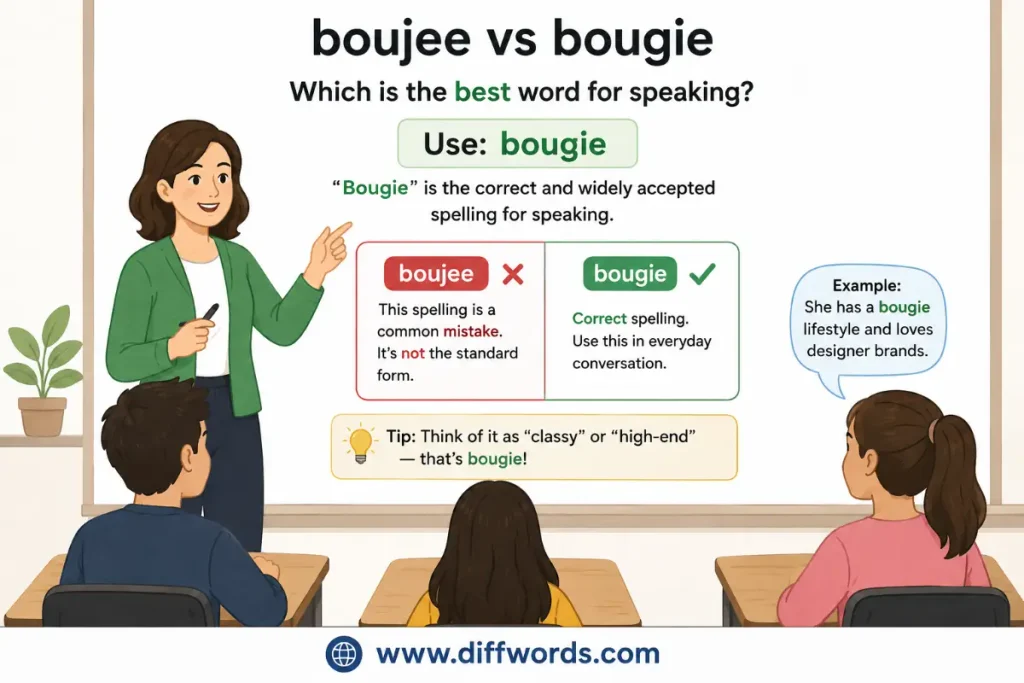
What is the best word for speaking:boujee vs bougie
In casual speech, bougie is natural if the people you’re talking to know the slang.
For example:
That restaurant is kind of bougie.
If you’re speaking to someone unfamiliar with the term, say:
That restaurant is really upscale.
This removes ambiguity.
Bougie vs bourgeois: what’s the difference?
These words are related, but they aren’t interchangeable.
Bourgeois is an established word with historical, social, and economic meanings. It can refer to the middle class or to values associated with that class.
Bougie is informal slang derived from the same general word family and is often used to mean fancy, materialistic, or pretentious.
| Bougie | Bourgeois |
|---|---|
| Slang | Standard/formal vocabulary |
| Casual | Academic/formal |
| Fancy or upscale | Related to a social class or its values |
| Often playful | Often analytical or critical |
| Common online | Common in history/social theory |
For example:
They have a bougie lifestyle.
is casual.
The novel criticizes bourgeois values.
is much more formal.
Bougie vs fancy: what’s the difference?
Fancy is broader and usually more neutral.
Bougie often carries an extra idea of wealth, status, or pretension.
Compare:
She bought a fancy dress.
This simply means the dress is attractive, elegant, or special.
She bought a bougie dress.
This may suggest that the dress is expensive, fashionable, luxurious, or associated with status.
So fancy is safer when you don’t want a social judgment.
Bougie vs luxurious: what’s the difference?
Luxurious focuses on comfort, quality, and expense.
Bougie can include those ideas, but it can also suggest that someone is showing off or trying to appear sophisticated.
Compare:
The hotel is luxurious.
This is generally positive.
The hotel is bougie.
This is more casual and may be positive, humorous, or slightly critical.
Bougie vs pretentious: what’s the difference?
This is an important distinction.
Pretentious specifically suggests that someone is trying too hard to appear important, cultured, intelligent, or sophisticated.
Bougie doesn’t always imply that.
For example:
She likes expensive restaurants.
That can be bougie without being pretentious.
But:
He constantly talks about expensive restaurants to make himself seem superior.
could be described as pretentious.
So don’t use pretentious as a direct replacement for every use of bougie.
Bougie vs upscale: what’s the difference?
Upscale is more neutral and professional.
Bougie is casual and can carry judgment.
Compare:
They moved to an upscale neighborhood.
This is neutral.
They moved to a bougie neighborhood.
This sounds conversational and may imply that the neighborhood is expensive, trendy, or status-conscious.
For formal writing, upscale is usually the better choice.
What does “bougie lifestyle” mean?
A bougie lifestyle is a lifestyle associated with expensive, fashionable, luxurious, or status-focused choices.
It might involve things like:
- expensive restaurants
- designer clothing
- luxury hotels
- specialty coffee
- fashionable neighborhoods
- premium products
- exclusive experiences
The phrase can be serious or humorous.
For example:
She jokes about living a bougie lifestyle because she loves fancy restaurants.
The word doesn’t necessarily mean the person is actually wealthy.
What does “bougie food” mean?
Bougie food usually means food that feels fancy, expensive, trendy, or presented in an upscale way.
Examples might include:
- expensive tasting menus
- specialty desserts
- gourmet dishes
- elaborate brunches
- premium ingredients
For example:
That tiny dessert looks so bougie.
The speaker may be joking about the presentation or price.
What does “bougie coffee” mean?
Bougie coffee usually refers to coffee that feels expensive, trendy, elaborate, or associated with specialty cafés.
For example:
I paid way too much for this bougie coffee.
This can be self-mocking. The speaker may enjoy the coffee while joking about its price.
What does “bougie brunch” mean?
A bougie brunch is a brunch experience that feels fancy, expensive, trendy, or upscale.
For example:
We’re going to a bougie brunch on Sunday.
It might involve an expensive café, stylish setting, elaborate food, or premium drinks.
The word is usually playful rather than strictly negative in this phrase.
What does “boujee” mean on social media?
On social media, boujee often means fancy, luxurious, stylish, or expensive-looking, usually in a playful way.
For example:
My room is looking boujee today.
The person may simply mean that the room looks polished or luxurious.
Social media has helped popularize the -jee spelling, especially in captions and memes.
Is boujee just slang?
Yes, boujee is informal slang.
It isn’t the word you would normally choose for formal academic or professional writing.
But slang can be useful when the goal is to sound:
- casual
- funny
- modern
- conversational
- playful
The important thing is matching the word to the audience.
What are 15 original examples of bougie?
- That new café looks incredibly bougie.
- She loves finding bougie restaurants for special occasions.
- The hotel was a little bougie, but the service was excellent.
- I bought a fancy coffee and felt very bougie.
- Their apartment has a stylish, bougie feel.
- We had a bougie brunch downtown.
- He jokes that his dog has a bougie lifestyle.
- The restaurant’s menu is expensive and slightly bougie.
- She likes bougie candles and fancy home décor.
- The new shopping center feels much more bougie than the old one.
- They chose an upscale venue for their event.
- My friend called the dessert bougie because it cost so much.
- The café has a very bougie atmosphere.
- She posted a photo of her bougie breakfast online.
- The hotel looked bougie, but the rooms were comfortable.
15 original examples of boujee?
- This café is so boujee.
- We’re having a boujee dinner tonight.
- Her new apartment looks boujee.
- That dessert is giving boujee vibes.
- He bought a boujee coffee machine.
- The restaurant has a boujee atmosphere.
- They stayed at a boujee hotel during the trip.
- My sister loves boujee home décor.
- That little café is surprisingly boujee.
- She wanted a boujee birthday dinner.
- The presentation makes the meal look boujee.
- This neighborhood has become pretty boujee.
- He joked that his new shoes made him look boujee.
- The party had a fun, boujee theme.
- That was probably the most boujee brunch I’ve ever had.
What are the common mistakes with bougie vs boujee?
Mistake 1: Treating one spelling as completely wrong
Because bougie and boujee are both used, it’s too simple to say one is always wrong.
The better explanation is:
Bougie is the more established spelling; boujee is a common modern variant.
Mistake 2: Using either word in formal writing
Both are slang.
Instead of:
The restaurant is bougie.
a formal article might say:
The restaurant has an upscale atmosphere.
Mistake 3: Assuming bougie always means rich
Someone can use bougie jokingly for a person who simply enjoys expensive or fashionable things.
It doesn’t necessarily mean the person is wealthy.
Mistake 4: Assuming bougie always means pretentious
It doesn’t.
A person can call something bougie simply because it’s fancy.
Mistake 5: Confusing bougie with bourgeois
The words are related, but bourgeois has a more specific historical and social meaning.
Don’t automatically replace one with the other.
Mistake 6: Using boujee when you need a precise word
Slang can be vague.
If you specifically mean “expensive,” say expensive.
If you mean “luxurious,” say luxurious.
And if you mean “pretentious,” say pretentious.
Precision is better than slang when the exact meaning matters.
What are the antonyms of bougie?
The opposite depends on what meaning you intend.
Possible contrasting words include:
- simple
- modest
- plain
- basic
- inexpensive
- affordable
- practical
- down-to-earth
- unpretentious
- casual
For example:
bougie ↔ modest
or:
luxurious ↔ simple
or:
pretentious ↔ unpretentious
There isn’t one exact antonym because bougie can have several meanings.
How can you choose between bougie vs boujee?
Use these quick guidelines:
Choose bougie when:
- you want the more established spelling
- you’re writing general informal English
- you want a casual but familiar slang term
- you’re discussing the word’s history
Choose boujee when:
- you’re writing very casually
- you’re creating a social media caption
- you want a playful spelling
- the style is intentionally slang-heavy
select neither when:
- you’re writing a formal essay
- you’re writing a resume
- you’re preparing a professional report
- your audience may not know slang
- you need a precise meaning
Instead, use a word such as upscale, luxurious, high-end, affluent, or pretentious, depending on your intended meaning.
Quick tips for choosing the right word: boujee vs bougie
- Bougie is the more established spelling.
- Boujee is a common modern variant.
- Both are informal.
- Both can mean fancy, upscale, expensive, or status-conscious.
- Bougie can be positive, negative, or playful.
- Boujee often feels especially playful or social-media-friendly.
- Don’t use either word in formal writing unless you’re discussing slang.
- Use upscale for a neutral professional tone.
- Use luxurious when emphasizing comfort and quality.
- Use pretentious when emphasizing an attempt to seem sophisticated.
- Use materialistic when emphasizing excessive focus on possessions.
- Use affluent when describing wealth.
- Use fancy when you simply mean more stylish or special.
- Context matters more than the spelling difference.
Conclusion
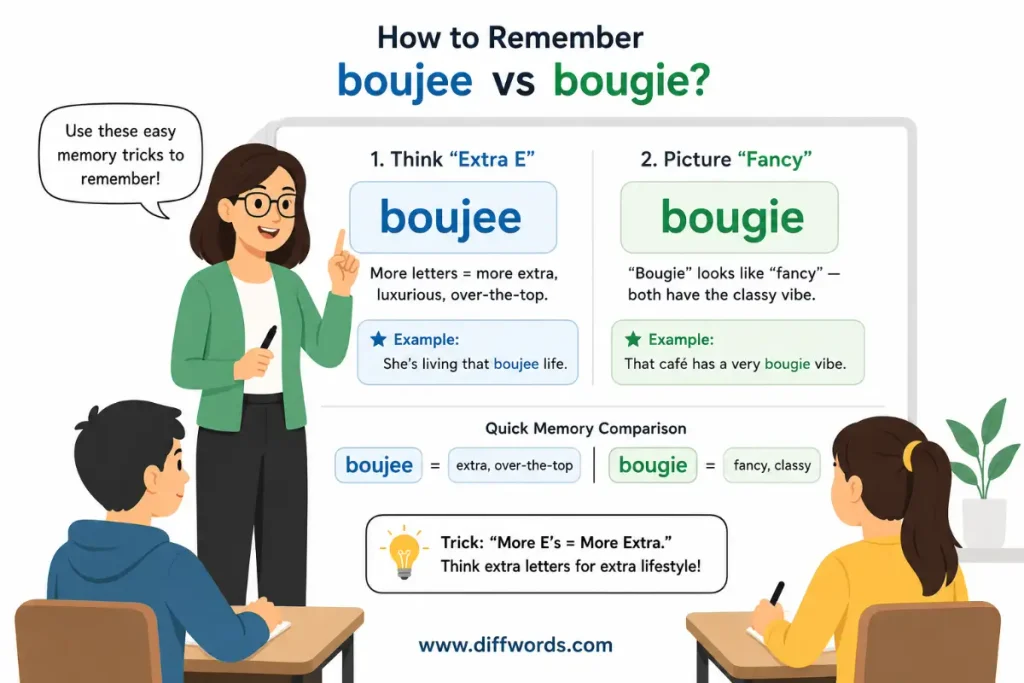
The choice between boujee vs bougie is mostly about spelling, tone, and context rather than a major difference in meaning. Bougie is the more established form, while boujee is a popular playful variant. Both can describe something fancy, upscale, expensive, fashionable, or concerned with status. They can also carry a hint of humor or criticism.
For texts, captions, and casual conversation, either spelling can work. For formal writing, though, it’s better to choose a more exact word. Use luxurious for comfort and expense, upscale for a neutral high-end feel, affluent for wealth, and pretentious when someone is trying too hard to appear sophisticated. Once you understand the tone behind the slang, choosing the right word becomes much easier.
Frequently Asked Questions
Is bougie vs boujee the correct spelling?
Bougie is the more established spelling, while boujee is a widely used informal variant. Both are common in modern slang, especially online.
What does bougie mean in slang?
Bougie means fancy, upscale, expensive, luxurious, or sometimes pretentious. It can be an insult, a compliment, or a playful description depending on context.
Is boujee the same as bougie?
Yes, boujee and bougie generally have the same basic slang meaning. The -jee spelling often gives the word a more playful or exaggerated feel.
What’s another way to say bougie?
Upscale, fancy, luxurious, high-end, posh, stylish, or classy can work depending on what you mean. For a negative meaning, pretentious or materialistic may be more precise.
Is bougie a bad word?
No, bougie isn’t inherently a bad word. It’s informal slang that can be positive, negative, or humorous depending on how it’s used.
Can I use bougie in an academic essay?
Usually, you should avoid bougie in a formal academic essay. Use a more precise word such as affluent, materialistic, luxurious, or pretentious, unless you’re specifically analyzing slang or popular culture.
Which spelling is better for social media, bougie vs boujee?
Either works, but boujee often has a more playful social-media feel. If you want the more established spelling, choose bougie.