
If you’re writing an email, essay, resume, product description, or text and suddenly wonder about sale vs sell, you’re dealing with a very common English mistake. The two words are closely related, but they don’t work the same way in a sentence.
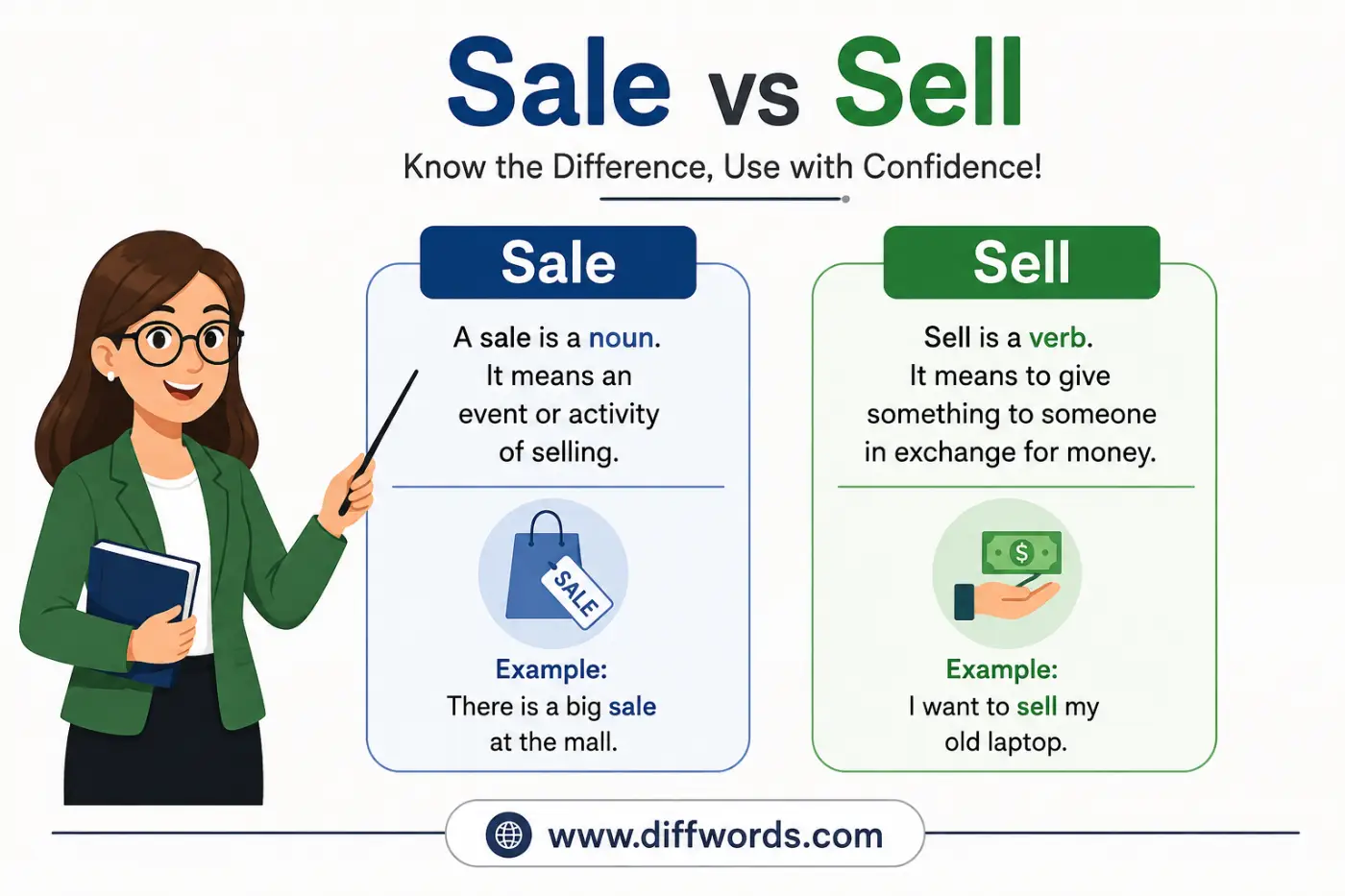
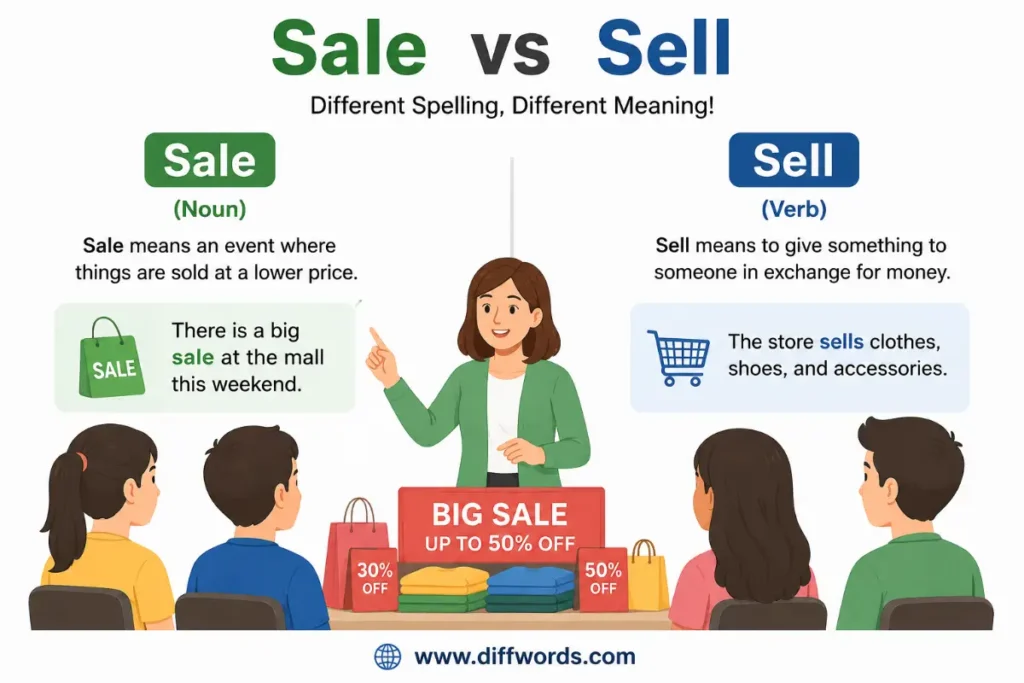
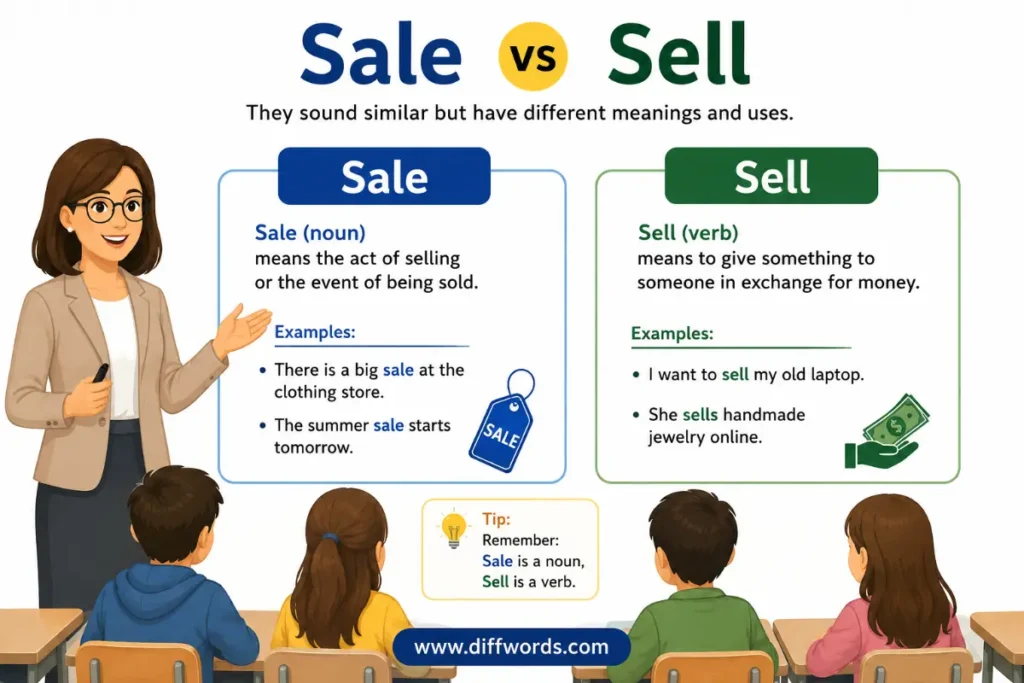
Sale is usually a noun that refers to the act of selling or an event where goods are offered at a lower price. Sell is a verb that means to give something to someone in exchange for money.
The difference becomes easy once you know which part of speech you need. If you’re describing an action, you usually need sell. If you’re naming the transaction, event, or special price period, sale is usually the right choice.
This guide explains the meanings, origins, grammar, synonyms, examples, common mistakes, regional notes, and the best word to use in emails, essays, resumes, product pages, and everyday conversation.
Is it catchup or catch up? Discover when to use each form with easy examples.
What is the difference between sale vs sell?
The basic difference is noun vs. verb.
| Word | Part of speech | Main meaning | Example |
|---|---|---|---|
| Sale | Noun | An act of selling or a period when products are offered, often at reduced prices | The store is having a sale. |
| Sell | Verb | To give something to someone in exchange for money | They sell shoes online. |
The simplest rule is:
Sell describes an action. Sale names the event, transaction, or opportunity.
For example:
I want to sell my old phone.
Here, sell is an action.
But:
My old phone is for sale.
Here, sale is a noun describing the phone’s availability for purchase.
Another common example is:
The store will sell winter clothes.
But:
The store is having a winter sale.
Once you recognize the grammar, the difference is much easier to remember.
What do sale and sell mean in plain English?
Sell means to offer something to another person in exchange for money.
She sells handmade cards.
They sell computers.
I want to sell my bicycle.
The word focuses on the action of transferring something to a buyer.
Sale has several related meanings.
It can mean the act of selling:
The sale of the house was completed yesterday.
It can also mean a special shopping event, often involving reduced prices:
The store is having a summer sale.
And for sale means that something is available for someone to buy:
Their house is for sale.
These meanings are connected, but they aren’t interchangeable.
You can sell a house, but the house is for sale.
You can sell clothes during a sale.
And you can sell a product at a sale price.
Where do sale and sell come from?
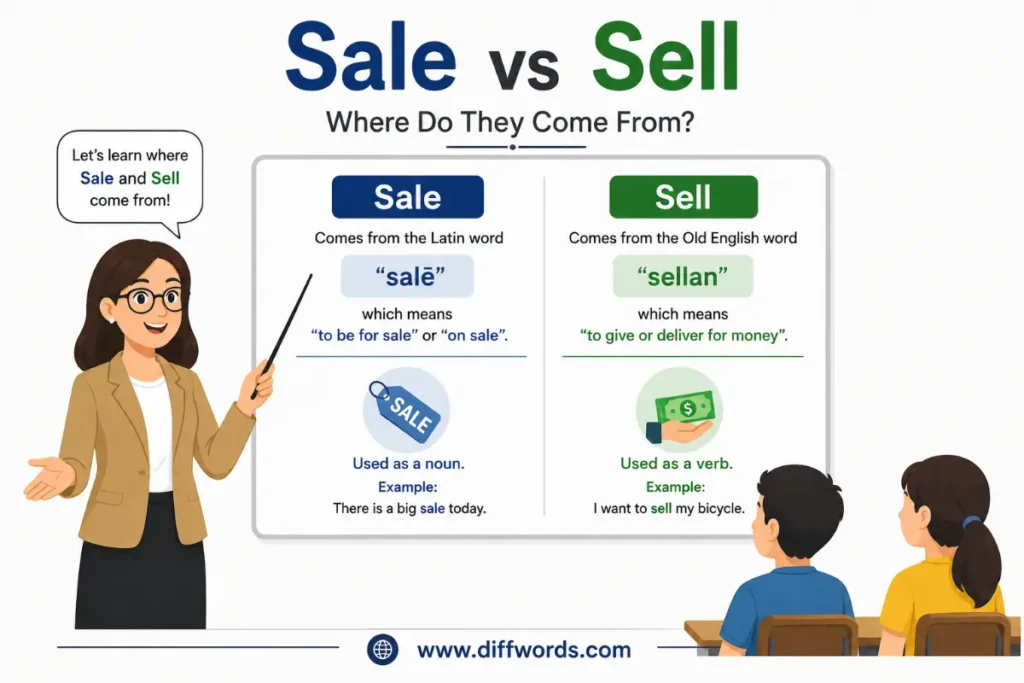
Sale and sell are closely related historically. Both come from old Germanic language roots connected with the act of giving or exchanging goods.
The modern English verb sell developed from Old English forms related to selling or giving something in exchange for payment.
Sale developed from the same broad word family and became the noun used for the act or process of selling.
Their shared history explains why they look and sound similar.
English has many word pairs like this where one form functions mainly as a verb and another as a noun.
For example:
- advise → advice
- choose → choice
- speak → speech
- sell → sale
However, English doesn’t always follow one simple spelling rule. That’s why it’s useful to learn sale and sell as a pair.
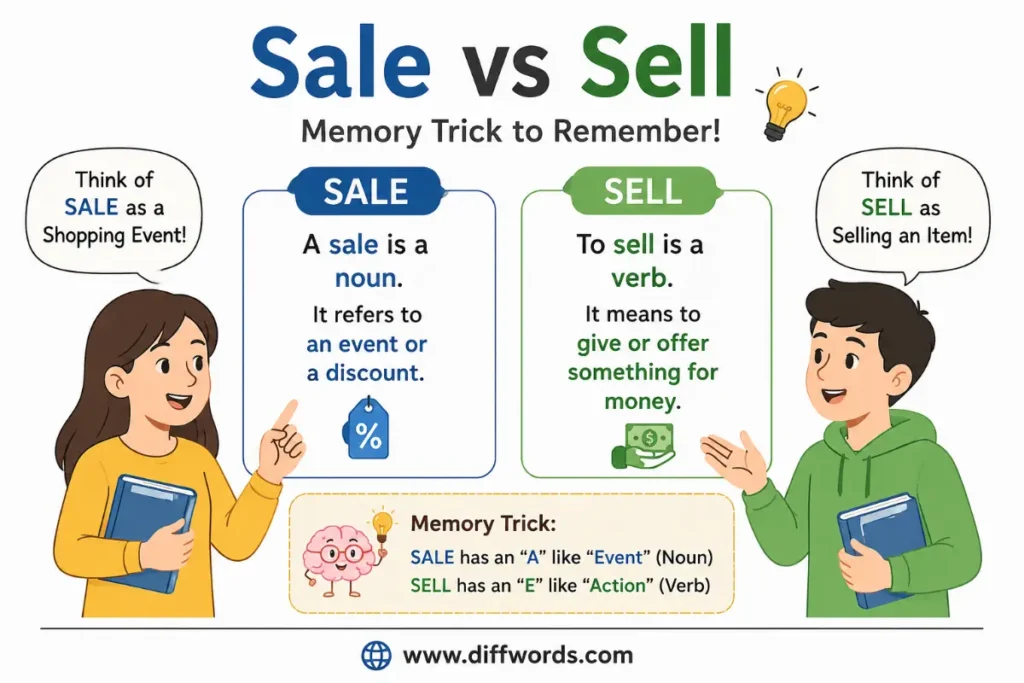
How do you remember sale vs sell?
A simple memory trick is:
Sell = action
Sale = event or thing
Think:
I sell something.
But:
I make a sale.
The verb sell often comes after words such as:
- want to
- need to
- plan to
- will
- can
- should
- must
Examples:
I want to sell my laptop.
We can sell these products online.
They will sell tickets tomorrow.
The noun sale often comes after:
- a
- the
- this
- that
- big
- special
- annual
- online
Examples:
The sale starts tomorrow.
We had a big sale.
This sale ends Friday.
Another useful phrase is:
for sale
If something is available to buy, it’s for sale, not “for sell.”
Is sale a noun or a verb?
Sale is a noun.
It names a thing, event, or process rather than an action.
Examples:
The sale starts tomorrow.
The house is for sale.
We made a large sale.
The company reported strong sales.
You cannot normally use sale where a verb is required.
Incorrect:
I want to sale my car.
Correct:
I want to sell my car.
This is one of the most common mistakes with these words.
Is sell a noun or a verb?
Sell is primarily a verb.
It describes the action of offering something for money.
Examples:
They sell fresh fruit.
I need to sell my old computer.
She sells clothes online.
The forms of the verb change depending on tense:
- sell
- sells
- selling
- sold
Examples:
I sell books.
She sells books.
She is selling books.
She sold the books yesterday.
Notice that sale is not the past tense of sell.
The past tense is sold.
I sell cars.
I sold a car yesterday.
Not:
I sale a car yesterday.
What are the synonyms of sale?
The best synonym depends on what sale means in your sentence.
Sale meaning a transaction
Possible alternatives include:
- transaction
- purchase
- deal
- trade
- exchange
- business
- transfer
Example:
The sale of the property was completed.
Possible alternative:
The property transaction was completed.
Sale meaning a discounted shopping event
Possible alternatives include:
- promotion
- special offer
- discount
- clearance
- markdown
- bargain event
- promotional event
Example:
The store is having a summer sale.
Possible alternative:
The store is offering a summer promotion.
These words aren’t perfect replacements in every sentence. A sale can be a transaction, while a discount is specifically a reduction in price.
What are the synonyms of sell?
The verb sell also has several alternatives depending on context.
| Word | Meaning | Tone | Example |
|---|---|---|---|
| market | Promote something to potential buyers | Professional | The company markets its products online. |
| trade | Exchange something, often for another item or value | Neutral | He traded his old bike. |
| offer | Make something available for purchase | Neutral | We offer handmade products. |
| retail | Sell goods directly to consumers | Business | The company retails clothing. |
| distribute | Supply products to stores or customers | Formal | The company distributes food products. |
| promote | Encourage people to buy something | Professional | They promote the new product online. |
| peddle | Sell goods, often informally | Informal | Vendors peddled snacks near the stadium. |
| auction | Sell to the highest bidder | Specific | They auctioned the painting. |
| advertise | Publicize something to attract buyers | Neutral | The seller advertised the car online. |
| pitch | Try to persuade someone to buy an idea or product | Business | She pitched the service to several clients. |
Be careful: some of these words describe only part of the selling process.
For example, advertise doesn’t necessarily mean someone completed a sale. It means they promoted the product.
What are the different meanings of sale?
The word sale is more flexible than many learners realize.
Sale as a transaction
The sale of the property took several weeks.
Here, sale means the transaction itself.
Sale as a discount event
The store is having a weekend sale.
Here, it means a shopping event where products may be offered at lower prices.
Sale as an available item
In the phrase for sale, it means something is available for purchase.
The house next door is for sale.
Sale as the number or value of products sold
In business English, sales can refer to the amount of business generated by selling products or services.
Sales increased this year.
This plural form is extremely common in business.
What does “for sale” mean?
For sale means something is available for someone to buy.
Examples:
The house is for sale.
My old laptop is for sale.
These paintings are for sale.
A common mistake is writing:
This phone is for sell.
That is incorrect.
Use:
This phone is for sale.
Why? Because for is followed here by the noun sale, not the verb sell.
Compare:
I want to sell this phone.
This phone is for sale.
The first describes what the owner wants to do. The second describes the phone’s status.
What does “on sale” mean?
On sale usually means a product is being offered at a reduced price.
These shoes are on sale.
The jackets are 30% off in the sale.
However, on sale can sometimes simply mean something is currently being offered for purchase, depending on context and regional usage.
In American English, shoppers commonly understand on sale as meaning the price has been reduced.
Compare:
The book is for sale.
This means the book is available to buy.
The book is on sale.
This often suggests the book is currently available at a special or reduced price.
What does “sell” mean in business?
In business, sell can mean more than simply exchanging an item for money.
A company can sell:
- products
- services
- subscriptions
- software
- advertising
- experiences
- ideas
For example:
The company sells accounting software.
The agency sells digital marketing services.
The salesperson sells insurance plans.
The word can also describe persuasion.
She knows how to sell an idea.
Here, sell means persuade someone to accept or support something.
For example:
He sold the team on the new strategy.
This doesn’t mean the strategy was literally exchanged for money. It means he persuaded the team that the strategy was worthwhile.
What does “sale” mean in business?
In business, sale often refers to a completed transaction.
The salesperson closed the sale.
This means the customer agreed to buy.
Sales can also refer to revenue or selling activity:
The company reported strong sales this quarter.
Other common business phrases include:
- sales team
- sales manager
- sales representative
- sales target
- sales report
- sales revenue
- sales strategy
- sales forecast
- sales department
In these phrases, sales is a noun.
What is the difference between sale and sell in a sentence?
Look at these pairs.
I want to sell my car.
My car is for sale.
The first uses a verb.
The second uses a noun.
Another pair:
They sell clothes online.
They are having a clothing sale.
Again, the first describes an action. The second names a shopping event.
One more:
The company sold 10,000 products.
The company reported strong sales.
The first focuses on what the company did. The second focuses on the business results.
Sale vs sell: which one should you use in an essay?
For an essay, first decide whether you need a verb or noun.
Use sell when describing an action:
Farmers sell their products at local markets.
Use sale when discussing the transaction or process:
The sale of agricultural products supports local communities.
In formal essays, you may also use related words such as:
- transaction
- commerce
- trade
- marketing
- distribution
- purchase
For example:
Online sales have changed the way consumers shop.
This is more precise than trying to force sell into every sentence.
Sale vs sell: which one is better for a resume?
Both can appear on a resume, but they serve different purposes.
Use sell to describe an action or responsibility:
Sold software subscriptions to small businesses.
And use sales to describe a business function or result:
Increased monthly sales through customer outreach.
Common resume phrases include:
- sales growth
- sales targets
- sales strategy
- sales support
- sales performance
- sold products
- sold services
- managed sales accounts
If you’re describing what you personally did, a strong action verb such as sold, developed, managed, or increased may be more useful.
For example:
Sold products to more than 100 customers per month.
is more direct than:
Responsible for sales.
Sale vs sell: which one belongs in an email?
In an email, choose the word based on grammar.
We plan to sell the equipment next month.
The equipment is now for sale.
The company is holding a sale this weekend.
For a professional email, be clear about whether you’re talking about the action, transaction, or discount.
Instead of:
We will sale the remaining items.
Write:
We will sell the remaining items.
Instead of:
The remaining items are for sell.
Write:
The remaining items are for sale.
Sale vs sell: which one is correct in texting?
Texting doesn’t change the basic grammar.
Correct:
Are you going to sell your bike?
Is your bike for sale?
I saw a sale at the mall.
Incorrect:
Are you going to sale your bike?
Is your bike for sell?
Short messages can make mistakes easier to overlook, but the correct forms remain the same.
What are 15 examples of sale and sell?
Here are examples from everyday life, school, work, and business.
- Buying and selling:I want to sell my old phone.
- Available product:My old phone is for sale.
- Discount event:The store is having a big sale this weekend.
- Business action:They sell furniture online.
- Property:The house is currently for sale.
- Business result:The company increased its sales last year.
- Completed transaction:The sale was completed on Monday.
- Online business:She sells handmade jewelry through her website.
- Promotion:The store announced a summer sale.
- Negotiation:
We couldn’t agree on the terms of the sale.
- Career:
He works in sales.
- Persuasion:
She knows how to sell her ideas clearly.
- Retail:
The shop sells school supplies.
- Discount:
These notebooks are on sale.
- Property listing:
The apartment has been put up for sale.
These examples show how the noun and verb fit into different sentence structures.
Sale vs sell vs sold — what’s the difference?
This is another important distinction.
Sell is the base form.
I sell books.
Sells is the third-person singular present form.
She sells books.
Sold is the past tense and past participle.
She sold the books yesterday.
Sale is a noun.
The sale was successful.
So:
| Word | Role | Example |
|---|---|---|
| Sell | Base verb | I sell products. |
| Sells | Present-tense verb | He sells products. |
| Selling | -ing form | She is selling products. |
| Sold | Past tense/past participle | They sold products. |
| Sale | Noun | The sale was successful. |
This table can help prevent a common mistake: treating sale as a form of the verb sell.
It isn’t.
Sale vs sales — what’s the difference?
Sale is singular.
The sale starts today.
Sales is plural, but in business it often has a broader meaning related to selling activity or revenue.
Sales are increasing.
Compare:
We made a sale.
This means one transaction or selling event.
We made strong sales.
This refers more broadly to business performance or multiple transactions.
Common expressions include:
- annual sales
- total sales
- online sales
- sales figures
- sales revenue
- sales growth
- sales team
If you’re talking about business performance, sales is often the form you’ll need.
Sale vs sell vs discount — what’s different?
These words are connected but not interchangeable.
Sell is an action:
They sell shoes.
Sale is an event or transaction:
They are having a shoe sale.
Discount is a reduction in the normal price:
The shoes have a 20% discount.
A sale may include discounts, but a sale and a discount aren’t exactly the same thing.
For example:
The store announced a sale.
This doesn’t tell us exactly how much the prices were reduced.
But:
The store offered a 20% discount.
This gives a specific price reduction.
Sale vs sell vs purchase — what’s different?
Sell describes the seller’s action.
Purchase describes the buyer’s action.
The company sells computers.
Customers purchase computers.
Sale describes the transaction itself.
The sale was completed yesterday.
Think of a simple three-part relationship:
Seller → sells → product
Buyer → purchases → product
Sale → transaction between them
This distinction is useful in business and academic writing.
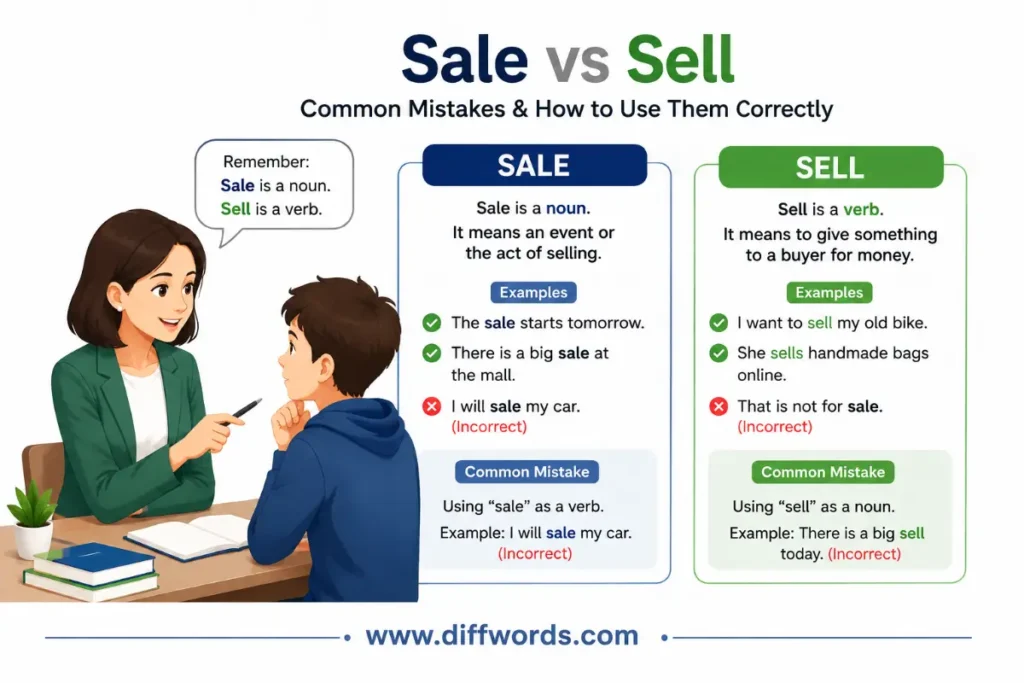
What are the most common sale and sell mistakes?
Mistake 1: “I want to sale it”
Incorrect:
I want to sale my car.
Correct:
I want to sell my car.
After want to, use the base verb sell.
Mistake 2: “It is for sell”
Incorrect:
This house is for sell.
Correct:
This house is for sale.
The phrase is always for sale.
Mistake 3: “They sale clothes”
Incorrect:
They sale clothes online.
Correct:
They sell clothes online.
Mistake 4: “We had a sell”
Incorrect:
The store had a big sell.
In standard American English, use:
The store had a big sale.
Mistake 5: “The sale was yesterday” when you mean the action
If you mean someone transferred an item for money, you may need sold:
I sold my car yesterday.
Not:
I sale my car yesterday.
Mistake 6: Confusing sale with sold
Remember:
sold = past tense of sell
sale = noun
So:
She sold the dress.
But:
The sale of the dress was completed.
What are the antonyms of sell?
The opposite of sell depends on the situation.
Common alternatives include:
- buy
- purchase
- keep
- retain
- hold
- give away
- donate
The clearest opposite in a basic buying-and-selling situation is usually buy.
I sell books.
I buy books.
But give away can also be an opposite when something is transferred without payment.
She gave the old clothes away.
This isn’t the same as selling them.
For sale, there is no single perfect antonym because the word has several meanings. Depending on context, opposites may include:
- purchase
- retention
- ownership
- withdrawal from the market
For example:
The house is for sale.
Opposite idea:
The house is not on the market.
Are sale and sell pronounced differently?
Yes.
Sale rhymes with words such as:
- tail
- fail
- scale
Sell rhymes with:
- bell
- tell
- well
- fell
This pronunciation difference can help you remember them.
Think:
sale → sounds like “sail”
sell → sounds like “bell”
The spelling may look similar, but the vowel sound is different.
Do American and British English use sale and sell differently?
The basic distinction is the same in American and British English.
Both use:
for sale
sell products
a sale
sales figures
There can be differences in how certain shopping terms are used, but sale and sell themselves follow the same basic grammar.
American English commonly uses phrases such as:
The store is having a sale.
British English uses the same structure.
The important rule doesn’t change:
sell = verb
sale = noun
What is the best word for a product description?
If you’re writing a product listing, use for sale to tell readers that the item is available.
Handmade wooden table for sale.
Use sell when describing what the business does:
We sell handmade wooden tables.
Use sale when describing a promotion:
Summer sale: 20% off selected tables.
For a product page, these three phrases can work together:
We sell handmade furniture.
Our summer sale starts Friday.
This table is now for sale.
Each word has a different job.
What is the best word for an advertisement?
For an advertisement, sale is often useful because it immediately suggests a shopping promotion.
Examples:
Summer Sale — Up to 50% Off
Weekend Sale — Shop Now
Clearance Sale — Limited Stock
But sell can be useful in the message itself:
We sell affordable home furniture.
Don’t confuse the noun and verb simply because both are connected with shopping.
What should you use in formal business writing?
In formal business writing, use the most precise term.
Use sell when describing the action:
The company sells software to small businesses.
Use sale for a transaction:
The sale was completed after several weeks of negotiation.
Also use sales for business activity or performance:
Sales increased by 12 percent.
Use revenue when you’re specifically discussing money earned by the business, because sales and revenue can have different accounting meanings depending on context.
Precision is more important than using the most sophisticated-looking word.
How can you choose the right word quickly?
Ask one simple question:
Am I naming an action or naming a thing/event?
If it’s an action, use sell.
We sell books.
If it’s an event or transaction, use sale.
The book sale starts tomorrow.
You can also look at the words immediately before it.
If you see “to”
You usually need sell:
to sell
want to sell
plan to sell
need to sell
If you see “for”
Use sale in the common phrase:
for sale
If you’re talking about a promotion
Use:
sale
If you’re talking about what someone does
Use:
sell
This quick test catches many errors.
Quick tips for remembering sale and sell
- Sell is a verb.
- Sale is a noun.
- You sell something.
- Something is for sale.
- A store can have a sale.
- A person can sell a product.
- The past tense of sell is sold, not sale.
- Sales often refers to business performance.
- On sale often means available at a reduced price.
- If you’re unsure, check whether the word describes an action or names an event.
A final sale vs sell cheat sheet
| You mean… | Correct word | Example |
|---|---|---|
| The action of exchanging something for money | sell | I want to sell my car. |
| An event with reduced prices | sale | The store has a sale. |
| Something available to buy | sale | The car is for sale. |
| The past action | sold | I sold my car yesterday. |
| Business activity | sales | Sales increased this year. |
| A person or company offering products | sell | They sell electronics. |
| A completed transaction | sale | The sale was completed. |
| A reduced price | discount | The product has a discount. |
Conclusion
Understanding sale vs sell comes down to one basic grammar rule: sell is a verb, while sale is a noun. You sell a product, but the product can be for sale. A store can sell clothes, while customers can shop during a clothing sale. If you’re talking about something that happened in the past, remember that the correct form is sold, not sale.
The same distinction works in business, school writing, emails, advertisements, resumes, and everyday conversations. When you’re unsure, check what role the word plays in your sentence. If you’re describing an action, choose sell. If you’re naming a transaction, event, or special shopping period, choose sale. Once you learn that simple pattern, these two commonly confused words become much easier to use correctly.
Frequently Asked Questions
Is it for sale or for sell?
The correct phrase is “for sale.” Sale is the noun used after “for,” while sell is the verb.
What is the simple difference between sale and sell?
Sell is a verb meaning to exchange something for money, while sale is a noun referring to the transaction or a shopping event.
Is sale the past tense of sell?
No. The past tense of sell is sold. Sale is a noun.
What’s another way to say sell?
Depending on the context, you can say market, offer, trade, retail, distribute, or promote. These words have slightly different meanings, so choose one that matches the action.
Is it “I want to sale my car” or “I want to sell my car”?
The correct sentence is “I want to sell my car.” After “want to,” you need the base verb sell.
What does “on sale” mean?
On sale usually means a product is being offered at a lower or special price. For example, “These shoes are on sale this weekend.”
Is it “a sell” or “a sale”?
In standard English, use “a sale” for a transaction or shopping event. Sell is normally used as a verb, while sale is the noun.
1 thought on “Sale vs Sell: The Ultimate Simple Guide”