
Have you ever paused while writing an email, essay, resume, or text and wondered whether to write catchup or catch up? You’re not alone. This small spacing difference can change the grammar and meaning of a sentence.
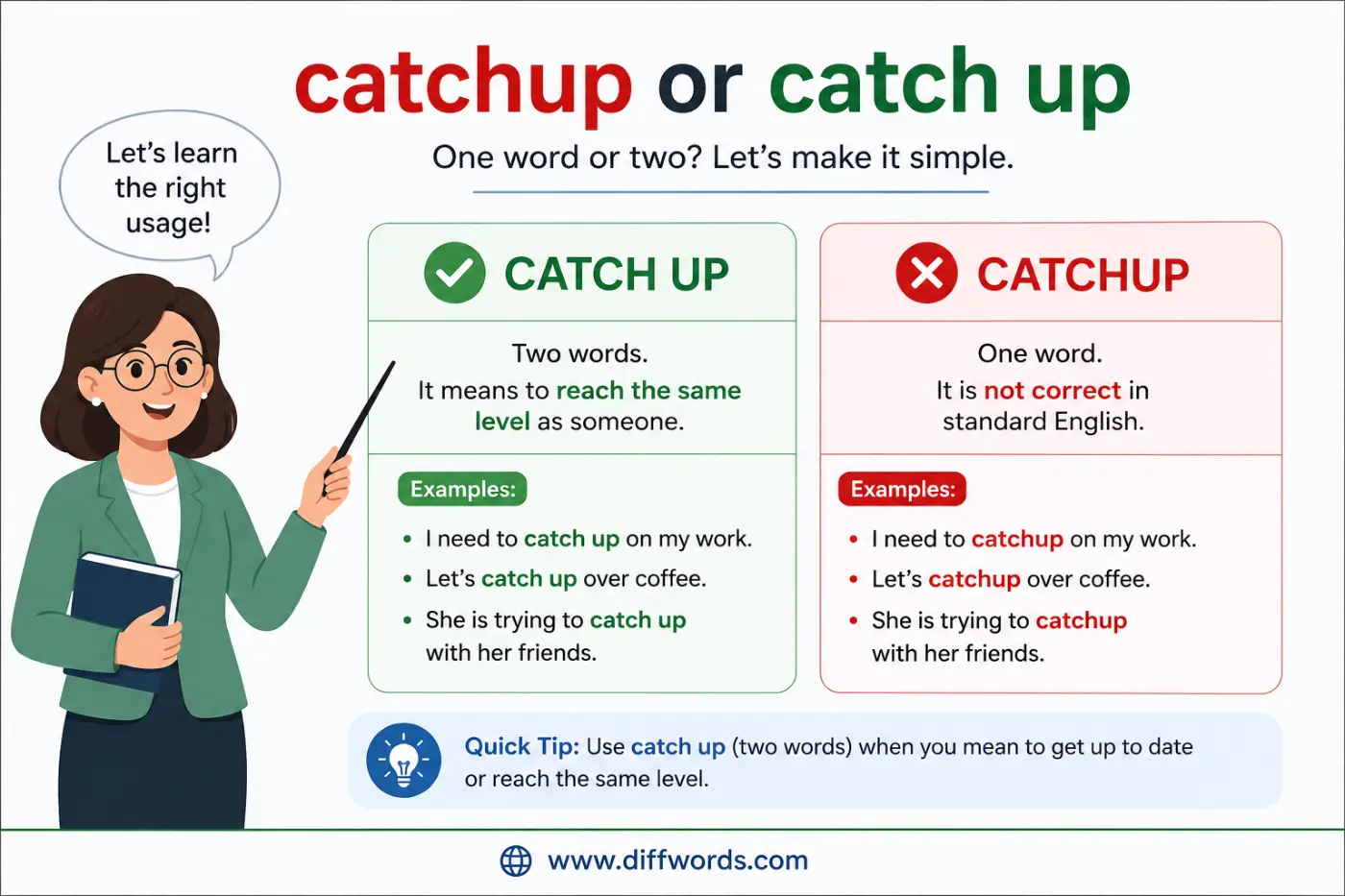
The good news is simple: “catch up” is usually the correct choice when you’re using the phrase as a verb. “Catch-up” can be used as a noun or adjective, while “catchup” is a less common noun spelling.
Quick answer: Use catch up when you mean to reach the same point as someone, get up to date, or talk with someone after time apart. Use catch-up when it works as a noun or modifier, such as “a catch-up meeting.”
The distinction becomes much easier once you see how the phrase works in real sentences. Below, you’ll learn where it came from, how its meanings developed, which synonyms fit different situations, and how to choose the best alternative for texting, emails, resumes, essays, and everyday speech.
Not sure whether to use scraped or scrapped? Learn the simple difference and avoid this common spelling mistake
What does “Catchup or Catch up” mean in plain English?
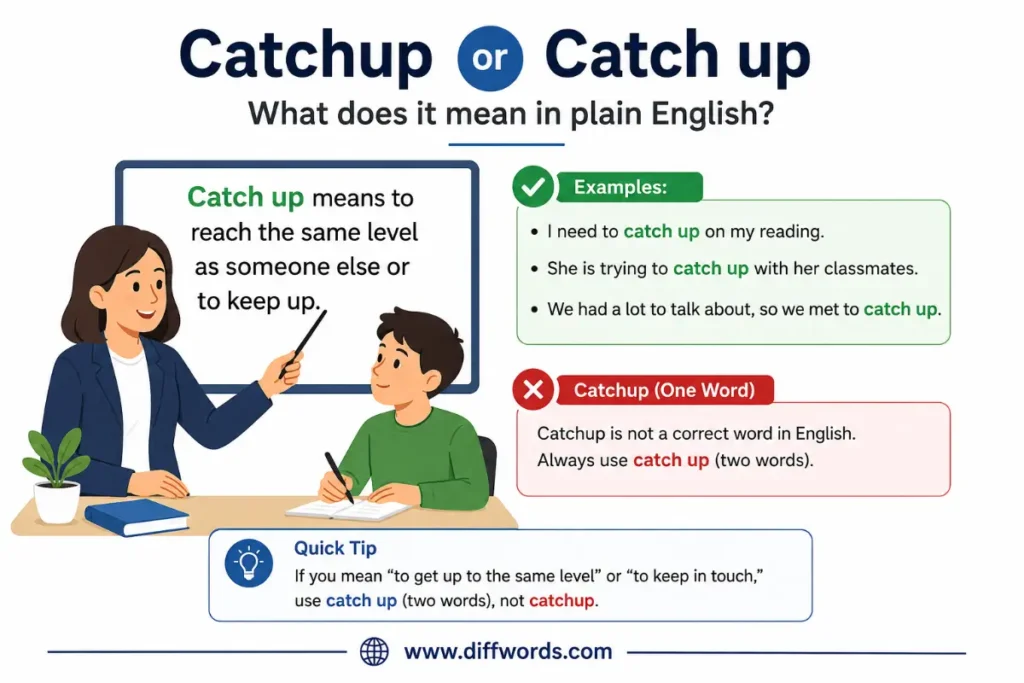
The basic meaning of catch up is to reach someone or something that is ahead of you. It can describe physical movement, progress, information, work, or conversation.
For example:
- “I walked faster to catch up with my friends.”
- “I need to catch up on my homework.”
- “Let’s catch up over coffee.”
- “She spent the weekend catching up on emails.”
The phrase has several related meanings, but they all share the idea of closing a gap.
That gap might be:
- A physical distance: “He ran to catch up with the group.”
- A difference in progress: “I’m trying to catch up with the rest of the class.”
- A lack of information: “I need to catch up on the latest news.”
- A delay in work: “She stayed late to catch up on her tasks.”
- A period without contact: “We should catch up soon.”
This is why catch up is so useful. It works in both literal and figurative situations.
Is “Catchup or Catch up” one word or two words?
As a verb, catch up is normally written as two words. “Catch” is the verb, and “up” is a particle that changes the meaning of the verb.
Examples:
- “I need to catch up.”
- “Can you catch up with me?”
- “He is catching up with his classmates.”
- “We need to catch up on the missed work.”
When the expression becomes a noun or adjective, catch-up is commonly hyphenated.
Examples:
- “We had a catch-up after lunch.”
- “I scheduled a catch-up meeting.”
- “This is a catch-up session.”
The form catchup also appears, especially as a noun in some styles and varieties of English, but it is less widely preferred than catch-up when the meaning is a meeting, conversation, or period of becoming current.
Where did “catch up” come from?
The history of catch up is closely connected to the older verb “catch,” which has long meant to seize, reach, or overtake something or someone.
“Catch” comes from Old French and ultimately traces back through earlier European language forms. English speakers later combined “catch” with particles such as “up” to create more specific meanings.
The word “up” adds the idea of reaching a level, position, or point. So, if one person is ahead and another moves forward until they reach the same position, the second person catches up.
Over time, the expression gained broader meanings.
A person can now catch up with:
- another runner,
- a class,
- a project,
- current events,
- messages,
- friends,
- work,
- information,
- or even sleep.
The figurative uses make sense because they preserve the original idea of closing a gap.
For example, imagine missing several days of school. Your classmates continue learning while you are away. When you return, you may need to catch up on the lessons you missed.
The same idea works for email. If you ignore your inbox for three days, the number of unread messages grows. When you work through them, you’re catching up on email.
This connection is useful because it gives you a simple memory trick:
Catch up = close a gap.
What are the best synonyms for “catch up”?
There isn’t one perfect synonym for catch up because the phrase has several meanings. Here is a broader synonym list, grouped by tone and use.
| Word or phrase | Meaning | Tone | Example |
|---|---|---|---|
| reach | Get to the same position | Simple | “I walked faster to reach them.” |
| overtake | Move ahead of someone | Everyday/Formal | “The runner overtook the leader.” |
| keep pace | Stay at the same speed or level | Everyday | “She worked hard to keep pace.” |
| keep up | Avoid falling behind | Everyday | “I can’t keep up with the class.” |
| get up to date | Learn the latest information | Everyday | “Let’s get up to date on the project.” |
| review | Look over missed material | Formal/Everyday | “I’ll review the notes tonight.” |
| review the latest | Examine recent information | Formal | “We reviewed the latest figures.” |
| reconnect | Contact someone again | Everyday | “I’d love to reconnect next week.” |
| confer | Talk to someone about a matter | Formal | “The managers conferred after the meeting.” |
| meet | Spend time with someone | Simple | “Let’s meet after work.” |
| chat | Have an informal conversation | Casual | “Let’s chat this weekend.” |
| recover | Make up for lost progress | Formal | “The team recovered lost ground.” |
| make up ground | Reduce a disadvantage | Everyday/Formal | “The company made up ground quickly.” |
| close the gap | Reduce a difference | Formal/Everyday | “The team closed the gap.” |
| make up for lost time | Work faster after a delay | Everyday | “We worked late to make up for lost time.” |
| resume | Start again after stopping | Formal | “She resumed her studies.” |
| continue | Keep going | Simple/Formal | “He continued working.” |
| progress | Move toward completion | Formal | “The students progressed well.” |
| follow | Stay informed or understand developments | Simple | “I follow the news closely.” |
| reconnect socially | Contact someone after time apart | Everyday | “We reconnected socially after college.” |
| catch up with | Reach the same level or contact someone | Everyday | “I’ll catch up with you later.” |
| catch up on | Complete or review something missed | Everyday | “I need to catch up on my reading.” |
What are synonyms for “catch up” from mild to strong?
The strength of the alternative matters.
Sometimes you only need to become informed. Other times, you’ve fallen far behind and need to make a serious effort.
Mild alternatives
These suggest a small gap or a simple update:
- review
- check in
- talk
- chat
- reconnect
- touch base
- get current
- get updated
Example:
“I’ll review the new information before the meeting.”
This doesn’t suggest that you were seriously behind.
Moderate alternatives
These suggest that some progress is needed:
- keep up
- keep pace
- get up to date
- make progress
- resume
- recover
- follow
Example:
“I spent the afternoon getting up to date with the project.”
Strong alternatives
These suggest a significant gap or effort:
- close the gap
- make up ground
- recover lost ground
- overtake
- make up for lost time
- reach the same level
Example:
“The team worked overtime to recover lost ground.”
These stronger phrases are useful in academic, business, sports, and performance contexts.
What parts of speech can “catch up” be?
Understanding grammar is one of the easiest ways to avoid the spacing mistake.
As a phrasal verb
Catch up is most commonly a phrasal verb.
Examples:
- “I need to catch up.”
- “She caught up with her brother.”
- “We are catching up on our work.”
- “They finally caught up with the other team.”
Different prepositions create slightly different meanings.
Catch up with someone usually means reaching a person or reconnecting with them.
“I’ll catch up with Sarah after work.”
Catch up on something usually means dealing with something you missed.
“I need to catch up on my reading.”
As a noun
When used as a noun, the expression is commonly written catch-up.
Examples:
- “We had a quick catch-up.”
- “The team scheduled a catch-up.”
- “I enjoyed our weekend catch-up.”
In some contexts, especially informal writing, you may see catchup as one word. However, catch-up is a clear and widely recognized choice when you’re using it as a noun.
As an adjective
The hyphenated form can also modify a noun.
Examples:
- “We had a catch-up meeting.”
- “The teacher arranged a catch-up class.”
- “She joined a catch-up session.”
The hyphen helps show that the two words work together as a modifier.
What is the US vs. UK difference?
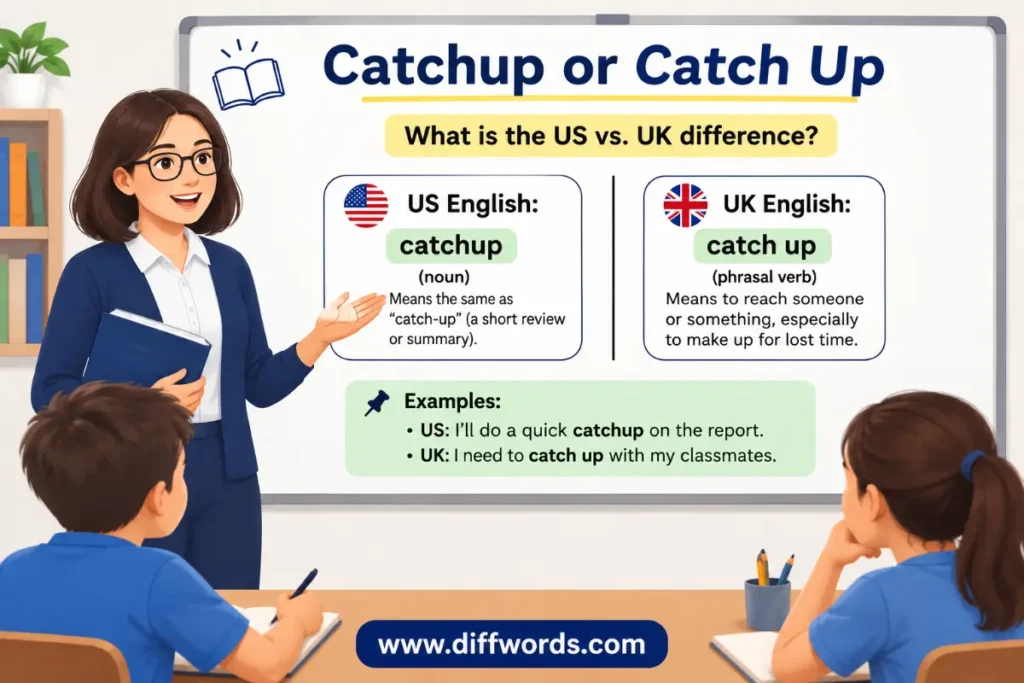
For most everyday purposes, American and British English use catch up as a two-word phrasal verb.
Examples are natural in both varieties:
- “I need to catch up on work.”
- “Let’s catch up later.”
- “She caught up with her friends.”
The main variation appears when the expression is used as a noun.
You may encounter catch-up or catchup, depending on the dictionary, publication, organization, or regional style guide.
For international writing, catch-up is often the safest choice when you need a noun or adjective because the hyphen makes the grammatical role clear.
For example:
“We had a catch-up meeting.”
That form is easy for both American and British readers to understand.
In formal writing, consistency matters more than trying to force a regional spelling. If your publication uses a particular style guide, follow it.
What’s the best word for a resume Catchup or Catch up?
On a resume, catch up is usually too conversational when you’re describing professional achievements.
Choose a more precise verb based on what you actually did.
Good options include:
- recovered
- completed
- accelerated
- updated
- streamlined
- restored
- brought up to date
- closed the gap
- achieved
- improved
Instead of:
“Caught up on a backlog of customer requests.”
Try:
“Cleared a backlog of 500 customer requests within two weeks.”
Or:
“Brought customer records up to date and reduced processing delays.”
These versions show the result instead of relying on a casual phrase.
When is “catch up” acceptable on a resume?
It can work if the resume is informal or you’re describing a specific responsibility, but stronger action verbs usually sound more professional.
For example:
“Updated and maintained project records to ensure all documentation remained current.”
This communicates the same basic idea with greater precision.
What’s the best word for an essay?
For an academic essay, avoid using catch up unless the subject itself is informal or the phrase appears in a quotation.
Better alternatives include:
- recover lost ground
- close the gap
- reach the same level
- become current
- review
- address missed material
- compensate for delays
For example:
Casual:
“Students who miss classes need to catch up.”
Academic:
“Students who miss classes may need to review missed material before continuing with the course.”
The second sentence is clearer and more specific.
What’s the best word for texting?
Texting is where catch up works especially well.
It’s natural, friendly, and short.
Examples:
“Want to catch up later?”
“We haven’t talked in forever. Let’s catch up!”
“I’ll catch up with you tomorrow.”
You don’t need a formal synonym in a casual text. “Reconnect” can sound more serious, while “confer” would sound unnatural.
In this context, catch up is friendly and conversational.
What’s the best word for an email?
The right choice depends on who you’re emailing.
For a friend or coworker:
“Would you like to catch up over coffee next week?”
For a client:
“I’d be happy to schedule a brief call to discuss the latest updates.”
And for a manager:
“Could we schedule a short meeting to review the project’s progress?”
And for a formal organization:
“I would appreciate an opportunity to discuss the recent developments.”
The more formal the audience, the more useful alternatives such as “discuss,” “review,” “update,” and “meet” become.
What’s the best word when speaking?
In everyday conversation, catch up is one of the most natural choices.
You might say:
“It’s been a while. Let’s catch up.”
Or:
“Can you catch me up on what happened?”
Notice the difference between catch up and catch me up.
Catch up means you become current or reconnect.
“I need to catch up.”
Catch me up means someone gives you the information you missed.
“Can you catch me up on the meeting?”
Both are common in spoken English.
What are some real examples of “Catchup or Catch up”?
Here are examples from different situations so you can see how the expression changes meaning.
- School: “I missed two classes, so I need to catch up on the lessons.”
- Work: “I’m staying late tonight to catch up on my emails.”
- Friends: “We haven’t seen each other since graduation. Let’s catch up soon.”
- Sports: “The team scored twice and began to catch up with its opponent.”
- Travel: “We left early so the second car could catch up with us.”
- News: “I watched the evening report to catch up on the latest events.”
- Reading: “I spent Sunday catching up on my favorite books.”
- Projects: “The developers worked through the weekend to catch up after the delay.”
- Family: “I called my cousin so we could catch up.”
- Messages: “I haven’t checked my phone all day, so I have a lot of messages to catch up on.”
- Fitness: “After missing several workouts, he slowly caught up with his training plan.”
- Finance: “The company is trying to catch up with its competitors.”
- Classwork: “Maya borrowed her friend’s notes to catch up on what she missed.”
- Conversation: “Give me a minute to catch up with the conversation.”
- Workplace: “Let’s catch up tomorrow and decide what to do next.”
- Technology: “The older system is struggling to catch up with newer platforms.”
- Housework: “I used Saturday morning to catch up on laundry.”
- Personal plans: “I need a quiet weekend to catch up on everything.”
These examples show why the phrase can’t always be replaced by one synonym. Its meaning depends heavily on the words around it.
Catch up vs. keep up — what’s the difference?
Catch up means you were behind and are trying to reach the current level. Keep up means you’re already at the level and want to avoid falling behind.
Compare:
“I missed three classes, so I need to catch up.”
You are behind.
“The course is difficult, but I’m keeping up.”
You are currently managing to stay at the same level.
This distinction is important in school, work, sports, and everyday conversations.
A simple memory trick:
- Catch up = behind → reach the level
- Keep up = at the level → stay there
You can even use both in one situation:
“I missed the first week, but I caught up and can now keep up with the class.”
Catch up vs. update — what’s the difference?
Catch up is broader and more conversational. Update specifically focuses on new information.
Compare:
“Let’s catch up tomorrow.”
This could mean talking about work, life, plans, or anything else.
“Let’s update each other on the project tomorrow.”
This clearly focuses on information about the project.
You can also say:
“Can you update me on the meeting?”
That means “Tell me what happened and give me the latest information.”
You generally wouldn’t replace that sentence with “Can you catch up me on the meeting?” That’s incorrect.
The correct phrase is:
“Can you catch me up on the meeting?”
So remember:
- Update me = give me new information.
- Catch me up = tell me what I missed.
- Catch up = become current, reach someone, or reconnect.
Catch up vs. reconnect — what’s the difference?
These expressions overlap when talking about people, but they aren’t exactly the same.
Reconnect emphasizes restoring contact after time apart.
“I’d like to reconnect with some former classmates.”
Catch up emphasizes spending time talking and finding out what has happened.
“I’d like to catch up with some former classmates.”
If you haven’t spoken to someone in years, “reconnect” can highlight the return of the relationship. “Catch up” sounds more relaxed and often implies a conversation about what has happened since you last met.
Catch up vs. review — when should you use each?
Use review when you’re looking over information again. Use catch up when you’re dealing with something you missed or fell behind on.
“I need to review yesterday’s lesson.”
This could mean you attended the lesson but want to study it again.
“I need to catch up on yesterday’s lesson.”
This suggests you missed it or didn’t complete the material.
The difference is small but useful in academic and professional writing.
What are the common mistakes with “Catchup or Catch up”?
A few errors appear often.
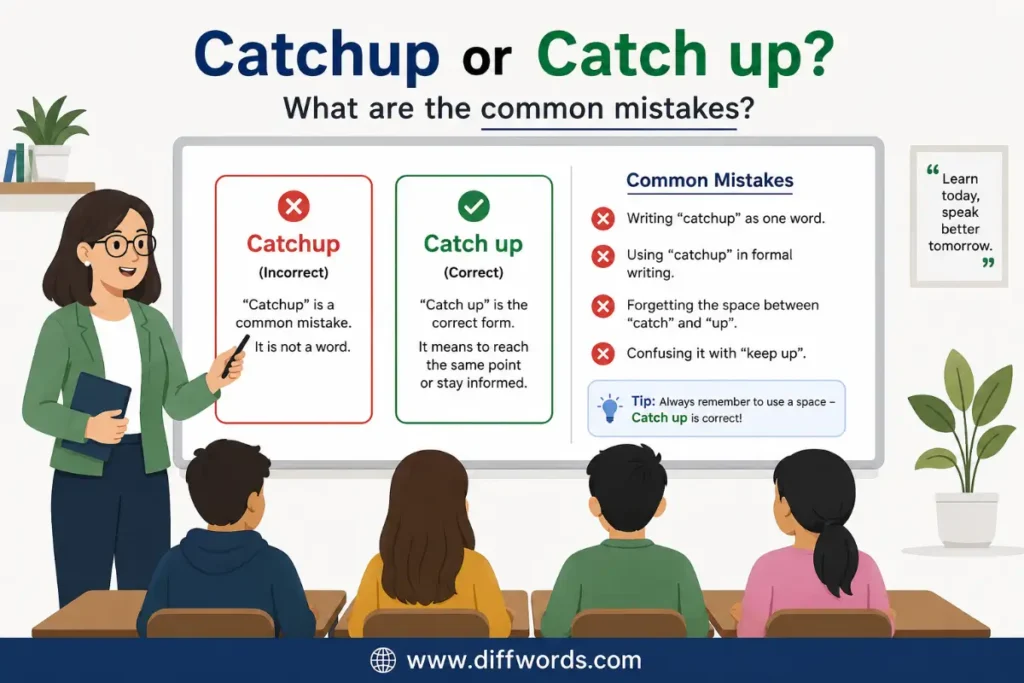
Mistake 1: Writing “catchup” as the verb
Incorrect:
“I need to catchup on my work.”
Correct:
“I need to catch up on my work.”
The verb form has two words.
Mistake 2: Using “catch up” as a noun without thinking about the style
You may see:
“We had a catchup yesterday.”
A clearer form is:
“We had a catch-up yesterday.”
The hyphen makes it clear that you’re using the phrase as a noun.
Mistake 3: Confusing “catch up on” and “catch up with”
Use catch up on for work, information, tasks, reading, news, and similar things.
“I need to catch up on my emails.”
Use catch up with for a person or group when you mean reaching them or talking with them.
“I need to catch up with my sister.”
You can also use “catch up with” for progress:
“Our company is catching up with its competitors.”
Mistake 4: Saying “catch up” when you mean “update”
Don’t say:
“Please catch up me on the changes.”
Say:
“Please catch me up on the changes.”
Or:
“Please update me on the changes.”
Mistake 5: Using the phrase in overly formal writing
In a research paper, “catch up” may sound too casual.
Instead of:
“The country is trying to catch up with other economies.”
You could write:
“The country is attempting to close the economic gap with other nations.”
The best replacement depends on your audience.
When should you NOT use “Catchup or Catch up”?
Avoid catch up when a more precise word communicates your meaning better.
For example, if you’re asking for information:
“Could you update me on the project?”
is clearer than:
“Could you catch up with me on the project?”
If you’re describing a resume achievement:
“Reduced the backlog by 70%”
is stronger than:
“Caught up on the backlog.”
If you’re writing an academic paper:
“The researchers reviewed the missing data”
may be better than:
“The researchers caught up on the missing data.”
If you’re describing someone moving past another person in a race, overtake may be more precise:
“The second runner overtook the leader.”
The key isn’t to avoid catch up. It’s to use it where it sounds natural and accurate.
What are the antonyms of “catch up”?
The opposite depends on the meaning.
For physical movement, possible opposites include:
- fall behind
- lag behind
- lose ground
- move away
- remain behind
For progress:
- fall behind
- lag
- regress
- lose ground
- delay
And for communication:
- lose touch
- disconnect
- remain uninformed
Examples:
“I don’t want to fall behind in class.”
“The company is losing ground against its competitors.”
“We lost touch after college.”
Notice that fall behind is the most useful opposite in many everyday situations.
How do you choose the right synonym Catchup or Catch up?
Start by asking what you actually mean.
If you mean “reach someone”
Use:
- reach
- catch up with
- overtake
Example:
“I walked quickly to reach the group.”
If you mean “finish missed work”
Use:
- complete
- review
- get up to date
- make up for lost time
Example:
“I spent Saturday completing the work I missed.”
If you mean “learn recent information”
Use:
- update
- review
- get current
- get up to date
- recap
Example:
“Can you give me a quick recap?”
If you mean “talk to someone after time apart”
Use:
- catch up
- reconnect
- meet
- chat
- touch base
Example:
“I’d love to reconnect with you sometime.”
If you mean “reduce a performance gap”
Use:
- close the gap
- make up ground
- recover lost ground
- improve
- overtake
Example:
“The team closed the gap during the second half.”
What should you remember about “Catchup or Catch up”?
A few simple rules cover most situations:
- Catch up is the normal two-word verb.
- Catch-up works as a noun or adjective.
- Catchup may appear as a noun in some usage, but it isn’t the clearest choice for general-purpose writing.
- Use catch up on for tasks, work, reading, news, and information.
- Use catch up with for people, groups, and comparable levels.
- Use catch me up when asking someone to tell you what you missed.
- In formal writing, choose a more precise synonym when appropriate.
- In texting and casual conversation, the phrase sounds completely natural.
- Always consider whether you mean reaching, updating, reviewing, reconnecting, or recovering.
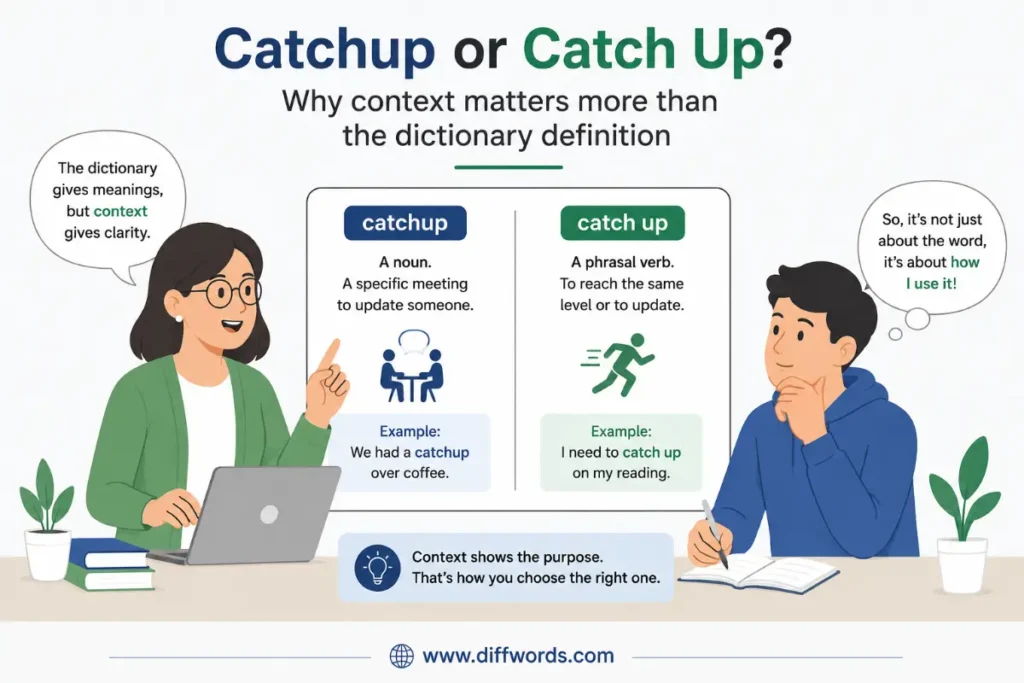
Why context matters more than the dictionary definition
A dictionary can tell you that catch up means reaching the same point or becoming current. But real communication requires more than knowing a definition.
Consider these three sentences:
“I need to catch up with John.”
“I need to catch up on John’s report.”
“John needs to catch me up on the report.”
All three are grammatically different.
The first suggests reaching or talking with John.
The second suggests reviewing or completing something related to John’s report.
The third asks John to give you information.
Changing one small word changes the relationship between the people and the action.
This is why learning phrases in context is more useful than memorizing isolated definitions.
Can “catch up” be used in professional English?
Yes, but its suitability depends on the situation.
It’s perfectly normal in a professional conversation:
“Let’s catch up tomorrow.”
It can also work in a friendly workplace email:
“I’d love to catch up and hear how the project is going.”
But formal reports may need more precise wording:
“The team reviewed the outstanding tasks and brought the project schedule up to date.”
The difference isn’t that catch up is wrong. It’s about tone and precision.
A good writer adjusts language to the reader.
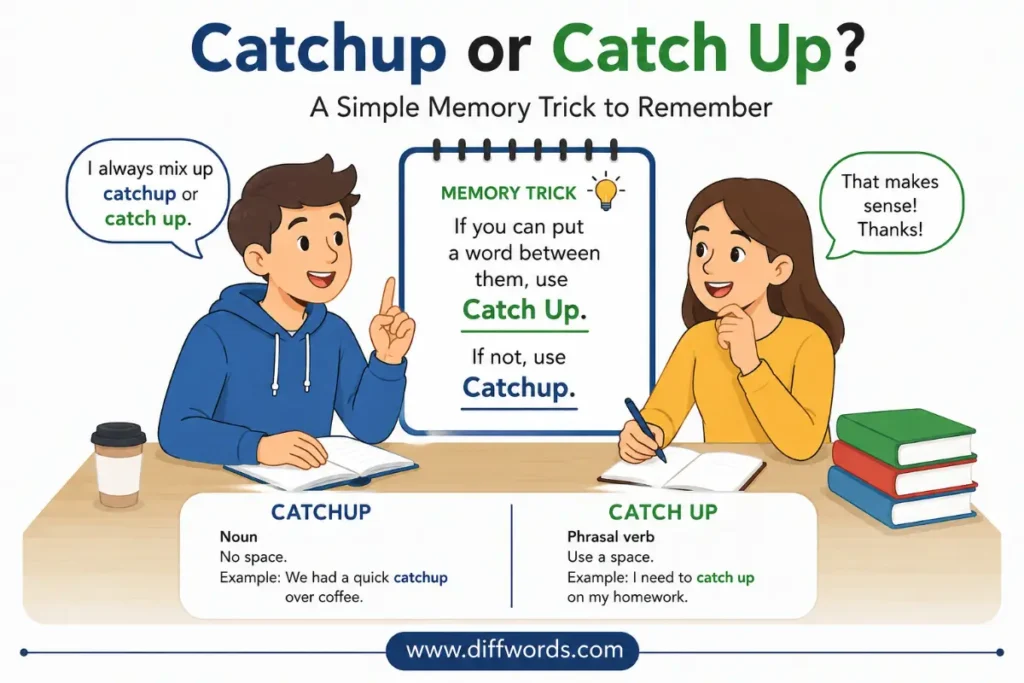
How can you remember the spelling Catchup or Catch up?
Use the “gap” trick.
Imagine that something is ahead of you.
You move forward until you reach it.
You catch up.
Because the phrase describes an action, write it as two words:
catch + up
When you turn the phrase into a noun or adjective, the hyphen can make the relationship clearer:
a catch-up
a catch-up meeting
This simple pattern will prevent most spelling errors.
Conclusion
Choosing the right form is easier when you focus on the job the phrase is doing. Use catch up as the normal verb when you mean reaching someone, becoming current, completing missed work, or reconnecting with someone. Use catch-up when the expression acts as a noun or adjective, especially in phrases such as “a catch-up meeting.” You may also encounter “catchup” as a noun, but the hyphenated form is often clearer for general writing.
When you need a more precise alternative, consider the exact meaning: “update” for information, “review” for material, “reconnect” for relationships, “overtake” for movement, and “close the gap” for performance. Once you match the word to the situation, your writing will sound more natural and accurate. The goal isn’t to avoid common phrases—it’s to use them with confidence and purpose.
Frequently Asked Questions
Is “catch up” one word or two?
As a verb, catch up is written as two words. The hyphenated catch-up form is commonly used as a noun or adjective.
What’s another way to say “catch up”?
Good alternatives include “get up to date,” “reach,” “reconnect,” “review,” “keep pace,” “update,” and “close the gap.” The best choice depends on the meaning and tone.
Is “catchup” grammatically correct?
Catchup can appear as a noun, but catch-up is a clearer and more widely recognizable noun form. As a verb, use catch up.
Should I write “catch up on” or “catch up with”?
Use catch up on for things you need to complete or review, such as work, reading, or news. Use catch up with for people, groups, or something you are trying to reach.
Is “catch up” formal or informal?
“Catch up” is neutral to informal and very common in everyday English. In highly formal writing, a more specific alternative such as “review,” “update,” “recover,” or “close the gap” may be better.
Can I use “catch up” in a resume?
You can, but stronger action verbs are often better on a resume. Words such as “completed,” “updated,” “recovered,” “accelerated,” and “cleared” can make your achievement more specific.
What is the difference between catch up and keep up?
Catch up means reaching a level because you were behind, while keep up means staying at the current level without falling behind. For example, a student may catch up after missing classes and then keep up with the class.
1 thought on “Catchup or Catch up: The Ultimate Guide to Getting It Right”