
You’re writing an email, essay, resume, or text and suddenly stop at a familiar word: reinforce vs reenforce. Both forms look reasonable, especially because English has many words that begin with “re-.” But only one is the standard spelling in modern English.
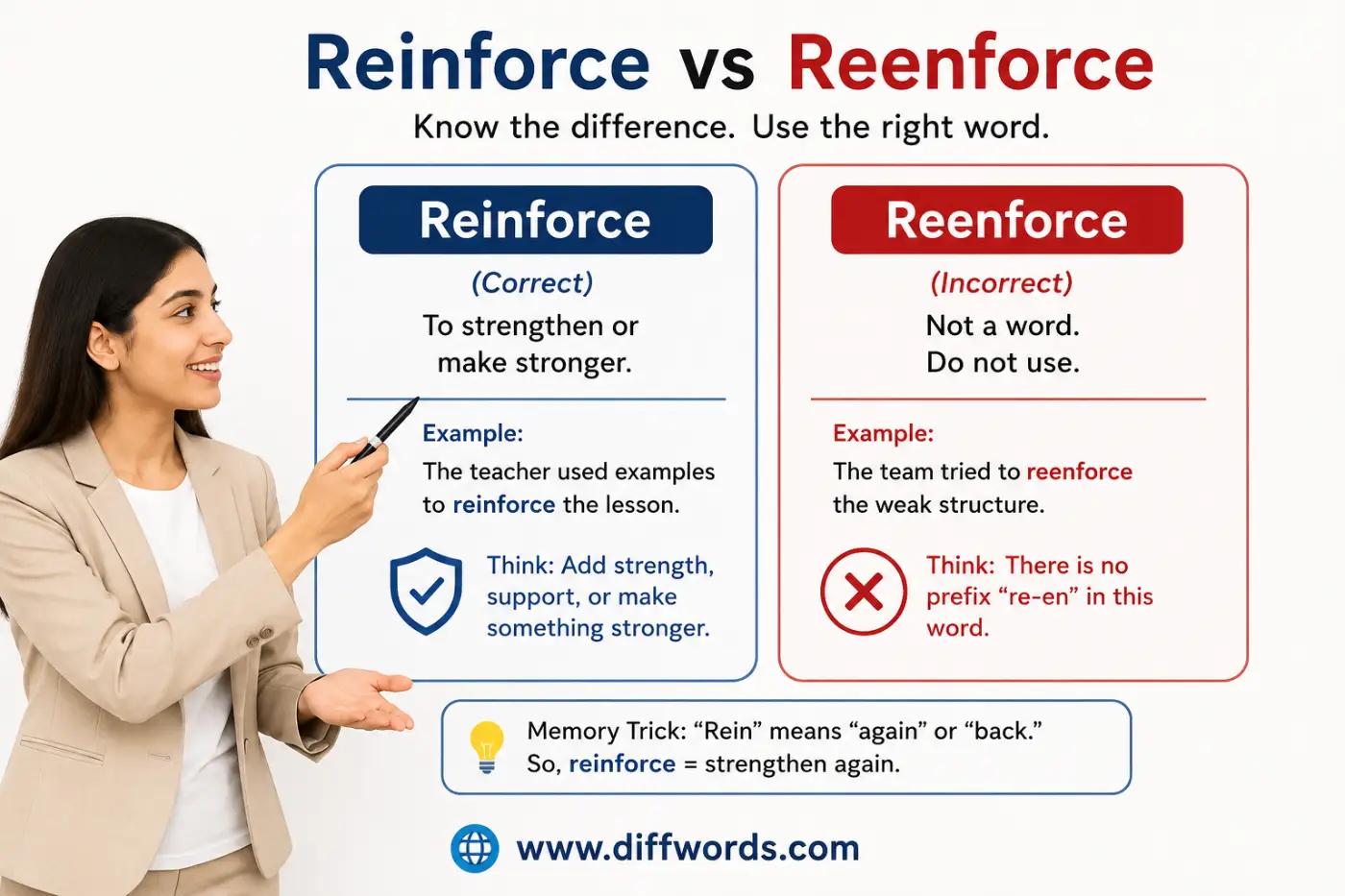
Quick answer: “Reinforce” is the correct standard spelling. “Reenforce” is a rare variant that is generally best avoided in modern US English.
The verb reinforce means to make something stronger, support an idea, add strength to a structure, or provide additional people or resources. You can reinforce a wall, reinforce a lesson, reinforce an argument, or reinforce a positive behavior.
This guide explains the difference, where the words came from, how to use “reinforce” naturally, which synonyms fit different situations, and which alternatives work best in resumes, essays, emails, texts, and everyday speech. You’ll also see common mistakes, regional notes, examples, and quick rules that make the spelling easy to remember.
Don’t confuse acceptions vs exceptions. Learn what these words mean and which one fits your sentence.
Is reinforce vs reenforce the correct spelling?
Reinforce is the standard spelling used in modern English.
Reenforce is an older or less common spelling variant. You may encounter it in historical texts, older dictionaries, or occasional modern writing, but it isn’t the preferred spelling for standard American English.
Correct:
“The steel beams reinforce the building.”
Correct:
“The teacher used examples to reinforce the lesson.”
Generally avoid:
“The steel beams reenforce the building.”
Generally avoid:
“The examples reenforce the main idea.”
If you’re writing an email, school assignment, article, business document, resume, or website, reinforce is the safe and standard choice.
A simple rule is:
Use reinforce, not reenforce, in normal modern English writing.
What does reinforce mean in plain English?
Reinforce means to make something stronger or provide additional support.
The word can describe physical strength, ideas, arguments, skills, habits, feelings, structures, teams, and many other things.
For example:
“Steel bars reinforce the concrete.”
Here, the bars make the concrete structure stronger.
But reinforce doesn’t have to describe something physical.
“The teacher repeated the rule to reinforce the lesson.”
The repetition strengthens the student’s understanding.
It can also describe an argument:
“The new evidence reinforces her conclusion.”
The evidence gives the conclusion more support.
It can describe behavior:
“Parents can reinforce good study habits by praising consistent effort.”
In this case, reinforcement encourages a behavior to continue.
So, while the core meaning is always connected to strength or support, the type of strength changes with context.
What are the main meanings of reinforce?
The most common meanings include:
- Make physically stronger
- Support an idea or argument
- Strengthen knowledge or learning
- Encourage behavior
- Add people or resources
- Make a feeling or impression stronger
- Confirm or strengthen an existing belief
- Provide additional protection or support
Examples:
“The bridge was reinforced with steel.”
“The report reinforces the need for reform.”
“Practice reinforces new vocabulary.”
“The manager praised the team to reinforce good performance.”
“Additional officers were sent to reinforce the local unit.”
Each sentence uses the same basic idea: something is being made stronger, supported, or more effective.
Where did the word reinforce come from?
Reinforce comes from French and ultimately traces back to Latin roots connected with strength.
The word entered English through French forms related to strengthening or fortifying something. Its structure reflects the idea of adding strength to an existing thing.
The prefix re- can sometimes mean “again,” but that doesn’t mean you should spell the word as reenforce.
The second part is related to force, meaning strength or power.
So, historically, the word carries the idea of adding force or strength.
This history also helps explain why the standard spelling is reinforce, rather than treating it as “re + enforce.”
The word became established in English with the spelling reinforce, and that is the form used today in standard dictionaries and general writing.
Why does “reenforce” seem logical?
The spelling reenforce may seem reasonable because English often combines re- with another word.
For example:
- reenter
- reexamine
- reeducate
- reenact
- reelect
These words can make writers expect re + enforce = reenforce.
But spelling isn’t always predictable from individual parts.
Reinforce is an established word with its own spelling and history. You shouldn’t create its spelling by simply joining “re” and “enforce.”
Think of it as one standard vocabulary item:
reinforce
not:
re + enforce
This is one reason memorizing the established form is more useful than trying to rebuild the word from its parts.
Why is reinforce spelled with “in”?
The spelling reinforce comes from the word’s historical development rather than a simple modern combination of “re” and “enforce.”
The “in” is part of the established spelling.
Compare these words:
- reinforce
- reinforced
- reinforcing
- reinforcement
They all keep the same base:
reinforce
For example:
“The evidence reinforced the argument.”
“The evidence is reinforcing the argument.”
“The evidence provided reinforcement for the argument.”
The spelling stays connected across the word family.
What is the difference between reinforce vs reenforce?
The practical difference is mostly about standard spelling and usage frequency.
| Word | Status | Recommended? | Example |
|---|---|---|---|
| reinforce | Standard modern spelling | Yes | “The evidence reinforces the claim.” |
| reenforce | Rare/variant spelling | Usually no | “The evidence reenforces the claim.” |
| reinforced | Standard past form | Yes | “The wall was reinforced.” |
| reinforcing | Standard -ing form | Yes | “The lesson is reinforcing the skill.” |
| reinforcement | Standard noun | Yes | “The structure needs reinforcement.” |
If you’re choosing between”reinforce vs reenforce” the two for normal writing, there is little reason to choose reenforce.
Use:
reinforce
This applies especially to American English.
What are the best synonyms for reinforce?
There isn’t one perfect synonym because reinforce has several meanings. A synonym that works for a building may sound strange when talking about an argument or a habit.
Here is a broad list of useful alternatives.
| Word | Meaning | Tone | Example |
|---|---|---|---|
| promote | Help something develop or continue | Everyday/Formal | “The program promotes healthy habits.” |
| uphold | Support or maintain something | Formal | “The court upheld the decision.” |
| validate | Support the correctness or value of something | Formal | “The results validated the approach.” |
| substantiate | Provide evidence for a claim | Formal | “The data substantiate the argument.” |
| buttress | Support or strengthen an idea or structure | Formal | “The evidence buttresses the conclusion.” |
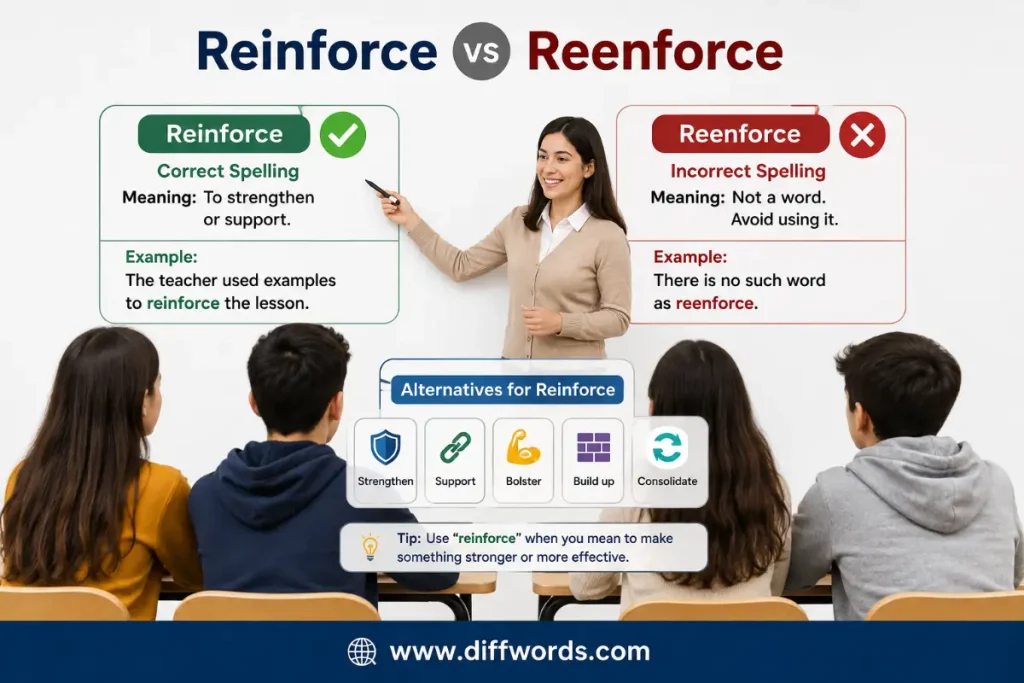
| bolster | Strengthen or support | Formal/Everyday | “The report bolstered investor confidence.” |
| augment | Increase or add to something | Formal | “The team augmented its resources.” |
| supplement | Add something that provides extra support | Formal | “The guide supplements classroom instruction.” |
| enhance | Improve quality or effectiveness | Formal | “The training enhanced employee skills.” |
| consolidate | Make something stronger or more stable | Formal | “The policy consolidated previous gains.” |
| stabilize | Make something steady | Technical | “The supports stabilized the platform.” |
| shore up | Provide additional support | Everyday | “The company shored up its finances.” |
| back | Support an idea or person | Casual | “Several experts backed the proposal.” |
| maintain | Keep something at its current strength | Simple/Formal | “The system maintains pressure.” |
| defend | Support against criticism or attack | Everyday/Formal | “The evidence defended the conclusion.” |
| add support | Provide extra assistance | Simple | “Extra beams add support.” |
| reinforce | Make stronger or better supported | Neutral | “The beams reinforce the structure.” |
| intensify | Make stronger in degree | Formal | “The news intensified public concern.” |
| deepen | Make stronger or more developed | Everyday/Formal | “The course deepened their understanding.” |
| reinforce confidence | Increase confidence | Neutral | “The results reinforced confidence.” |
| reaffirm | Confirm or state support again | Formal | “The company reaffirmed its commitment.” |
| corroborate | Confirm with additional evidence | Formal | “The witness corroborated the account.” |
What are simple synonyms for reinforce?
If you’re writing for a general audience, the easiest replacements are:
- strengthen
- support
- help
- improve
- boost
- encourage
- confirm
- protect
Examples:
“The new evidence strengthens the argument.”
“Extra beams support the roof.”
“The campaign boosted public awareness.”
These words are clear and familiar.
When should you use strengthen instead?
Strengthen is probably the closest general synonym for reinforce.
You can use it for:
- physical structures,
- arguments,
- relationships,
- skills,
- policies,
- confidence,
- evidence,
- organizations.
For example:
“The new evidence strengthens the case.”
This has almost the same meaning as:
“The new evidence reinforces the case.”
“Strengthen” is often a good replacement when you want very plain English.
What are everyday synonyms for reinforce?
In casual speech, you may hear:
- boost
- back up
- support
- help
- strengthen
- shore up
- encourage
- build up
Examples:
“The good results boosted her confidence.”
“The extra information backs up his argument.”
“We need to shore up the damaged fence.”
These expressions sound natural in conversation, but they aren’t always suitable for formal writing.
What are formal synonyms for reinforce?
Formal writing gives you more precise options.
Useful choices include:
- substantiate
- corroborate
- validate
- bolster
- buttress
- fortify
- uphold
- augment
- consolidate
- reaffirm
- strengthen
For example:
“The additional evidence corroborates the researchers’ findings.”
This is more precise than simply saying:
“The additional evidence reinforces the findings.”
However, don’t choose a formal synonym just because it sounds more academic. If “strengthen” communicates the idea clearly, it may be the better choice.
What are informal or slang alternatives for reinforce?
English has several casual expressions that can communicate a similar idea.
Back up
“The new data back up her claim.”
This means the evidence supports the claim.
Build up
“The exercises build up his strength.”
This emphasizes gradual development.
Boost
“The good news boosted morale.”
This suggests an increase.
Shore up
“The company needs to shore up its finances.”
This often means giving extra support to something that may be weak.
Push
In some contexts, “push” can mean encouraging an idea or behavior:
“The campaign pushed the new message.”
But “push” isn’t a direct synonym in every situation.
What are synonyms for reinforce from mild to strong?
The strength of the alternative matters.
Mild reinforcement
Use these when something receives a small amount of added support:
- support
- help
- encourage
- maintain
- confirm
Example:
“The reminder supported the lesson.”
Moderate strengthening
Use these when something becomes noticeably stronger:
- improve
- strengthen
- boost
- bolster
- enhance
- build up
Example:
“Regular practice strengthens memory.”
Strong reinforcement
Use these when something receives substantial support or protection:
- fortify
- buttress
- shore up
- consolidate
- intensify
- substantially strengthen
Example:
“The engineers fortified the structure against severe weather.”
The right word should reflect the actual degree of change. Don’t use “fortify” if you only mean “support.”
What are synonyms for reinforce by part of speech?
Reinforce is mainly a verb, so most direct synonyms are also verbs.
Reinforce as a verb
Common alternatives:
- strengthen
- support
- boost
- encourage
- bolster
- fortify
- validate
- confirm
- substantiate
- enhance
Example:
“The evidence reinforces the conclusion.”
Reinforcement as a noun
The noun form is reinforcement.
Possible alternatives include:
- support
- strengthening
- backing
- assistance
- confirmation
- encouragement
- fortification
- reinforcement
- added protection
Example:
“The bridge needs additional reinforcement.”
Reinforced as an adjective
Reinforced can describe something that has been made stronger.
Examples:
“The building has reinforced concrete.”
“The company uses reinforced packaging.”
Related alternatives include:
- strengthened
- supported
- fortified
- protected
- stabilized
- secured
Reinforcing as an adjective or participle
Examples:
“The teacher used reinforcing examples.”
“The team is reinforcing the structure.”
Depending on context, alternatives include:
- strengthening
- supporting
- encouraging
- confirming
- bolstering
What are the different meanings of reinforce?
Understanding the different meanings will help you choose the right synonym.
Reinforce a physical structure
This means adding material or support to make something stronger.
Examples:
“Workers reinforced the bridge.”
“Steel bars reinforce the concrete.”
“The wall was reinforced before the storm.”
Possible alternatives:
- strengthen
- fortify
- stabilize
- secure
- shore up
Reinforce an argument
This means adding evidence or reasoning that makes the argument more convincing.
Examples:
“The new study reinforces the argument.”
“These statistics reinforce her point.”
Possible alternatives:
- support
- strengthen
- substantiate
- corroborate
- buttress
- validate
Reinforce learning
This means helping knowledge or a skill become stronger or easier to remember.
Examples:
“Practice reinforces new vocabulary.”
“The quiz reinforced the main concepts.”
Possible alternatives:
- strengthen
- review
- practice
- consolidate
- deepen
Reinforce behavior
This means encouraging a behavior to continue or become more likely.
Examples:
“Positive feedback reinforced the student’s effort.”
“The reward reinforced the behavior.”
Possible alternatives:
- encourage
- reward
- promote
- strengthen
- support
Reinforce a feeling or impression
This means making a feeling, belief, or impression stronger.
Examples:
“The experience reinforced my confidence.”
“The result reinforced her belief that the plan would work.”
Possible alternatives:
- strengthen
- deepen
- confirm
- intensify
- solidify
Reinforce a team or group
This means adding people or resources.
Examples:
“Two additional workers were sent to reinforce the team.”
“The company reinforced its customer service department.”
Possible alternatives:
- strengthen
- support
- supplement
- augment
- add to
Is reinforce a noun or a verb?
Reinforce is a verb.
Examples:
“The evidence reinforces the conclusion.”
“They reinforced the bridge.”
“The teacher reinforced the lesson.”
The related noun is reinforcement.
“The bridge needs reinforcement.”
The adjective is reinforced.
“The structure is made from reinforced concrete.”
The -ing form is reinforcing.
“The examples are reinforcing the main point.”
Understanding these forms helps prevent grammar errors.
| Word | Part of speech | Example |
|---|---|---|
| reinforce | Verb | “The evidence reinforces the claim.” |
| reinforces | Verb | “This result reinforces the theory.” |
| reinforced | Verb/adjective | “The wall was reinforced.” |
| reinforcing | Verb/adjective | “The exercise is reinforcing the skill.” |
| reinforcement | Noun | “The structure needs reinforcement.” |
Is reinforce vs reenforce used in American English?
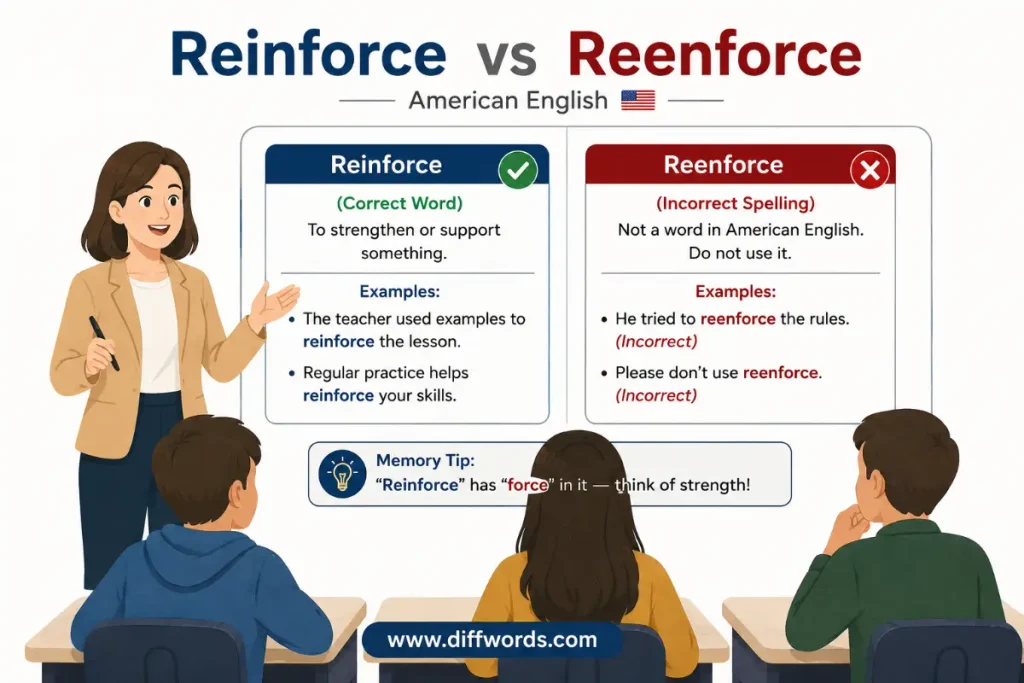
American English strongly favors reinforce.
You may occasionally encounter reenforce, but it is uncommon and can look like a spelling mistake to modern readers.
For US English writing, especially in:
- school assignments,
- websites,
- resumes,
- business reports,
- emails,
- professional documents,
- applications,
use reinforce.
For example:
“The findings reinforce the importance of early education.”
This is the standard form.
Is reinforce vs reenforce used in British English?
British English also uses reinforce as the standard modern spelling.
You may encounter older or variant forms in historical sources, but that doesn’t mean you should use them in contemporary writing.
The main word remains:
reinforce
Regional English does not generally create a standard British-versus-American spelling difference here.
This is different from words such as:
- color / colour
- center / centre
- traveled / travelled
With reinforce, the standard form is broadly consistent.
What’s the best word”reinforce vs reenforce” for a resume?
On a resume, reinforce can be useful when describing how your work strengthened a process, system, message, or result.
Examples:
“Reinforced customer retention strategies through targeted follow-up.”
“Reinforced workplace safety standards through staff training.”
“Reinforced brand messaging across digital campaigns.”
However, stronger resume writing often uses a more measurable verb.
Instead of:
“Reinforced sales performance.”
Try:
“Increased sales by 18% through targeted customer outreach.”
The second sentence tells the reader exactly what happened.
When should you use strengthen instead of reinforce on a resume?
Use strengthen when you want plain, direct language.
“Strengthened relationships with key clients.”
Use reinforce when you mean that you added support to something that already existed.
“Reinforced existing client-retention procedures.”
That subtle difference can make a resume more precise.
What’s the best word”reinforce vs reenforce” for an essay?
Reinforce works well in academic writing because it can describe evidence supporting a claim.
Examples:
“These findings reinforce the study’s main conclusion.”
“The historical evidence reinforces the author’s argument.”
“Repeated practice reinforces language skills.”
Other useful academic alternatives include:
- support
- strengthen
- substantiate
- corroborate
- confirm
- validate
- bolster
Choose based on the exact relationship.
If the evidence proves or confirms something, confirm or corroborate may be better.
If the evidence simply makes an argument stronger, reinforce or strengthen may be better.
What’s the best word for texting?
In casual texts, reinforce is correct but can sound more formal than necessary.
For example:
“That really reinforces what I was saying.”
This is perfectly natural.
But a casual speaker might also say:
“That really backs up what I said.”
Or:
“That just proves my point.”
The best choice depends on how formal the conversation is.
If you’re texting a friend, “backs up” may sound more relaxed.
If you’re texting a coworker, “reinforces” may be perfectly appropriate.
What’s the best word”reinforce vs reenforce” for an email?
For professional email, reinforce is a useful and natural word.
Examples:
“I wanted to reinforce the importance of meeting the deadline.”
“The recent results reinforce our decision to continue the project.”
“This training will reinforce the procedures discussed last week.”
If you’re writing to a friend, simpler language may sound more natural:
“I just wanted to remind you about the deadline.”
In that situation, “remind” may actually communicate your meaning better than “reinforce.”
What’s the best word”reinforce vs reenforce” when speaking?
In everyday speech, reinforce is common enough, especially when discussing ideas, learning, or opinions.
Examples:
“That really reinforces my point.”
“We need to reinforce the wall.”
“Practice helps reinforce what you learned.”
For very casual speech, you might choose:
- strengthen
- support
- back up
- confirm
- remind
- boost
The best choice depends on the context.
What are some real examples of reinforce?
Here are examples from different areas of life.
- “The engineers reinforced the bridge before reopening it.”
- “The teacher repeated the rule to reinforce the lesson.”
- “The new evidence reinforces the researcher’s conclusion.”
- “Positive feedback can reinforce good study habits.”
- “The company hired additional staff to reinforce the customer support team.”
- “The training reinforced the importance of workplace safety.”
- “The steel frame reinforces the building’s structure.”
- “The results reinforced her confidence in the plan.”
- “The photographs reinforce the article’s main argument.”
- “The coach used practice drills to reinforce the team’s strategy.”
- “The manager’s comments reinforced the need for better communication.”
- “The concrete wall was reinforced with steel.”
- “The teacher used short quizzes to reinforce key vocabulary.”
- “The successful launch reinforced investor confidence.”
- “The additional data reinforce the study’s findings.”
- “The company added two employees to reinforce its technical support team.”
- “The experience reinforced my belief that preparation matters.”
- “The campaign reinforced the brand’s focus on quality.”
- “Regular review reinforces information that students have already learned.”
- “The warning signs reinforced the need for immediate action.”
- “The protective coating reinforces the surface against corrosion.”
- “The team’s recent victory reinforced its confidence.”
- “The report reinforces concerns about rising costs.”
- “The manager praised the employee to reinforce the desired behavior.”
- “The additional beams reinforced the damaged roof.”
These examples show that the word works across physical, academic, professional, social, and emotional contexts.
Reinforce vs strengthen — what’s the difference?
Reinforce and strengthen are very close, but they don’t always emphasize the same idea.
Strengthen is broader. It simply means making something stronger.
Reinforce often suggests adding support to something that already exists.
| Reinforce | Strengthen |
|---|---|
| Add support to an existing thing | Make something stronger generally |
| Often implies extra support | Can describe improvement or growth |
| Common with arguments and structures | Works across even more situations |
| Suggests strengthening from an added source | Doesn’t require added support |
Compare:
“The evidence reinforces the argument.”
The evidence is added support.
“The new training strengthens employees’ skills.”
The training improves the skills.
You could say “strengthens the argument” too, but “reinforces” highlights the added support.
Reinforce vs support — what’s the difference?
Support is broader and often weaker in meaning.
If you support an idea, you agree with it or provide evidence for it.
If you reinforce an idea, you make its existing support or effect stronger.
Compare:
“The evidence supports the theory.”
This says the evidence provides grounds for believing the theory.
“The evidence reinforces the theory.”
This often suggests that the theory already has support and the new evidence adds to it.
In physical situations, the distinction can be clearer:
“The brackets support the shelf.”
They hold it up.
“The brackets reinforce the shelf.”
They add strength or stability.
The two words can overlap, but reinforce often carries the idea of added strength.
Reinforce vs confirm — what’s the difference?
Confirm means to establish that something is true, correct, or accurate.
Reinforce means to make an existing idea, belief, or conclusion stronger.
Compare:
“The test confirmed the diagnosis.”
The test established or verified it.
“The test reinforced the doctor’s confidence in the diagnosis.”
The test added support to an existing belief.
This distinction is useful in academic and professional writing.
If something provides direct verification, confirm may be better.
If something adds weight to an existing position, reinforce may be better.
Reinforce vs remind — what’s the difference?
These words are sometimes confused when discussing teaching or instructions.
Remind means helping someone remember something.
Reinforce means making knowledge, behavior, or an idea stronger.
Compare:
“The teacher reminded students about the deadline.”
The teacher helped them remember.
“The teacher used practice exercises to reinforce the lesson.”
The exercises strengthened their understanding.
A reminder may be part of reinforcement, but the words aren’t identical.
Reinforce vs repeat — what’s the difference?
Repeat means saying or doing something again.
Reinforce means making something stronger or more effective.
For example:
“The teacher repeated the instructions.”
The instructions were given again.
“The teacher repeated the instructions to reinforce the safety rules.”
Now the repetition has a purpose: strengthening understanding or compliance.
This is why repetition can reinforce an idea without being a direct synonym for it.
What are common mistakes with reinforce?
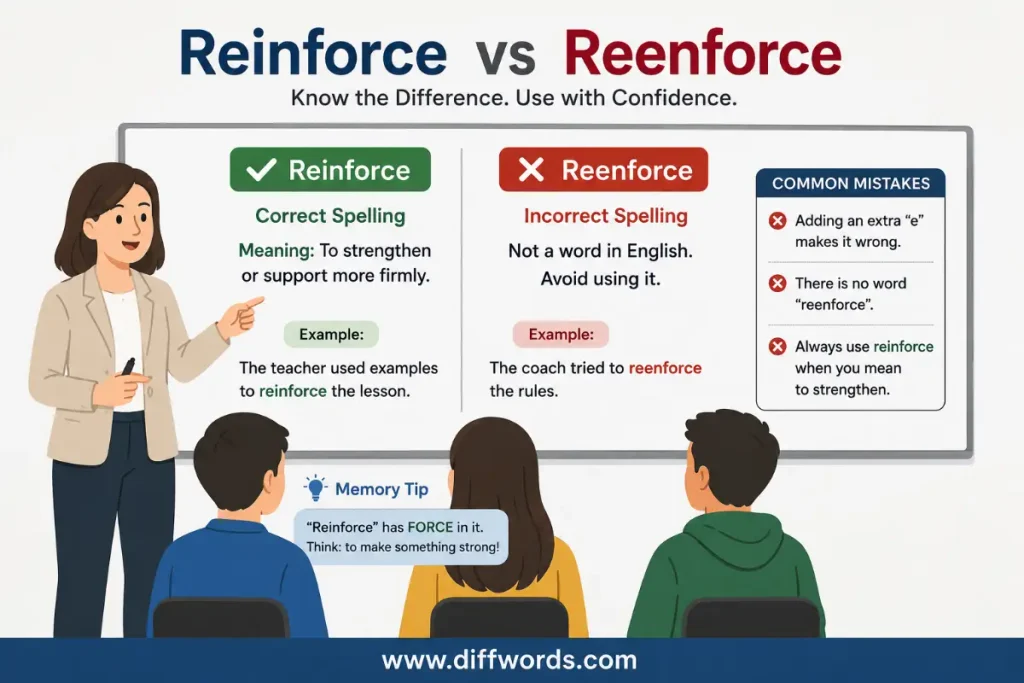
Mistake 1: Writing reenforce in standard English
Incorrect:
“The evidence reenforces the conclusion.”
Preferred:
“The evidence reinforces the conclusion.”
Mistake 2: Confusing reinforce with reinforcement
Incorrect:
“The bridge needs reinforce.”
Correct:
“The bridge needs reinforcement.”
Or:
“The bridge needs to be reinforced.”
Reinforce is the verb.
Reinforcement is the noun.
Mistake 3: Using reinforcement when a verb is needed
Incorrect:
“These findings reinforcement the argument.”
Correct:
“These findings reinforce the argument.”
Mistake 4: Using reinforce when you mean remind
Incorrect or awkward:
“Please reinforce me about the meeting.”
Better:
“Please remind me about the meeting.”
“Reinforce” doesn’t normally mean “remind someone.”
Mistake 5: Using reinforce when you mean repeat
You don’t simply “reinforce a sentence” every time you repeat it.
Instead:
“The speaker repeated the point to reinforce its importance.”
This clearly explains the relationship.
Mistake 6: Using a very formal synonym unnecessarily
Words such as “buttress” and “substantiate” have specific uses.
Don’t write:
“The teacher buttressed the vocabulary lesson.”
when you simply mean:
“The teacher reinforced the vocabulary lesson.”
Clear writing is usually better than unnecessarily complex writing.
When should you NOT use reinforce?
Don’t use reinforce when another word describes the action more accurately.
Use remind when you’re helping someone remember something:
“Please remind me tomorrow.”
Use repeat when you’re saying something again:
“Please repeat the instructions.”
Also use repair when you’re fixing something damaged:
“Workers repaired the wall.”
Use replace when you’re removing something and putting in a new one:
“They replaced the damaged panel.”
Use confirm when you’re verifying something:
“The test confirmed the result.”
And use increase when you’re simply making an amount larger:
“The company increased its budget.”
Use encourage when you’re supporting a person’s behavior:
“The teacher encouraged the student.”
These words may overlap with “reinforce” in certain contexts, but they aren’t universal substitutes.
What are the antonyms of reinforce?
The opposite of reinforce depends on the situation.
Common contrasting words include:
- weaken
- undermine
- damage
- reduce
- diminish
- discourage
- erode
- destabilize
- contradict
- challenge
Examples:
“The evidence undermined the argument.”
“The storm weakened the structure.”
“Negative feedback discouraged the behavior.”
“The new information challenged the original conclusion.”
If you’re talking about physical strength, weaken is usually the clearest opposite.
If you’re talking about an argument, undermine may be better.
And if you’re talking about behavior, discourage may fit.
How is reinforce used in business English?
Business writing uses reinforce in several common ways.
Reinforce a message
“The campaign reinforces the company’s commitment to quality.”
Strategy for Reinforce
“The new data reinforce our current strategy.”
Reinforce a team
“The company added experienced managers to reinforce the leadership team.”
Reinforce customer confidence
“The successful launch reinforced customer confidence.”
Policy for reinforce
“The training reinforces the company’s safety policy.”
The word is useful because it describes adding strength without necessarily suggesting that the original strategy or message was weak.
How is reinforce used in education?
Education is another common context.
Teachers can reinforce:
- lessons,
- skills,
- rules,
- concepts,
- vocabulary,
- positive behavior,
- study habits,
- understanding,
- memory.
Examples:
“Practice reinforces new skills.”
“Quizzes reinforce important concepts.”
“Positive feedback reinforces productive behavior.”
“Review sessions reinforce material covered in class.”
In education, reinforcement often happens through repetition, practice, feedback, examples, rewards, or reminders.
How is reinforce used in science and research?
Academic and scientific writing frequently uses reinforce to describe evidence that adds support to an existing finding or conclusion.
Examples:
“The results reinforce earlier findings.”
“The study reinforces the need for further research.”
“These observations reinforce the proposed explanation.”
However, be careful not to use the word when the evidence actually proves something for the first time.
If a study establishes a fact for the first time, words such as demonstrate, show, or establish may be more precise.
Reinforce usually suggests that something already exists and receives additional support.
How is reinforce used in construction and engineering?
In construction, reinforce often has a literal physical meaning.
A structure can be reinforced with:
- steel
- concrete
- beams
- brackets
- cables
- mesh
- support columns
- plates
- composite materials
Examples:
“Workers reinforced the foundation.”
“Steel rods reinforce the concrete.”
“The roof was reinforced before the renovation began.”
In this context, strengthen is often a direct synonym, while fortify may suggest stronger protection against external forces.
How is reinforce used in psychology and behavior?
In discussions of behavior, reinforce can have a more specific meaning.
When an action is reinforced, something happens that makes that behavior more likely to continue.
For example:
“The reward reinforced the child’s habit of completing homework.”
The reward encourages the behavior.
This doesn’t always mean punishment or reward in the everyday sense. In behavioral science, reinforcement has a more precise technical meaning.
If you’re writing for a general audience, however, keep the explanation simple unless the technical distinction matters.
How can you remember the spelling?
The easiest memory trick is to learn the word as a complete unit:
REINFORCE
Don’t try to construct it as:
re + enforce
Instead, connect it with the noun:
reinforce → reinforcement
Both clearly use rein at the beginning.
Another useful association is:
reinforce = add strength
If you see the word “strength” in your mind, remember the spelling reinforce.
You can also practice a few common forms:
- reinforce
- reinforces
- reinforced
- reinforcing
- reinforcement
Seeing the complete word family makes the correct spelling easier to remember.
What should you remember about reinforce vs reenforce?
Here are the most useful rules:
- Reinforce is the standard modern spelling.
- Reenforce is a rare or older variant and is generally best avoided.
- Reinforce is a verb.
- Reinforcement is the noun.
- Reinforced is the past form and a common adjective.
- Reinforcing is the -ing form.
- Use reinforce for physical structures, ideas, arguments, skills, behaviors, feelings, and teams.
- “Strengthen” is the closest broad synonym.
- “Support” is useful when something provides evidence or assistance.
- “Confirm” is better when something verifies that an idea is true.
- “Remind” is better when the goal is helping someone remember.
- “Fortify” is stronger and often more physical or defensive.
- “Bolster” and “buttress” are more formal alternatives.
- Standard US and UK English both use reinforce.
How do you choose the right synonym quickly?
Ask what exactly is becoming stronger.
Is a physical object becoming stronger?
Use:
- reinforce
- strengthen
- fortify
- stabilize
- shore up
Example:
“The workers reinforced the foundation.”
Is an argument receiving more evidence?
Use:
- reinforce
- strengthen
- support
- substantiate
- corroborate
- buttress
Example:
“The new evidence strengthens the argument.”
Is someone learning or remembering something?
Use:
- reinforce
- practice
- review
- consolidate
- deepen
Example:
“The exercises reinforce the lesson.”
Is a behavior being encouraged?
Use:
- reinforce
- encourage
- promote
- reward
- support
Example:
“Positive feedback reinforces good habits.”
Is something being verified?
Use:
- confirm
- validate
- corroborate
- verify
Example:
“The second test confirmed the result.”
Is someone simply being reminded?
Use:
- remind
- notify
- alert
- prompt
Example:
“The email reminded employees about the deadline.”
This quick distinction prevents many awkward word choices.

Conclusion
The correct modern spelling is reinforce, not the commonly misspelled “reenforce.” The verb describes making something stronger, adding support, increasing confidence, encouraging behavior, or providing additional people or resources. Its noun form is reinforcement, while reinforced and reinforcing are common related forms.
When choosing a synonym, look at what you’re strengthening. “Strengthen” is the safest general alternative, while “support” works well for ideas, “confirm” fits verification, “substantiate” suits formal evidence, and “fortify” often fits physical protection. In casual conversation, “back up,” “boost,” or “build up” may sound more natural. Once you remember the standard spelling and connect the word to its core idea of added strength, this common spelling question becomes much easier.
Frequently Asked Questions
Is reinforce vs reenforce correct?
Reinforce is the standard spelling in modern English, while “reenforce” is a rare variant that is generally best avoided in ordinary writing.
What does reinforce mean in simple words?
To reinforce something means to make it stronger, better supported, or more effective. You can reinforce a structure, argument, lesson, habit, feeling, or team.
What’s another way to say “reinforce”?
Common alternatives include “strengthen,” “support,” “boost,” “bolster,” “confirm,” “encourage,” “fortify,” and “substantiate.” The best synonym depends on what you’re making stronger.
Is reinforce a verb or noun?
Reinforce is a verb. The related noun is reinforcement, as in “The bridge needs additional reinforcement.”
Is “reenforce” an acceptable spelling?
“Reenforce” exists as a rare or historical variant, but reinforce is the standard spelling used in contemporary general English. For school, business, professional, and online writing, choose “reinforce.”
What is the difference between reinforce and strengthen?
Both can mean making something stronger, but reinforce often suggests adding support to something that already exists. “Strengthen” is broader and can describe general improvement.
Can I use reinforce in academic writing?
Yes. Reinforce is common in academic writing when evidence, examples, or findings add support to an existing argument, conclusion, or idea. For example, “The results reinforce the study’s main conclusion.”
1 thought on “Reinforce vs Reenforce: The Ultimate Spelling Guide”